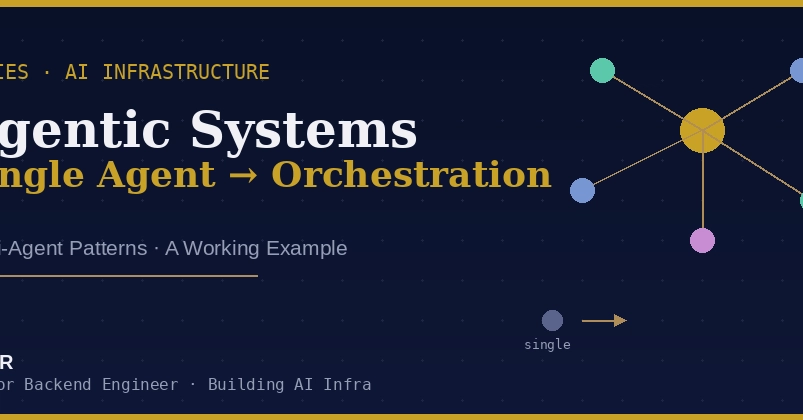
A single agent — one model, a system prompt, a handful of tools, and a loop — gets you surprisingly far. It's also where most people stop, because it works for demos and falls over the moment a task needs more than one kind of reasoning happening at once.
Multi-agent orchestration isn't a hype upgrade over a single agent — it's what you reach for when a task naturally decomposes into sub-tasks that benefit from different context, different tools, or genuinely different roles. This post covers when that shift is warranted, the orchestration patterns actually used in production, and a small working example of a coordinator delegating to worker agents.
Why a single agent stops being enough
A single agent's context window and tool list grow with every capability you bolt on. Three failure modes show up as that happens:
Context pollution — a research task's intermediate scratch work bleeds into the reasoning for an unrelated coding sub-task, degrading both