Agentic AI Orchestration: The Architecture Patterns That Actually Work at Scale
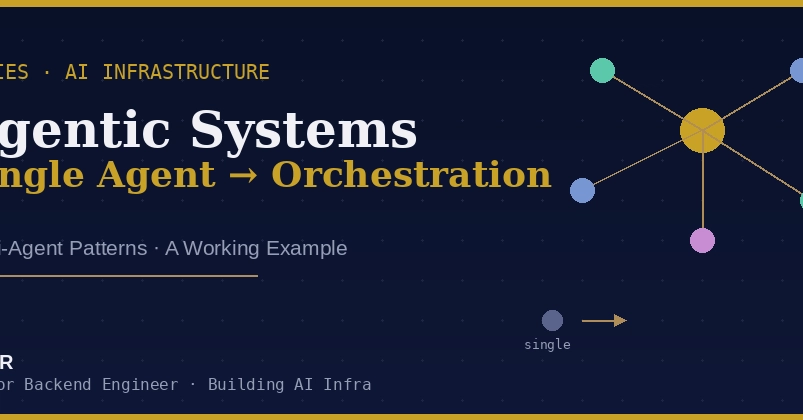
Subtitle: Most developers build their first agent as a loop. Here is what happens when that loop needs to handle production workloads — and the five patterns that survive it.
Tags: artificial-intelligence, software-architecture, multi-agent-systems, llm, engineering
The single-agent loop works beautifully in a demo. You give the model a goal, it calls tools, it checks its work, it finishes. Clean. Contained. Legible.
Then you try to run it on a workload that's actually large — a codebase audit, a multi-step research pipeline, a production incident triage across 12 services — and the loop starts to break. Not dramatically. Quietly. The context fills up. Tool calls queue. The model starts confabulating intermediate results it can't actually see anymore. You add memory, and now the memory is the bottleneck. You add more tools, and now the model is spending half its tokens deciding which tool to pick.