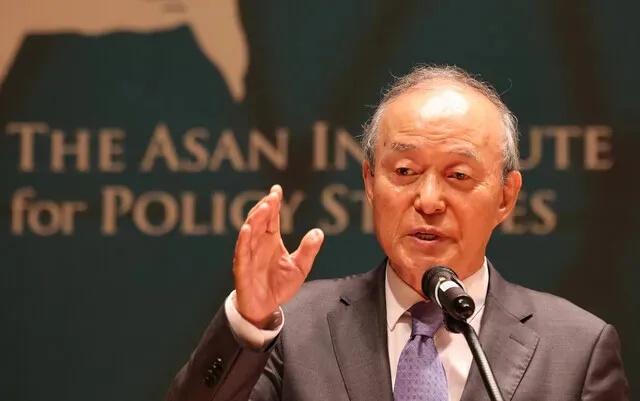
Song Min-soon, who served as South Korea’s minister of foreign affairs and trade from 2006 to 2008, speaks at the Korean Peninsula Future Forum Symposium at the Asan Institute for Policy Studies in Seoul on July 15, 2026. (Yonhap)
A former Korean foreign minister said that as great power rivalry ramps up following the US’ war against Iran, China has come to view North Korea’s nuclear arsenal as an asset in its efforts to bring East Asia under its sway, making the prospect of North Korea’s denuclearization even more remote.Song Min-soon, who served as South Korea’s minister of foreign affairs and trade from 2006 to 2008, offered this perspective during a symposium titled “How the Iran War Is Changing National Security and the Future of the World Order” that was organized by the Korean Peninsula Future Forum on Wednesday.Song predicted that following its war with Iran, the US may well refrain from overseas adventurism as it did after the Vietnam War amid the likely formation of American and Chinese spheres of influence.“As China benefits from the US’ loss of international credibility after the Iran war, it’s pushing countries in the Asia-Pacific region to kiss the ring,” the former foreign minister observed.As key examples of this trend, Song cited Chinese President Xi Jinping’s blunt expression of resolve about the Taiwan Strait during his summit with US President Donald Trump in May, during the Iran war, and his “confirmation of China’s sphere of influence in Northeast Asia” during his first visit to North Korea in seven years, which took place last month. Song pointed to signs of emerging military blocs in East Asia, one comprising South Korea, the US and Japan and another with North Korea, China and Russia. In this context, he said Beijing considers Pyongyang’s nuclear capabilities an “asset, not a burden” for countering Washington, noting that references to a nuclear-free Korean Peninsula are disappearing from China's national strategic documents and summits with the North.The war with Iran, he added, has amplified the confrontational mood on the peninsula, rendering discussion of denuclearization virtually impossible. “The prospect of meaningful North Korea-US dialogue has grown even slimmer, and Washington finds it more difficult to justify such talks due to the war with Iran,” he said.On what Seoul’s strategy for responding to this situation should be, the former minister stressed efforts to ease tensions and manage crises to boost military stability on the peninsula, but called a push for “peaceful coexistence” based on exchange and cooperation as unrealistic for now. Song proposed as a realistic solution “maintaining a ‘negative [cold] peace’ for now based on non-interference and non-intimidation while maintaining a robust capacity to deter threats and provocations, and to expect a ‘positive [warm] peace’ through exchange and cooperation only when changes occur within North Korea.”On the transfer of wartime operation control (OPCON) from the US, he recommended regaining the authority as early as possible. “Despite concerns from some quarters, the transfer will raise the morale and capabilities of our military and accordingly enhance our country’s global standing in managing the situation on the Korean Peninsula,” he said.In his welcome address, Chun Yung-woo, Seoul’s chief negotiator in the six-party talks on the North’s nuclear program and now chairman of the Korean Peninsula Future Forum, said that the Iran war “has demonstrated that even the US, the world’s preeminent superpower, has countries it cannot subjugate by force alone and problems it cannot solve.”“The repercussions of the Iran war won’t merely raise Iran’s regional hegemony and reshape the Middle Eastern strategic landscape; they will also have a massive impact on the Sino-US strategic competition, American alliance system, East Asia and the Korean Peninsula, and ultimately the global order,” he said. “The Iran war is an unnecessary conflict triggered by Trump’s unilateral withdrawal from a 2018 nuclear deal with Tehran,” said Song Woong-yeob, who formerly served as Korea’s Ambassador to Iran, adding that “the US didn’t win and Iran didn’t lose” the conflict.“The US will face the most difficult negotiations in world history in facing the negotiating acumen of Persian merchants developed over millennia,” the former ambassador said. “It’s highly likely that this unstable situation of ‘small deals’ and ongoing negotiations will persist,” he added. “Unlike the US, whose midterm elections are in November, Iran is not pressed for time.”“When discussing fees to pass through the Strait of Hormuz, a comprehensive agreement is possible if the parties consider the model used for the Strait of Malacca: recognition of the sovereignty of neighboring countries over Hormuz and allowing voluntary contributions by user states,” the former ambassador said.By Park Min-hee, senior staff writerPlease direct questions or comments to [english@hani.co.kr]