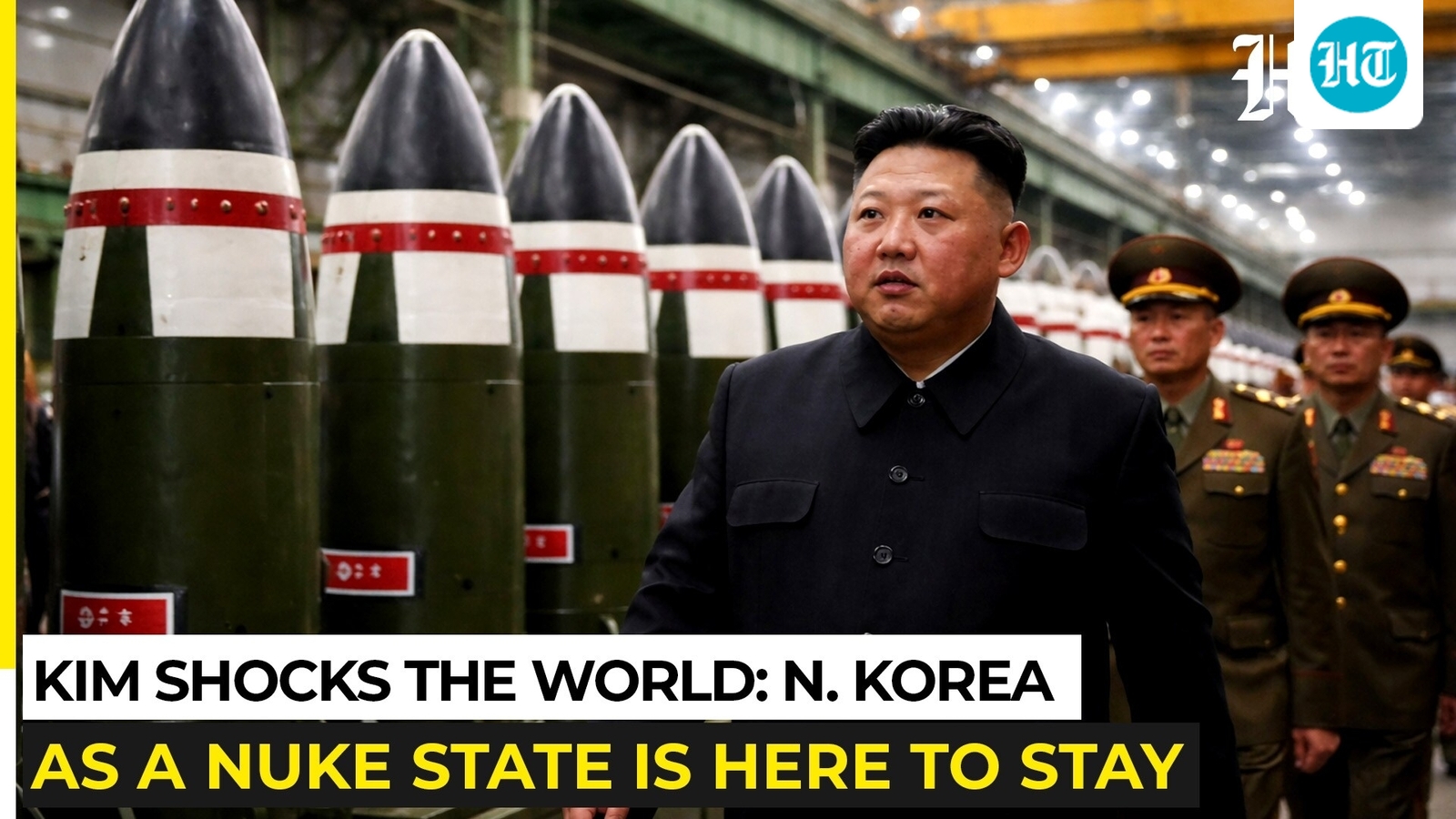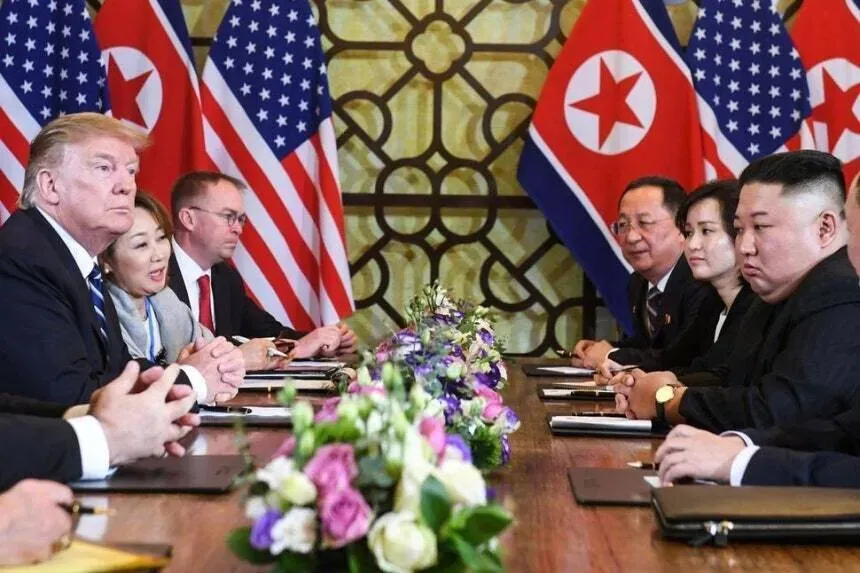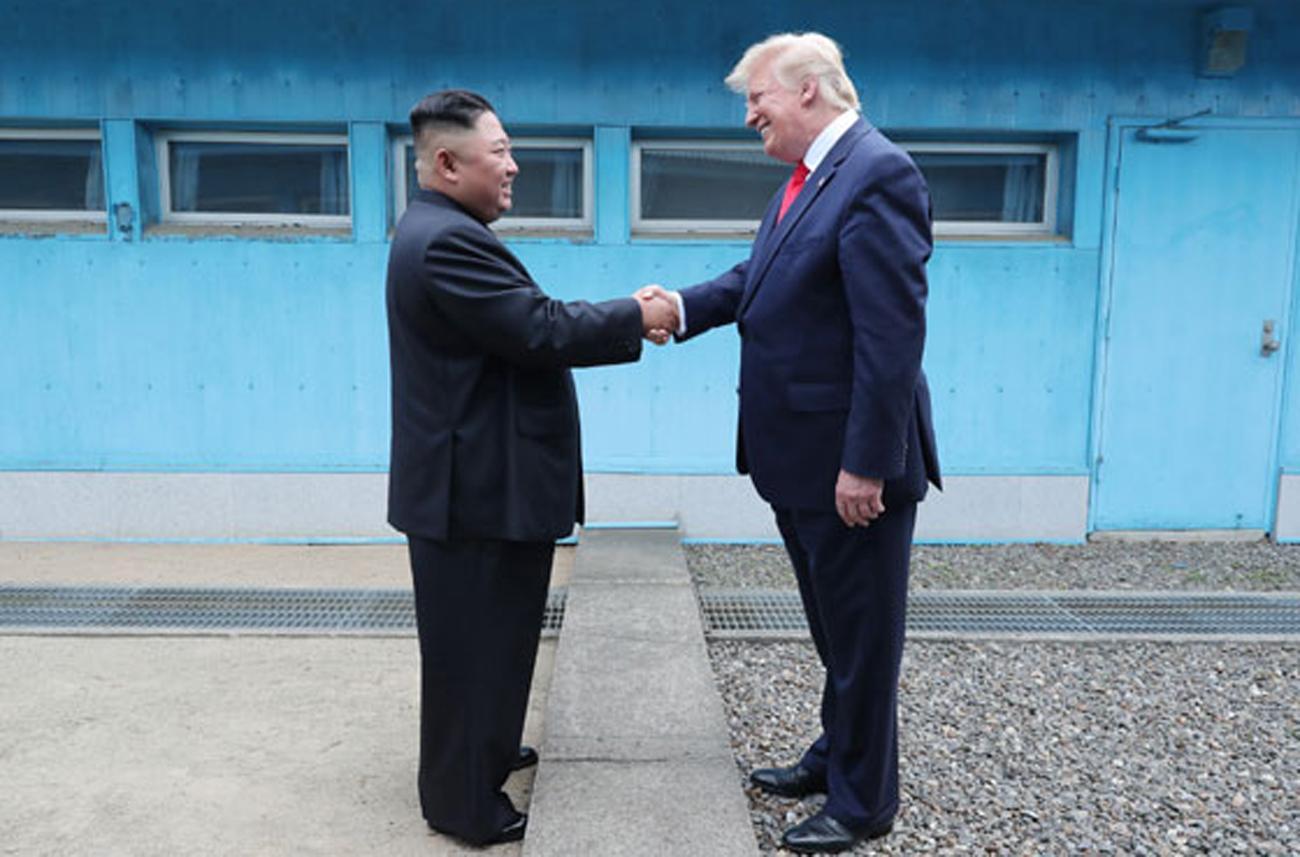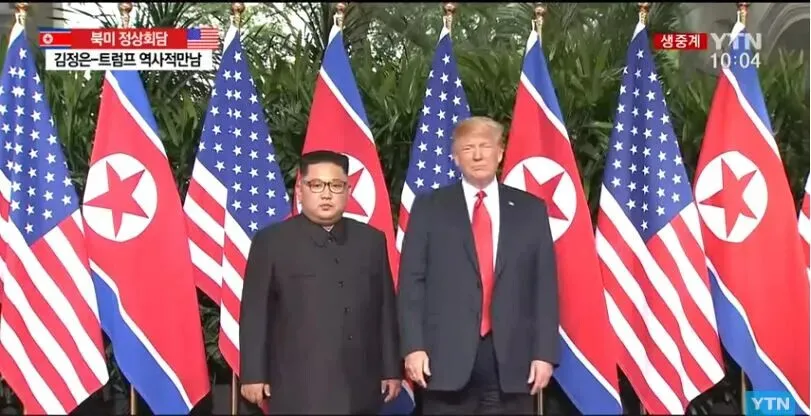
North Korean leader Kim Jong-un and US President Donald Trump during a summit. (still from YTN)
The war of nerves surrounding the denuclearization of the Korean Peninsula — or more specifically, North Korea’s denuclearization — persists. While the US in mid-May reaffirmed the principle of denuclearization at its summit with China, Beijing maintained strict silence on the issue. No mention of denuclearization was made at Chinese President Xi Jinping’s summit with North Korean leader Kim Jong-un in Pyongyang on June 8-9. Instead, the two sides agreed to upgrade bilateral relations to a “strategic partnership” and greatly boost exchanges and cooperation in a range of fields, including the economy. Two days later, South Korea and the European Union agreed in a summit to “reaffirm their commitment to the complete denuclearization of the Korean Peninsula.”Seoul has constantly reaffirmed the denuclearization principle with its allies based on the judgment that it aligns with national interests and security. But an objective assessment is needed on whether the adherence to denuclearization truly serves national interests. This is because if each issue is examined individually — from the proposed US-North Korea summit that the Lee Jae Myung administration has strongly pursued to potential scenarios if Washington gets tougher about denuclearization — the outcomes could harm South Korea’s national security and interests. Issues must be scrutinized from the perspective of preventing war, which is of vital importance to the country.First, the possibility of North Korea — or the DPRK*, as it prefers to be known — agreeing to talks with the US on denuclearization has grown even more remote since the Kim-Xi summit. This means that Pyongyang will agree to a meeting with Washington only if the US drops its demand for denuclearization. Consequently, if the Lee administration wants to contribute to the holding of such talks, it must propose to the Trump administration to drop the demand for denuclearization. While the likelihood of this is low, what is clear is that insisting on denuclearization and holding a summit are mutually exclusive.A hypothetical scenario has US President Donald Trump, who eagerly seeks dialogue with Kim, initially agreeing to set aside denuclearization to make the summit happen, only to bring up the topic in their meeting. What would happen then? Talks would likely break down. The same would be true even if Trump agreed on denuclearization being a long-term goal and proposing a start with discussions on “freezing and reducing” the DPRK’s nuclear program and corresponding measures. This is because Pyongyang considers denuclearization a subject not up for discussion and a thing of the past.Nevertheless, the stronger the US pushes for the dismantling of the DPRK’s nuclear weapons, the more South Korea’s interests and security will inevitably be jeopardized. Many experts, both at home and abroad, agree that the Kim regime has no chance of giving up its nuclear capabilities. This could lead to the DPRK, which seeks to become a permanent nuclear state, confronting the US, which is serious about denuclearization, raising uncertainty over the peninsula’s security to the extreme. For instance, suppose that Trump, a believer in the “madman theory” of foreign policy, mobilizes maximum pressure by saying the DPRK must give up its nuclear weapons and that this is possible through dialogue or other means.How would Pyongyang react if Trump again throws verbal bombs like “fire and fury” or “total destruction of North Korea,” as he did in 2017? What if the US does not stop at threats, but flies strategic bombers skimming the Military Demarcation Line and North Korean airspace as attempts at intimidation, as it did in September 2017? Pyongyang was unaware of these actions at the time, but what if it detected them now, given its stronger intelligence capacity? With its nuclear capabilities much higher than in 2017, the DPRK would respond strongly under its principle of “words for words” and “actions for actions.”When tension between the US and the DPRK escalates to a volatile level this way, the South Korean economy will suffer a severe blow. Brinkmanship between Pyongyang and Washington in the second half of 2017 was based on the calculation of one side negotiating from a position more advantageous than the other. But if military tension rises again, the situation will be qualitatively different because, unlike nine years ago, there is no clear way to turn the crisis into an opportunity for negotiation.In June last year, the US launched Operation Midnight Hammer against Iran, which was in the middle of negotiations, and conducted a preemptive strike on major Iranian nuclear facilities. This brought to mind how some in the first Trump administration proposed a “bloody nose strike” on the DPRK, a concept devised from the thought of hitting Pyongyang with one hard blow since words or threats did not work. What would happen if the US launched a preemptive strike on the DPRK or another Operation Midnight Hammer? What if the US attack that killed the Iranian leadership in February this year was conducted on the Kim regime?Just as Iran retaliated against US military bases in the Middle East, the DPRK could do the same to such outposts in South Korea or Japan if Washington launches a preemptive strike. If the US escalates the conflict and South Korea, Japan or both take military action against the North, this will fan the flames of war to uncontrollable proportions.Another wild card is China and Russia, which have alliances with the DPRK that include automatic intervention clauses. If the US or other states launch a decapitation attack on the grounds of the DPRK’s imminent use of nuclear weapons, the likelihood of Pyongyang using such arms “automatically” also rises, given its previously declared nuclear doctrine.I chose to mention this scenario — something I don’t even want to imagine — not because I believe the situation on the Korean Peninsula is highly likely to go in this direction. The US is not so reckless as to go to war with the DPRK, which has powerful retaliatory capabilities, and South Korea is not Israel, which persuaded the US to set the Middle East ablaze. Nevertheless, I mention this dire possibility because I believe now is the time to break free from the fixation on denuclearization.The reasons for this can also be found in the relationship between the DPRK’s nuclear program and war and peace. Since the early 1990s, when the nuclear issue first appeared, military crises on the peninsula have primarily seen a cycle of negotiations and breakdowns. The fear was that if the US did not get the DPRK’s denuclearization through pressure and dialogue, it could consider the use of force, and that a preemptive strike could trigger a full-scale war with Pyongyang’s retaliation. Paradoxically, however, the prospect of such a strike has disappeared following North Korea’s nuclear armament.Until just a few years ago, fears both at home and abroad in certain quarters arose that the DPRK could attempt communist reunification of the peninsula using nuclear weapons, and think tanks in South Korea and the US even put forward scenarios related to this. In declaring its “two-state theory,” however, the DPRK also expressed its abandonment of reunification, meaning that the purpose of its nuclear arsenal is not to change the status quo (reunification) but to maintain it (two states).With recent events such as Russia’s invasion of Ukraine and the US-Israel attacks on Iran, the perception of vulnerability without war deterrence is spreading globally. As self-reliance emerges as a key theme of the times, South Korea stands at the forefront. While “modernizing” its alliance with Washington, Seoul is massively investing to maintain independence in national defense. Thus, the demand for denuclearization inevitably sounds to the DPRK like an order to abandon war deterrence.As uncomfortable as this is and something I don’t want to admit, the pursuit of denuclearization has run its course, and an alternative must be found.The core of the alternative lies in seeking peaceful coexistence with a “nuclear-armed” DPRK rather than dealing with a “non-nuclear” one. Ideas for solutions proposed at home and abroad include arms control talks to freeze and reduce nuclear weapons, rather than fixating on denuclearization. Trump has also proposed a starting point for an ultimate solution, the idea that global powers like the US, Russia and China should take the lead in nuclear disarmament and invite the North to join them. For that reason, I believe the time has come to bring the DPRK’s nuclear issue into the larger discussion of the goal of a world without nuclear war or weapons.By Cheong Wook-sik, director of the Hankyoreh Peace Institute and director of the Peace NetworkEditor’s note: The official English name of North Korea is the Democratic People’s Republic of Korea, or DPRK for short. But in Korean, the country refers to itself as “Choson” rather than using “Hanguk” like South Korea. In the original Korean piece, the author uses the term “Choson” in an attempt to do away with the baggage of using the term “North Korea,” which can imply that it is an extension of South Korea. In translation, we render this as “DPRK” for the sake of intelligibility to readers while maintaining the spirit of referring to the country by the name it uses for itself. South Korea is retained. For more on why the author uses “Choson,” read his column here: [Column] ‘Choson’: Is it time we start referring to N. Korea in its own terms? https://english.hani.co.kr/arti/english_edition/english_editorials/1137832.html Please direct questions or comments to [english@hani.co.kr]