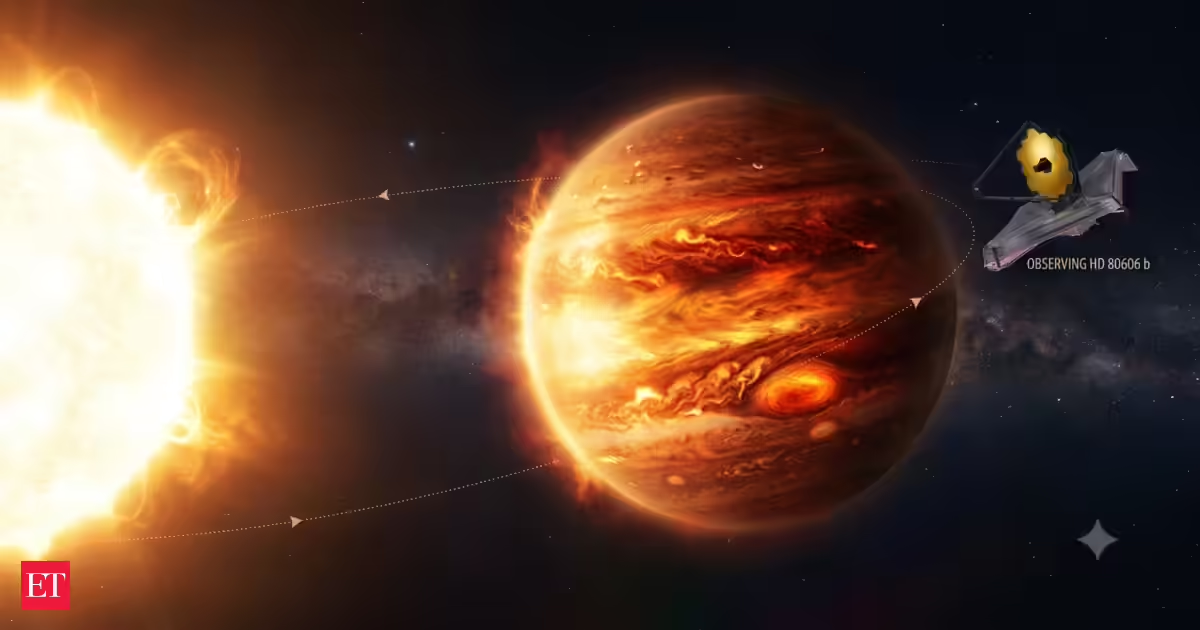
Imagine the year 2158. You're pursuing a PhD in planetary volcanology at the University of Utopia Planitia on Mars, surviving on freeze dried ramen while searching for the perfect exoplanet to study. After finishing your research on Jupiter's volcanic moon Io, you need a rocky world beyond our solar system with intense volcanism driven not by gravity, but by the searing heat of a nearby star. Better yet, it has to be within 50 light years so your faster than light (FTL) research mission stays within budget.
While that scenario is fictional, astronomers today are already studying a remarkable candidate.
Using NASA's James Webb Space Telescope (JWST), researchers have investigated the super Earth 55 Cancri e (55 Cnc e), an extreme rocky planet located about 41 light years from Earth. Measuring roughly 1.88 Earth radii and about 8 Earth masses, the planet circles a Sun like star in only about 0.7 days. By comparison, Mercury takes 88 days to orbit our Sun.
Because 55 Cancri e orbits so close to its star, scientists believe its surface is hot enough to remain molten. Their findings, which have been submitted for publication in Nature Astronomy, could provide valuable insights into how lava exoplanets form and evolve.