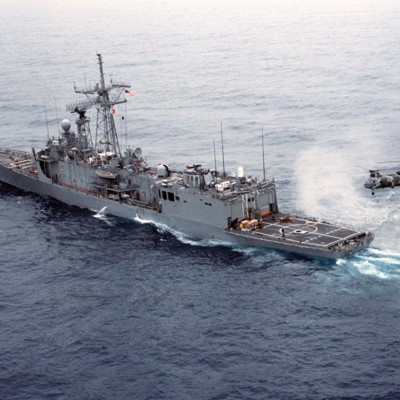
On April 14, 1988, the U.S.S. Samuel B. Roberts struck an Iranian mine in the Persian Gulf. The mine inflicted severe damage to the ship, breaking her keel and blowing a 21-foot-hole in the port side, flooding the ship with 2,000 tons of water in two main spaces and starting a major fire. Three of the four diesel generators were damaged, and the ship lost power for five minutes. Ordinary sailors, cross trained in electrical, mechanical and damage control methods, rose to the occasion in the absence of the incapacitated primary engineering team. Fireman Mike Tilley, trapped below decks, managed to suicide-start the fourth diesel generator, restoring enough power for pumps and firefighting. A cross-trained team of sailors—ranging from cooks and radiomen to sonar technicians—rigged emergency power in just 22 minutes to save the warship.The warship had a crew of 220 sailors from different backgrounds and places of origin, with varying levels of education and very minimal experience; 67% of the crew had never been out to sea and another 20 had only one tour under their belts. Yet their intense training kicked in automatically, like a reflex built from countless drills. In the chaos, they executed what their bodies and minds had rehearsed a hundred times before, a pattern that mirrors how forward-deployed engineering teams must operate when cut off from headquarters and forced to stand up, configure, and integrate complex systems under fire.India’s IT industry was built on a different training problem. Y2K created urgent demand for programmers who could inspect legacy systems, find two-digit date fields, expand them, test the fix and move on. The work was bounded and specifiable. NIIT, Aptech and early IT services firms could train graduates quickly because the unit of work had already been defined. Software exports rose from $1 billion in 1997 to $6.2 billion by 2000–01, making Y2K the industry’s first proof of delivery.That success became a model. Engineering colleges added programming languages, firms built training campuses, and fresh graduates entered a delivery pyramid. Juniors handled defined tasks, managers translated client requirements, and senior specialists carried escalation risk. It worked because clients largely knew what they wanted built, rewritten, tested or maintained.AI deployment unsettles that model. In Y2K, the engineer arrived after the problem had been specified. In AI, discovering the problem is often the first task. A hospital may not need a chatbot; it may need a triage workflow that understands language, doctor availability, patient history and escalation. A port may not need computer vision; it may need a system that fits cargo movement and customs data.This is why AI upskilling is necessary but insufficient. Nasscom estimates that more than two million Indians have been upskilled in AI, but only 200,000 to 300,000 have advanced capabilities. The constraint often lies in the ability to carry the model knowledge into institutions and make it survive contact with workflow, data and accountability.The Forward Deployed Engineer is closer to the shipboard engineer than to the Y2K programmer. She cannot wait for specifications from headquarters. She must enter the client’s environment, understand the machinery already running, diagnose what is failing, improvise safely and translate field learning back into the product. The skill is part software, part systems integration, part domain reasoning and part field command. AI companies have committed $9.75 Billion in 12 months to forward-deployed engineering. The FDE model, embedding engineers inside customers to deploy AI, has gone from a Palantir signature to an industry default.India needs training built for that reality. FDEs will not be produced at scale through courses, hackathons or certificates alone. They need deployment residencies inside hospitals, discoms, tax offices, ports, courts, banks and municipalities, where engineers work beside domain officers until a workflow goes live.Graduation should mean measured outcomes, user adoption, audit trails and failure logs, not course completion almost on the lines of Certificate of Competence (CoC) issued to officers onboard Shipping vessels. Universities must become living labs for deployment at scale, giving students enough time inside real systems to learn problem discovery, workflow redesign and practical problem-solving before they are certified as job-ready. Published - July 15, 2026 05:08 pm IST
Beyond AI courses: Training engineers for deployment
Training engineers for real-world AI deployment requires immersive experiences, integrating theory with practical problem-solving in diverse environments.
686 words~3 min read