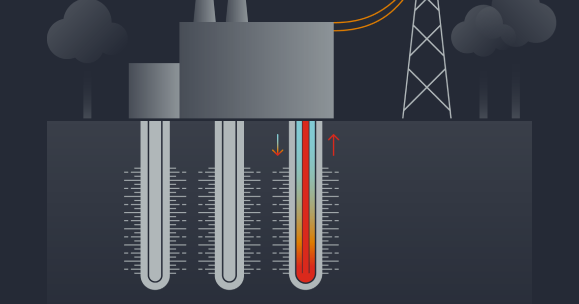
Top officials from the Ministry of New & Renewable Energy (MNRE) including Secretary Santosh Sarangi met Graham Gillies, Vice President for Asia-Pacific at Baker Hughes, on Tuesday to strengthen cooperation in the renewable energy sector, including geothermal energy.The discussions covered renewable energy integration, grid stability, green hydrogen and ammonia, and emerging technologies such as geothermal energy, the Ministry said.During the meeting, Sarangi highlighted India’s remarkable renewable energy journey, driven by enabling policies, and underscored the importance of collaboration to accelerate innovation and advance the clean energy transition.Geothermal energy harnesses heat stored inside the earth’s surface and is best suited for applications such as heat pumps, cooling and agriculture.The United States is the leading country in this segment. The Houston-headquartered Baker Hughes has around 40 years of experience in geothermal energy. It offers end-to-end solutions—from exploration to planning, from drilling to production, to heat utilisation.It also offers technology for geothermal power generation. Its turbine portfolio offers complete power-generation solutions for both steam flashing applications and lower enthalpy Organic Rankine Cycle applications.The development assumes importance as India is pushing for expanding the geothermal energy segment. To enhance participation from private sector, the Ministry is exploring incentives such as tax breaks, voluntary gap funding (VGF) and long term concessional loans to expand potential and viability of the site-specific renewable energy source (RES).To this effect, the MNRE in September last year unveiled the National Policy on Geothermal Energy. The intent behind the policy is to harness untapped geothermal resources for power generation and direct-use applications such as district heating, agriculture, aquaculture, and space cooling as well as heating via Ground Source Heat Pumps (GSHPs).In this direction, the policy aims to integrate geothermal energy with India’s Net Zero (2070) target and renewable energy objectives. The government may explore the possibility of long-term concessional loans from Public and Private Sector Financial Institutions, Sovereign Green Bonds, Viability Gap Funding (VGF), Loans or Grants for Risk Mitigation, Feed-in-tariff, among other avenues.The Ministry may also explore fiscal mechanisms to support the sector such as Import duty and GST exemptions on equipment, machinery, and services related to geothermal energy. Other avenues can be tax holidays on geothermal projects, Accelerated Depreciation, and Property tax exemptions.Currently, geothermal energy is cost intensive with around Rs 36 crore required to create 1 megawatt (MW) of capacity (global estimate). At present, the cost of producing power from such sources will be more than Rs 10 per unit in India.India’s geothermal energy capacity is projected to be around 10 gigawatts (GW), with studies and pilot projects underway to ascertain its real potential. In this direction, the policy provides a comprehensive framework to promote exploration, development and utilisation.Globally, geothermal capacity is around 15.43 GW, as per IRENA’s RE capacity statistics 2024. Geothermal energy increased by roughly 0.4 GW in 2024 from around 15.05 GW in 2023, led by New Zealand, Indonesia, Türkiye, and the US.Published on July 15, 2026
India, Baker Hughes explore strengthening cooperation on geothermal energy
Top officials from the Ministry of New & Renewable Energy (MNRE) including Secretary Santosh Sarangi met Graham Gillies, Vice President for Asia-Pacific at Baker Hughes, on Tuesday to strengthen cooperation in the renewable energy sector, including geothermal energy.
482 words~2 min read