Story audio is generated using AI
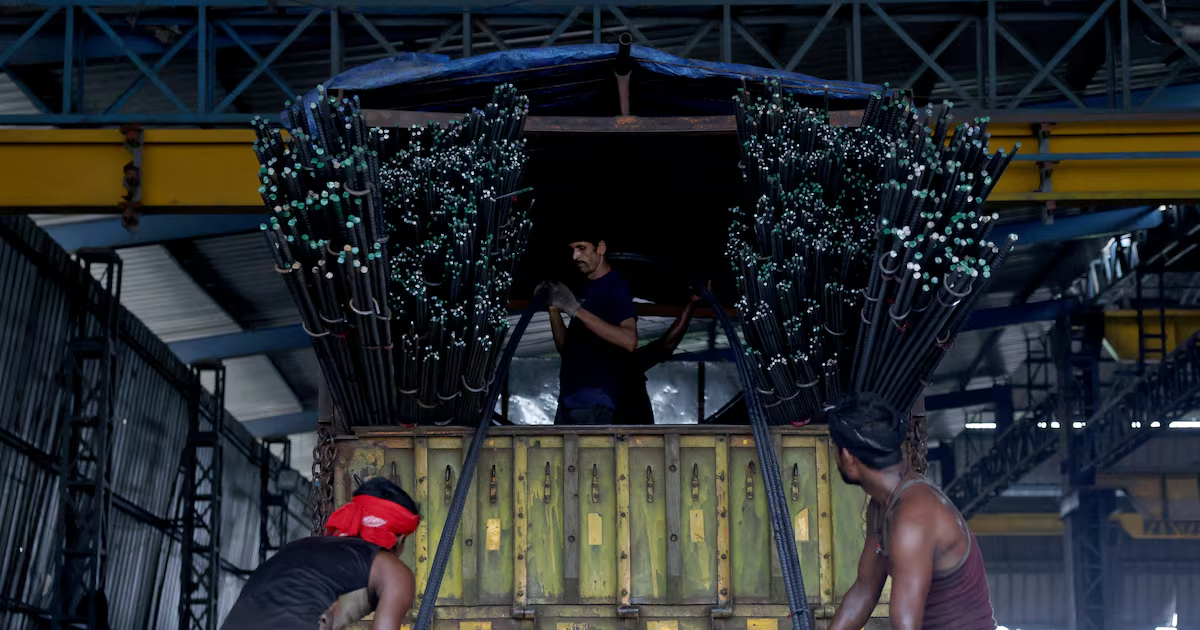
The Middle East war has worsened the plight of South Africa’s steel industry, which was already in a years-long state of decline due to weak demand and low levels of investment even before the conflict broke out in late February.The industry’s crisis has been compounded by high input costs — including electricity, rail and port inefficiencies — as well as competition from low-priced imports, particularly from Asia, while global steel overcapacity has also depressed prices.South Africa’s economy is not growing enough to support the ailing sector, Steel and Engineering Industries Federation of Southern Africa (Seifsa) CEO Tafadzwa Chibanguza said on Tuesday.“Steel consumption is a function of GDP. As your economy grows, your steel consumption also naturally follows. So it follows that in a country that is growing at sub 1%, it’s too low to generate sufficient steel consumption,” he told Business Day on the sidelines of the manufacturing indaba.“For meaningful upward movement in steel consumption, the economy needs to be growing at least above 3.5% for you to see meaningful steel consumption.”Industry data shows that since 2008 steel production has been declining at a rate of 2% on a compound basis, Chibanguza said.“The outcome variable of all of this unfortunate economic deterioration is employment. We’ve lost an excess of 220,000 jobs in this industry during that same period,” he said.Seifsa represents steel and engineering companies, many of which are operating below capacity.“If you average it across the entire industry, both up and downstream, you are working at about 70% capacity utilisation, which is underutilised capacity. But most concerning is if you look at the upstream, metal production. They are working at about 48% capacity utilisation,” Chibanguza said.“That has major implications for sustainability. It has implications for even pricing, because in essence you are then diluting your cost base into a very low demand profile.”The industry has also seen low levels of gross fixed capital formation, both private and public, he said.“The private side is a function of confidence. If companies are feeling confident in the investment profits of South Africa, they would be investing. The public gross fixed capital formation is actually a policy choice and unfortunately we’re seeing that capital rather being prioritised for other reasons, mainly social, so the social wage, and not on investing in the economic growth engine.”The war between the US and Iran and the resulting disruptions to global oil supply have piled the pressure on the sector, which uses much diesel, Chibanguza said.“A lot of the companies that operate within our industry already hold considerable reserves of diesel for production purposes. They run locomotives [and] they use diesel in their production,” he said.“The last numbers when we looked at diesel, it was north of a 50% increase in costs. That’s a cost-push issue, which is the first-round effect.“The longer-term implication, which is the second-round effect, is that as costs increase in an environment of low production, that means that companies that are incurring this cost push inflation don’t have sufficient volumes to dilute those costs into production.“In the longer term, you would then have margin pressure, sustainability pressure, largely driven by the fact that these companies can’t dilute these costs into production. The longer-term macroeconomic implication of this war will be a general decline in economic activity globally and domestically. And in a low GDP environment, it’s negative all around.“It is not being alarmist to say that it is an industry in crisis on a multiyear historic view and all the stats coming out are all pointing in the negative,” Chibanguza said.Business Day