Story audio is generated using AI
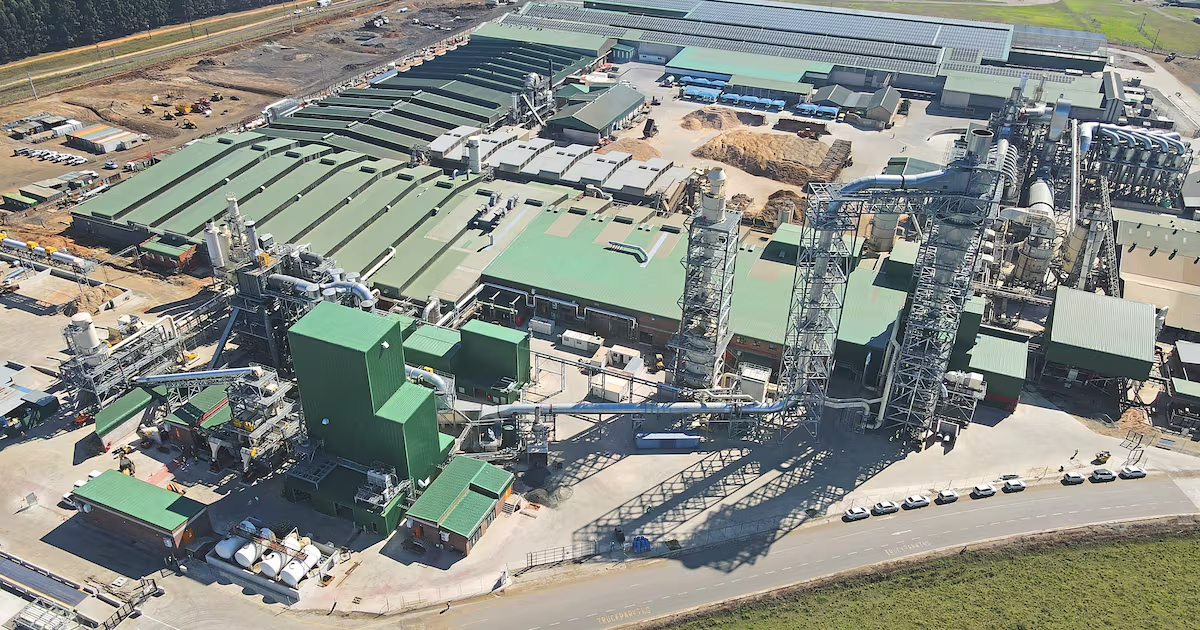
South Africa’s economic growth is likely to be muted in 2026 despite beating expectations in the first quarter, as higher input costs deriving from a sharp jump in fuel prices take their toll on sectors such as manufacturing, mining and agriculture.Finance, agriculture, trade and transport did the heavy lifting on the production side of the economy in the first three months of the year, resulting in a slight uptick in growth to 0.5% from 0.4% during the fourth quarter of 2025, Stats SA said on Tuesday. The demand side was supported by a decline in imports and a rise in household and government consumption as well as exports.Economists had predicted a slowdown in growth to about 0.2% in the first three months of the year, anticipating that rising input costs stemming from a steep jump in fuel prices due to the Middle East conflict would be a drag on GDP.But the economy held up relatively well, propped up by the finance, real estate and the business services industry, which increased by 0.9%, contributing 0.2 percentage points to the overall number. Mining was also stronger due to higher output in platinum group metals, gold, chromium ore and diamonds. (Karen Moolman) Factory production, however, declined by 0.8%, subtracting 0.1 percentage points from first-quarter GDP growth. Five of the 10 manufacturing divisions reported negative growth rates.The economy only felt the partial impact of the US-Iran conflict, which has disrupted the flow of cargo through the Strait of Hormuz since it broke out at end-February, Standard Bank economist Shireen Darmalingam said. The effect is certain to be more pronounced for the rest of the year.“We anticipate a slowdown in GDP growth in the coming quarters, driven by the protracted Middle East conflict and the resulting increase in fuel costs. Business confidence has already deteriorated in the second quarter and we expect mounting pressure on consumers who were already under strain prior to the fuel price shock,” she said.Expenditure on real GDP increased by 0.5% in the first quarter after a 0.3% increase at the end of last year, Stats SA data shows. But household consumption, historically a key growth driver, expanded by a marginal 0.1%, the lowest growth rate in eight quarters.We anticipate a slowdown in GDP growth in the coming quarters, driven by the protracted Middle East conflict and the resulting increase in fuel costs. — Shireen Darmalingam, Standard Bank economist “The softer consumption spending momentum in 1Q26 is particularly concerning, especially as it pre-dates the significant domestic fuel price increases and the latest interest rate hike,” First National Bank economist Thanda Sithole said.The South African Reserve Bank raised its key policy rate by 25 basis points to 7% last month, citing intensified inflation risks stemming from higher oil prices. Since the start of April, the retail price of petrol has leapt by R7.76/l in the economic hub of Gauteng and other inland areas, while the cost of diesel has jumped by R9.54-R10.17. Further increases are in store for consumers as the government phases out the temporary relief it has provided by reducing the general fuel levy built into pump prices.Tuesday’s economic data came a day after the government published its revised industrial development strategy, acknowledging South Africa must urgently secure an affordable, reliable energy supply, particularly electricity, and address bottlenecks in its ports, rail and telecommunications networks to get economic growth to 3%.This is the level the economy needs to grow at annually to make a significant dent in unemployment, which edged up to 32.7% in the first quarter of 2026 from 31.4% in the last quarter of 2025.The document notes that the gradual deindustrialisation of the economy since the advent of democracy in 1994 has whittled the manufacturing sector’s contribution to GDP to about 13% from about 23%.The economy expanded by a tepid 1.1% in 2025, again weighed down by manufacturing and missing the National Treasury’s estimate of 1.4%.Finance minister Enoch Godongwana forecast a 1.6% increase for 2026 in his February budget but is likely to cut this in his medium-term budget policy statement in October as higher input costs hinder production.