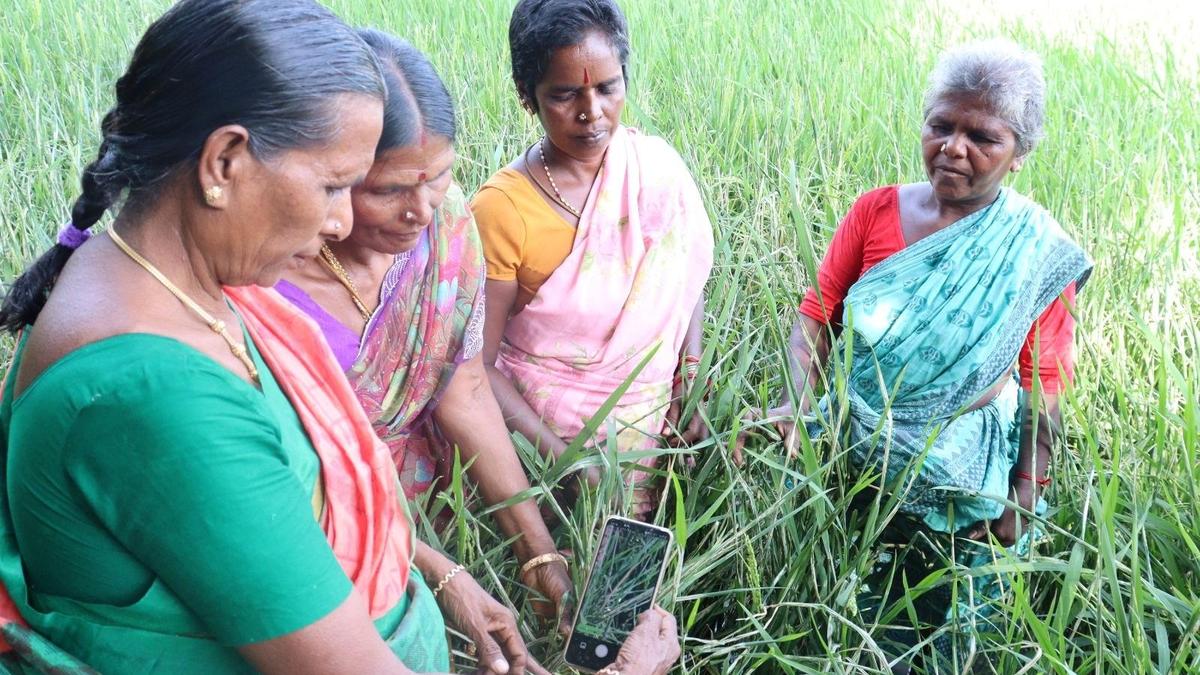
S. Muthulakshmi (left) shares information on a crop through her smartphone scientists of M.S. Swaminathan Research Foundation from Thirumalairayasamuthiram village in Pudukkottai District as her fellow farmers look on.
| Photo Credit: SPECIAL ARRANGEMENT
In her fifties, paddy farmer S. Muthulakshmi of Thirumalairayasamuthiram village in Pudukkottai District, is living the life of her dreams.“I have realised that farmers can be kings and queens of their land only when they grow crops successfully. For this, we must keep learning and sharing our knowledge with others,” Ms. Muthulakshmi told The Hindu.In recent years, Ms. Muthulakshmi has turned around her profit margin manifold with the help of training in agricultural technology and scientific crop cultivation from M.S. Swaminathan Research Foundation (MSSRF).Widowed in her late 30s and with four young children to support, Ms. Muthulakshmi was left with a loss-making two-acre paddy field approximately 10 years ago. Relying on the advice of fertilizer and pesticide sellers, she was spending over ₹3,000 per acre, but was getting a paddy yield of only around ₹1,800 kg per acre.“One day a Plant Clinic camp was set up in our village by MSSRF and we were encouraged to bring our crops for inspection. Watching the creepy-crawlies under the microscope helped us to understand why we were losing out on our yield,” she said.Following MSSRF’s advice on scientific crop management, Ms. Muthulakshmi has managed to increase her harvest from 20 sacks to 45 sacks of grain harvested per acre. Her plant protection costs declined to nearly ₹1,800 to ₹2,100 per acre, while paddy productivity increased from about 1,800 kg to nearly 2,160 kg per acre.She learned to use digital extension tools such as the farmers’ helpline, mobile-based voice SMS advisory services, audio conferences with scientists, and the Plantix mobile application for real-time diagnosis of crop pests and diseases.Ms. Muthulakshmi has also been trained in eco-friendly agricultural practices such as seed treatment with bio-fungicides, application of neem cake as basal manure, preparation and use of botanical extracts, foliar application of bio-growth promoters, and integrated pest management.At present, she is the elected leader of a Farmers’ Interest Group, in which capacity she arranges meetings within the local agricultural community and also promotes natural farming techniques.She leads the Vembu Women’s Group, an enterprise producing eco-friendly agricultural inputs such as Panchakavya, Dasakavya, fish amino acid, vermicompost, and other bio-based agricultural inputs.“I have been farming from a very young age, but my knowledge about agriculture was based on tradition rather than any scientific reasoning. Once we realise how to nurture crops successfully, we can increase our profits sustainably. I will keep working on my farm, no matter how old I am,” she said. Published - July 14, 2026 07:48 pm IST