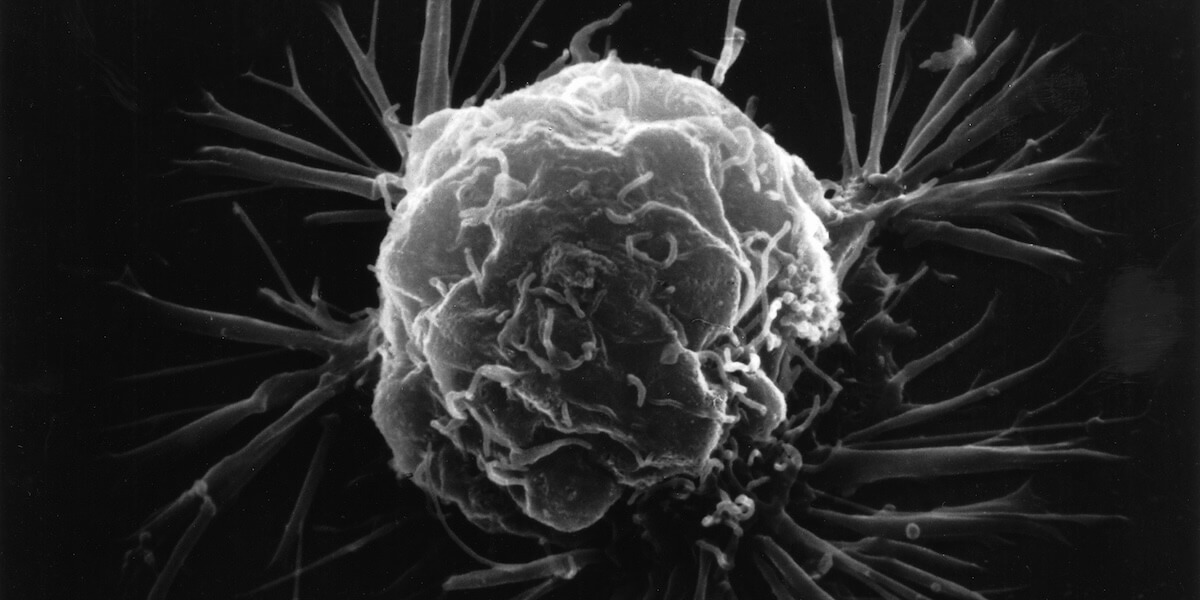
A breast cancer cell. Image/National Cancer Institute (NCI), National Institutes of Health
Researchers at the USC Viterbi School of Engineering and Keck School of Medicine of USC have engineered a remarkable genetic tool that addresses one of the most persistent obstacles in cancer immunotherapy: the physical softness of tumors. The work, detailed in the journal Nature Biomedical Engineering, reveals how the soft environment of a tumor enables cancer cells to become “stealthy” and resistant to treatment, providing a powerful new mechanism to tag those evasive cells for destruction.
The paper’s lead author, Jenny Yunjia Qu, a postdoctoral researcher in the lab of Peter Yingxiao Wang, the Dwight C. and Hildagarde E. Baum Department Chair in the Alfred Mann Department of Biomedical Engineering, collaborated with the USC Viterbi and Keck School of Medicine teams to develop a technique that successfully targets hard-to-reach “cancer stem-like cells.” These cell types possess stem cell-like abilities, including self-renewal, which make them key drivers of tumor growth, drug resistance, and cancer recurrence.
The Soft Barrier to Immune Attack
Peter Yingxiao Wang, Dwight C. and Hildagarde E. Baum Chair in Biomedical Engineering. Image/Dani Orlando, USC Viterbi School of Engineering.