Whether the relationship between insolvency law and anti-money laundering enforcement should be recalibrated is ultimately a question for Parliament
| Photo Credit:
Wanchai Noolpong
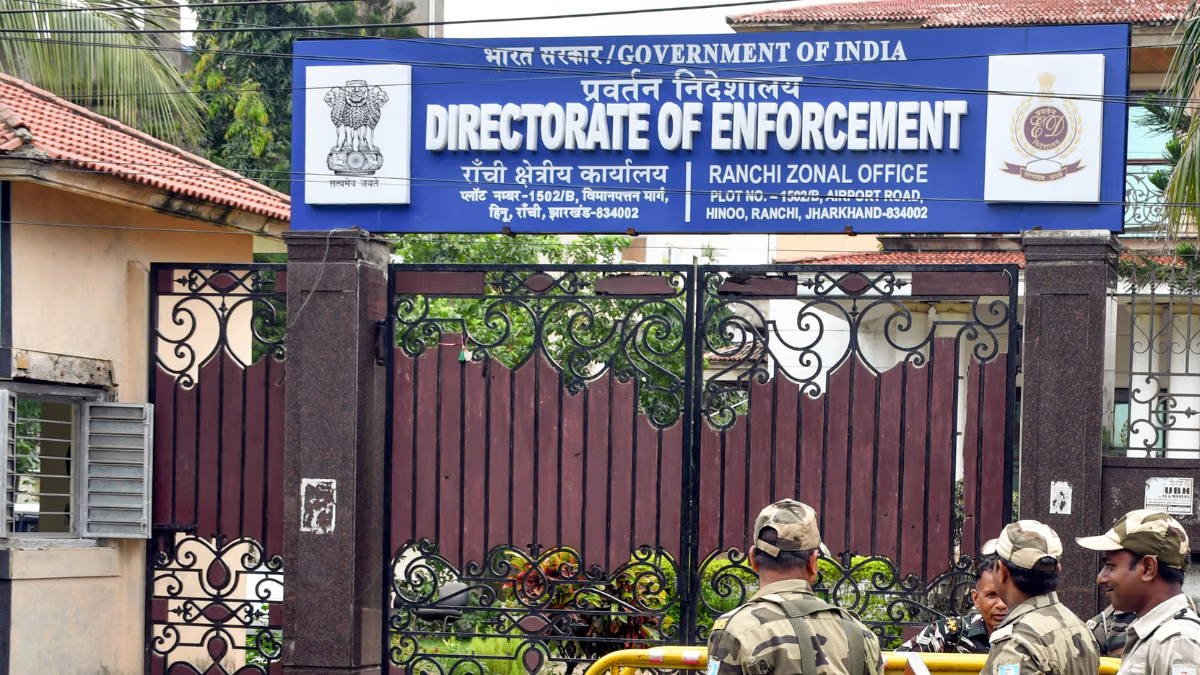
Judicial decisions require courts to reconcile competing statutory objectives. But that exercise is one of interpretation, and not of legislative revision. Where Parliament enacts two statutes serving different public purposes, the judicial task is to ascertain how they operate alongside each other within the statutory framework, not to redefine that framework according to broader notions of public policy.The recent decision of the National Company Law Appellate Tribunal (NCLAT) in the case of Value Wise Consultancy Private Ltd v. Deputy Director, Directorate of Enforcement, raises this question on the interface between the Insolvency and Bankruptcy Code, 2016 (IBC) and the Prevention of Money Laundering Act, 2002 (PMLA), an area that has generated considerable litigation since the Code came into force. The NCLAT upheld the powers of the Enforcement Directorate (ED) to proceed against the corporate debtor, notwithstanding the pendency of insolvency proceedings. The result may not surprise practitioners familiar with the existing line of authority, but the reasoning adopted by the Tribunal deserves closer scrutiny.What distinguishes the judgment is not merely its conclusion on jurisdiction, but the language through which that conclusion is reached. The judgment contrasts the interests of creditors with ‘national interest,’ describes the Code as not being intended to create a ‘holy Ganges’ to wash away criminality and cautions against insolvency becoming a camouflage for ill-gotten wealth. These observations frame the Tribunal’s understanding of the relationship between the IBC and the PMLA, and provide the backdrop to its conclusion. But they also invite a larger inquiry: is it the function of an adjudicatory Tribunal to recalibrate the policy balance struck by the legislature, or simply to interpret and apply the balance that Parliament has built?The legal issueThe facts were relatively straightforward, though the legal issue was not. Before the commencement of the corporate insolvency resolution process, ED had provisionally attached certain assets of the corporate debtor, which was confirmed by the Adjudicating Authority under the PMLA but overturned by the Appellate Authority. During the moratorium, it also withdrew over ₹2.29 crore from the Corporate Debtor’s bank account and issued directions affecting the recovery of its receivables. Following liquidation, the liquidator challenged these actions before the NCLT. The NCLT declined to entertain the challenge, holding that the issues fell within the statutory framework of the PMLA. On appeal, the NCLAT affirmed that view.Had the judgment rested there, it would have simply reaffirmed an established jurisdictional principle. The Supreme Court had already made it clear in Embassy Property Developments that the NCLT’s jurisdiction under section 60(5) of the Code cannot be expanded into a general supervisory jurisdiction over statutory authorities acting under other enactments. The real significance of Value Wise lies in the broader philosophy that the Tribunal invokes to explain why the insolvency process must yield where allegations of money laundering arise. It is that aspect of the judgment that merits closer examination, rather than the conclusion itself.The NCLAT’s reasoning proceeds on a broad conceptual distinction between the purposes served by the two enactments. It describes the PMLA as legislation enacted to fulfil India’s international obligations to combat money laundering, deprive offenders of the proceeds of crime and protect the integrity of the financial system. By contrast, the IBC is characterised as legislation intended to resolve the financial distress of an insolvent company and maximise value for its stakeholders. On that premise, the Tribunal concludes that the two statutes operate in distinct domains and that the protections available under the IBC extend only to legitimately acquired assets. Assets alleged to represent the proceeds of crime fall outside the insolvency process.There can be no quarrel with the proposition that the two enactments pursue different objectives. The PMLA combats money laundering; the IBC seeks timely resolution of insolvency and, failing that, an orderly liquidation. But that does not resolve the legal issue before the Tribunal.The Tribunal was not required to decide whether combating money laundering serves an important public purpose. Parliament has already answered that question by enacting the PMLA. Nor was it required to determine whether insolvency proceedings should become a refuge for criminality. No one suggested that they should. Its task was the narrower question of identifying how Parliament intended these two statutes to operate when they converged upon the same factual situation.Competing objectivesThis is not to suggest that Parliament ignored this tension. It recognised that insolvency law and criminal enforcement may intersect. Section 32A illustrates Parliament’s legislative approach. When Parliament chose to accommodate competing objectives, it did so through carefully calibrated language. The significance of section 32A lies not in answering the present dispute, but in demonstrating that Parliament addressed the interface through legislation rather than broad appeals to public policy. Whether one agrees with that legislative choice is beside the point. The point is that the balance was Parliament’s to strike.By invoking national interest and the holy Ganges metaphor, the Tribunal explains why the conclusion appears intuitively compelling. But those considerations cannot themselves answer the question before it. Once Parliament has legislated upon the relationship between competing public objectives, and the constitutional validity of section 32A has been upheld by the Supreme Court in Manish Kumar v. Union of India, the court’s task is to give effect to that legislative choice. It is not to reformulate it by reference to broader notions of public policy. Viewed in that light, Value Wise may ultimately be remembered less for the conclusion it reaches than for the questions it raises about the limits of judicial interpretation.NCLAT’s decision in Value Wise is undoubtedly an important addition to the evolving jurisprudence on the interface between the IBC and the PMLA. Its reaffirmation of the jurisdictional limits of the insolvency Tribunal is unlikely to be controversial. What may invite closer debate is the reasoning adopted to reach that conclusion. Whether the relationship between insolvency law and anti-money laundering enforcement should be recalibrated is ultimately a question for Parliament. Until then, the legitimacy of adjudication lies in giving effect to the balance that Parliament has so carefully crafted.The writer is a lawyer and former Judicial Member of the National Company Law TribunalPublished on July 14, 2026