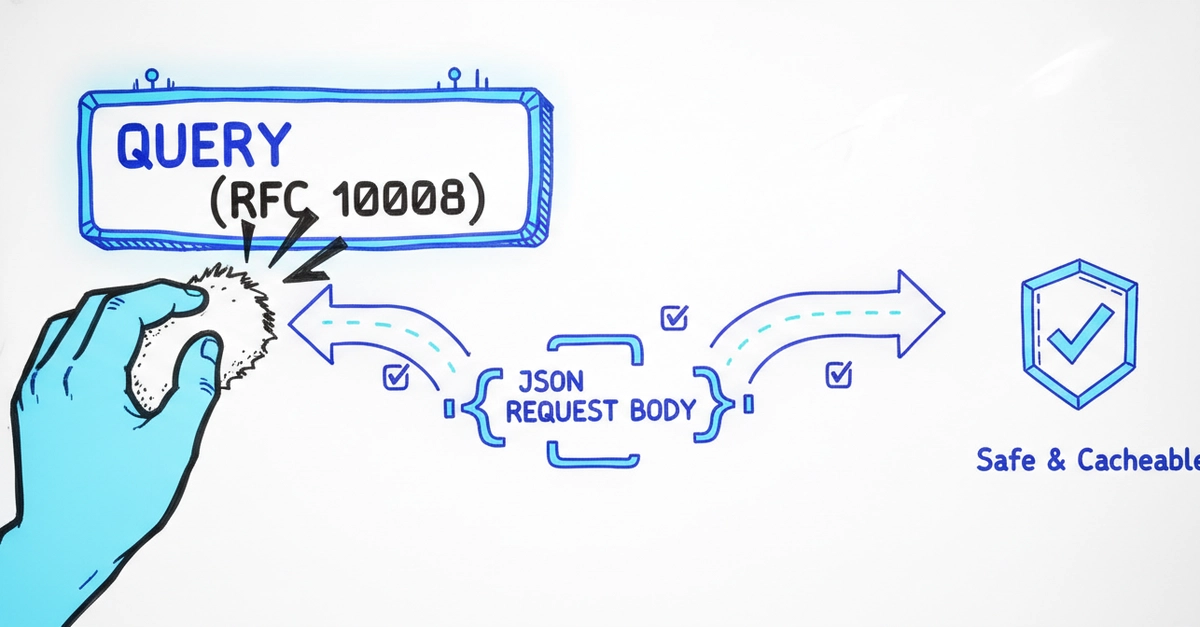
"Idempotent" may be jargon, but the term performs an important job in HTTP as a hall pass that gives reverse proxies and gateways the go-ahead to cache complex query responses and automatically retry failed requests.HTTP has long allowed automatic retries for idempotent methods, but complex queries are often sent using POST, which intermediaries cannot safely assume is retryable. Developers have worked around that limitation for decades. The Internet Engineering Task Force (IETF) has published a new HTTP request method, QUERY (RFC 10008), joining familiar methods including GET, POST, PUT, and PATCH.
In development since 2021, the QUERY request method provides a way for an HTTP client to make an idempotent request to an HTTP server. An idempotent request has the same intended effect whether it is sent once or multiple times (so retrying it should not charge a user's credit card again).
The specification defines QUERY as safe and idempotent, and the solution was surprisingly simple. "Thanks to QUERY, we finally have functional HTTP caching for complex requests. Proxies, CDNs, and browsers can now cache requests with a body. This is huge for performance," writes developer Elie Treport in a recent blog post. Query operations have traditionally used the GET method. HTTP defines GET as safe and idempotent, as it made no changes to the server itself, but GET becomes awkward when the query data is too large or complex for a URI.The idea behind GET was to load all the necessary query parameters onto the form's URL, resulting in a very long string that the browser sent to the server. Many search services still work this way, appending query parameters to the URL after a question mark. Those URLs can expose sensitive data through browser histories, server logs, and bookmarks.Festooned with nested filters, sort rules, date ranges, and other database flotsam, GET URLs can become unwieldy. HTTP recommends support for URIs of at least 8,000 octets, but there is no universal maximum, so an oversized URL may be rejected by any of the systems it passes through.Long query strings are also a pain to read and debug.Faced with these Franken-URLs, many developers turned to POST instead. POST can carry query data in the request body, but its semantics do not tell intermediaries that the operation is safe and idempotent. The method is more commonly associated with operations such as submitting form data, uploading a PDF, or creating and modifying resources.For a basic HTML form, switching <form method="GET"> to <form method="POST"> moves the encoded form data from the URL into the request body.