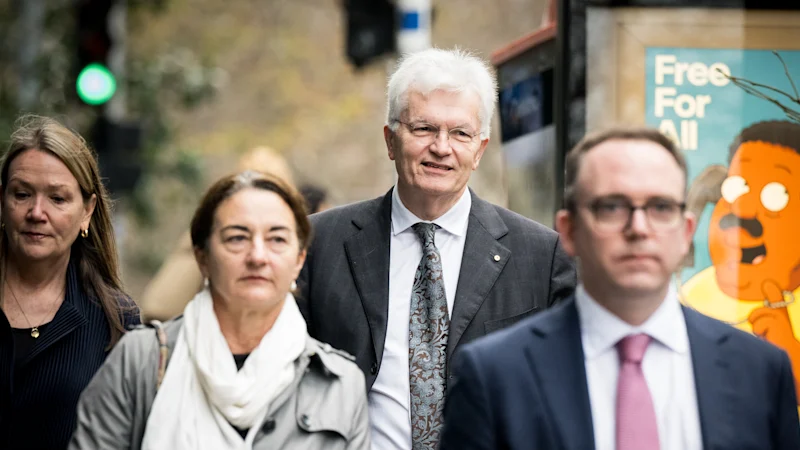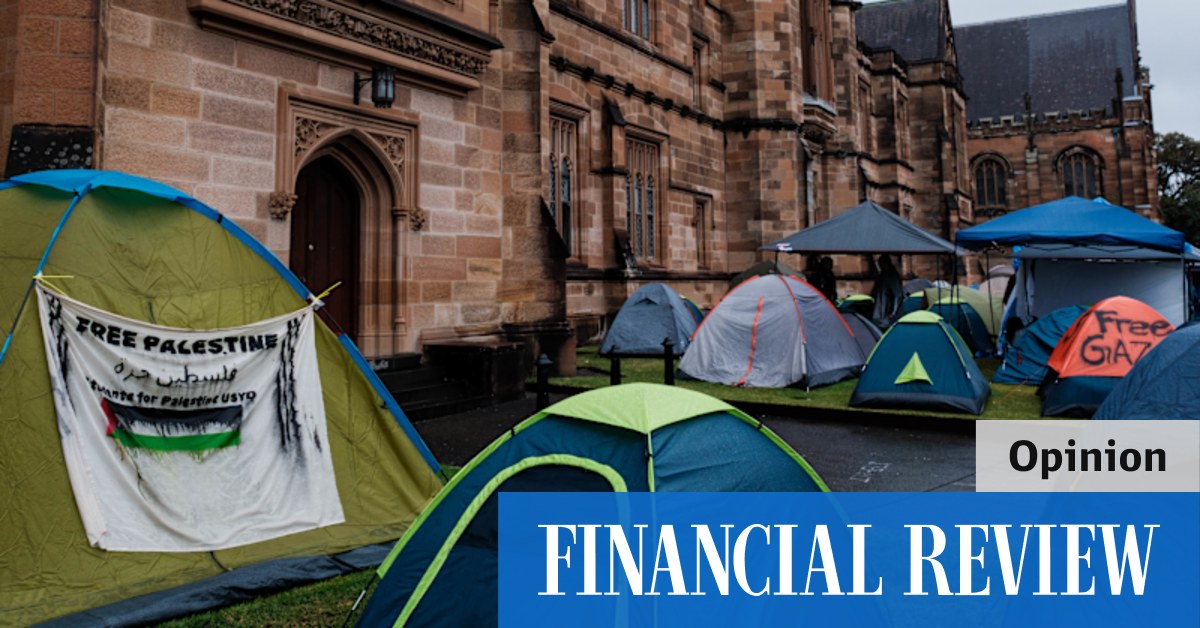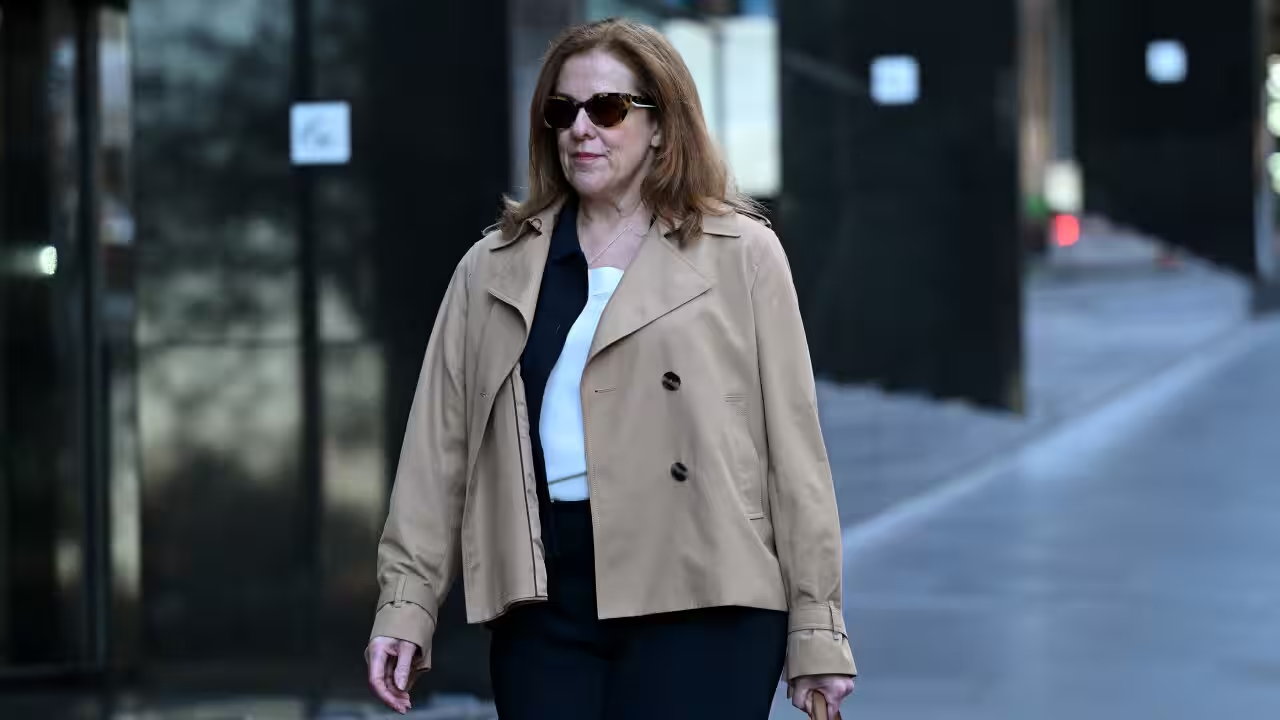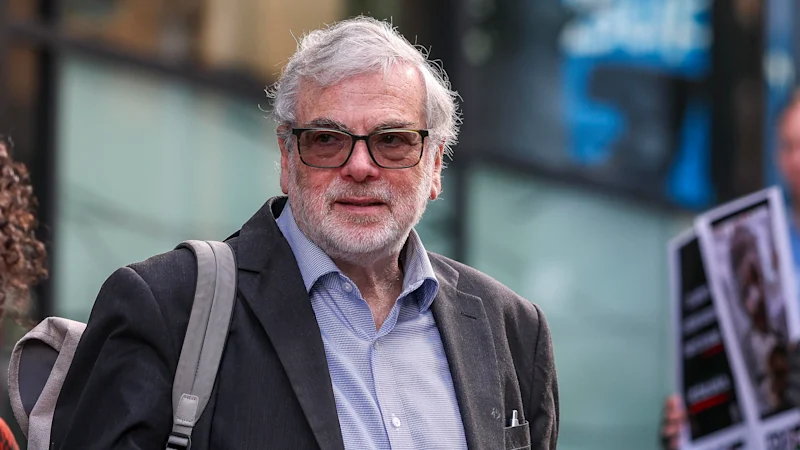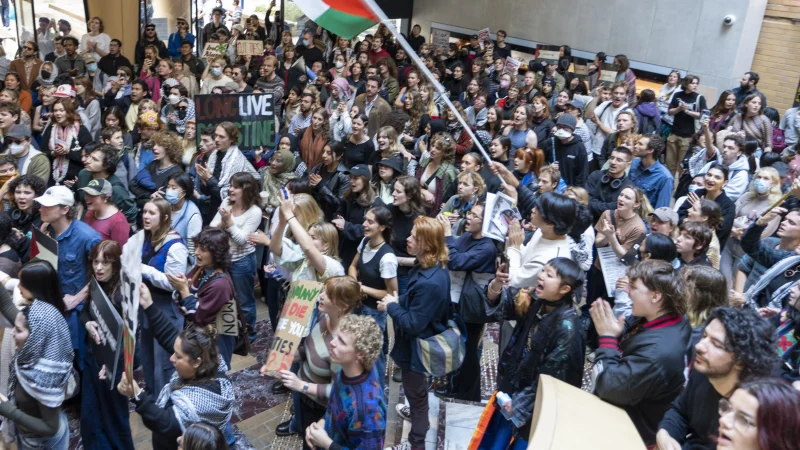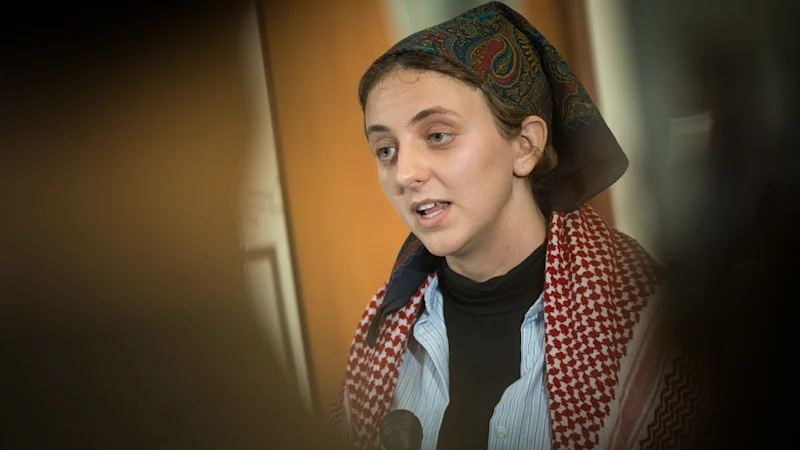
Updated July 13, 2026 — 6:28pm,first published 12:30pmA prominent pro-Palestine university student leader has told the Royal Commission on Antisemitism and Social Cohesion that violence is a legitimate tactic in freedom movements, but would not say if she believed Hamas’ October 7, 2023, attack on Israel had been a legitimate use of that violence.Yasmine Johnson, a co-convener for Students for Palestine and protest organiser, appeared as part of the commission’s first day of hearings in Melbourne. She followed other witnesses who said that, as Jews and Zionists, they had felt threatened by protests on university campuses across Australia.Yasmine Johnson speaks to the media after testifying at the Royal Commission on Antisemitism and Social Cohesion in Melbourne.AAPAnother student, Liat, earlier told the commission she had felt “very physically unsafe” during the long encampment at her university campus “when people would laugh and leer at me and say, ‘Look at the baby killer, look at the genocide supporter’”.Johnson, who is Jewish, told the media following her evidence the idea that campus protests “creates a dangerous atmosphere, fear for people, is farcical”.“What we’ve heard ... so far is day after day after day of evidence which conflates legitimate anti-genocide, pro-Palestine activism with genuine antisemitism which exists in our society,” said Johnson, who helped organise protests across Sydney, including the march across the Harbour Bridge.“The primary concern in a democracy, when we’re talking about free speech, cannot be simply whether somebody’s feelings will be hurt by something or not.”Johnson also told reporters the commission was a farce because it had “allowed government-appointed figures like the antisemitism envoy [Jillian Segal] to air ideas that our state media should be muzzled, and ... that national service should be introduced”.The University of Technology Sydney student had agreed to give evidence at the royal commission because she wanted to “push back against the narrative”, she said.In her evidence to Commissioner Virginia Bell, Johnson defended chants saying “from the river to the sea, Palestine will be free”, and “globalise the intafada”.Students for Palestine called for freedom of all inhabitants of Israel and Palestine, not for the genocide of Jewish people, she said.“The history of my family – my grandmother lost every living relative in the Holocaust – gives me a sense that being Jewish should mean fighting for that to be the end of genocide forever,” Johnson said.She likened the push for independence in Gaza to the violent struggle against slavery in the United States, against apartheid in South Africa, and by the Viet Cong in the Vietnam War.“I think the resistance of people against colonisation has always involved elements of both mass non-violence and also violent resistance,” she told the commission.When asked by reporters several times whether the October 7, 2023, attack by Hamas in Israel had been a legitimate expression of violence, Johnson walked away from the microphone.Earlier on Monday, Australian National University student Liat was granted partial anonymity by the commission and was the first of a number of lived experience witnesses who will not be fully named.The Royal Commission on Antisemitism and Social Cohesion began in Melbourne by hearing from a university student, Liat.Jason SouthBell said these witnesses would not be cross-examined on their evidence.Liat described experiencing a “low-level hum” of antisemitism on campus before October 2023, but said that after the Hamas attack on Israel and Israel’s subsequent war on Gaza, a sense of “pervasive fear” had developed. She told the commission she felt the need to hide her identity, to the extent of not using her real name when ordering coffee.Living as a Jew at the ANU in Canberra had been “exhausting”, Liat said, and passing the encampment, which was set up in the middle of the campus, was a daily ordeal.Liat, who acts as a spokesperson for the Australasian Union of Jewish Students, said she had helped organise a counter-protest on campus where a man approached, despite a heavy security presence, and performed a Nazi salute.The pro-Palestine encampment at ANU in 2024.Alex EllinghausenAfter October 2023, the student, who told the commission she was a Zionist, said she had lost the vast majority of her non-Jewish friends.She said one friend told her: “You’re of Israeli heritage, you can’t possibly be my friend.”In the magazine welcoming students produced by the ANU student association, a line included said: “Zionism is a far-right political project, and the state of Israel is run by war criminals and proponents of genocide.” Liat told the royal commission the statement “portrays Jews as uniquely and distinctly bloodthirsty and murderous” and was an antisemitic trope.Liat said she also felt unwelcome when, in a meeting of the student association, fellow students voted to remove a reference that condemned Hamas as a terror organisation.She was later told that during the large online meeting, a number of fellow students had given the Nazi salute, and another had made a gesture indicating a Hitler moustache.In other evidence, the Australian Academic Alliance Against Antisemitism’s Josh Keller said a survey of 548 Jewish staff and students at 30 universities had shown that campus protests meant they did not want to be part of the university any more.A tutor and PhD student at the University of New South Wales told the commission that in 2024, four students had performed the Nazi salute towards him in his classroom, and again in the corridor outside the business lesson.As the grandson of Holocaust survivors, he said, “when someone does a Nazi salute to me, it feels like they want to kill me”.David Watson appeared outside the Royal Commission on Antisemitism and Social Cohesion’s first day in Melbourne on Monday to protest against the war in Gaza. Jason SouthWhen the man complained to the university, he said the response was inadequate. Initially, he was told the students would be given a verbal reprimand and reminded of university policies, and it was only after he reported the incident to police that the students were suspended for two weeks.Dr Andy Smidt, a speech pathology academic formerly at the University of Sydney, said it was “really difficult to do your job” during the pro-Palestinian protests and encampment on campus.“If the Jews on campus, primarily as the Jews in Australia do, identify with Israel as part of who they are, then any attack on Israel is an attack on the Jews,” she told the commission.“And so it’s not about conflating. It’s about the fact that they are connected. They’re undeniably inextricably connected.”The president of the Australian Human Rights Commission, Hugh de Kretser, told the commission there had been a large spike in racist incidents following October 2023. This had affected Jewish, Israeli, Palestinian, Muslim, and Middle Eastern staff and students. But the vast majority of those who had complained to universities, including 80 per cent of academics, were disappointed with the outcome of their complaints, he said.He described people as having “shockingly low confidence in university complaint processes around racism”.Introducing the hearing, Zelie Heger, SC, the counsel assisting the commissioner, said Australian universities carried a “profound duty of care to ensure that everyone feels safe, respected and included”.Heger acknowledged institutions faced challenges in balancing different rights and freedoms, and “it’s not always easy to discern when legitimate expressions of opinion cross the line into antisemitism or other forms of racism”.“Nevertheless, the difficulty of striking that balance cannot be used as an excuse for inaction,” she said.The hearing comes after the Albanese government’s announcement on Sunday that it would compel all universities to apply clear definitions of racism, including antisemitism, Islamophobia and anti-Aboriginal racism.Start the day with a summary of the day’s most important and interesting stories, analysis and insights. Sign up for our Morning Edition newsletter.From our partners
Violence a legitimate tactic in freedom movements: pro-Palestine student leader
Yasmine Johnson gave evidence at the royal commission’s first day of hearings in Melbourne. Other witnesses said that as Jews, they had felt threatened by protests on university campuses.
1,272 words~6 min read