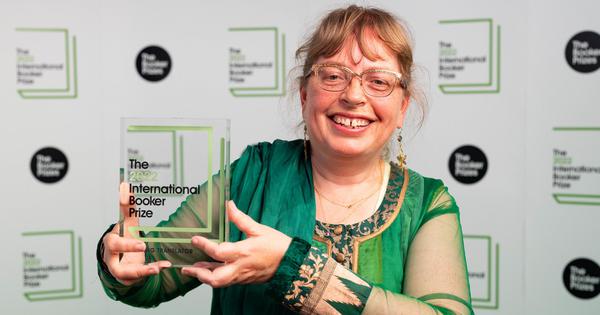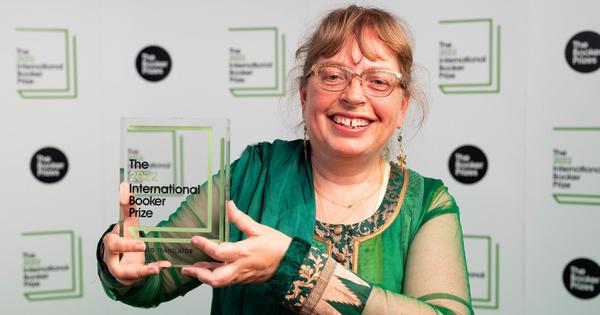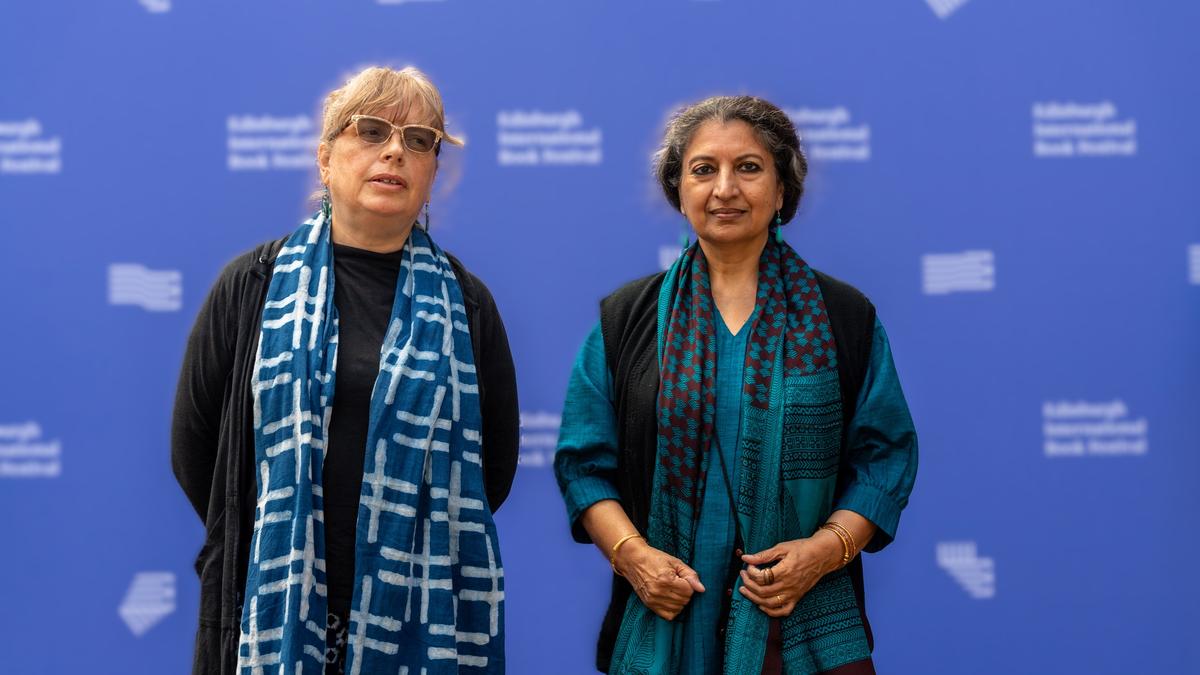
International Booker Prize-winning translator Daisy Rockwell.
| Photo Credit: Getty Images
Just before I laid hands on Daisy Rockwell’s new book, my Swedish husband happened to tell me how the Beatles’ ‘Yesterday’ became a somewhat different product in his language. The word for ‘geese’ is gäss, pronounced like the English ‘yes’. And the other two syllables of the refrain, ‘ter’ and ‘day’, sound very similar to the Swedish te and dej: ‘to’ and ‘you’, respectively. So that classically gloomy song was sung to mean ‘Geese to you, I want to give some geese to you…’ Not quite a translation but still this parodic transporting by the jazz musician who called himself Helmer Byrd is liable to cause transports of delight.‘To carry across’ is the root meaning of ‘translation’, Rockwell reminds us in Mixed Metaphors, which too is often funny about an often contentious subject: literary translations. The slim text is divided into the theory and the practice, as it were. The first half has her casting about for the most apt metaphor for translation and she lays out 22 — in verse.Now translation is a harmless, homey occupation like building a Lego castle (but without a manual, so improvisations are called for) or replicating a fabric quilt with bits of coloured paper. Now it is innovative, like Ginger Rogers dancing a score Fred Astaire choreographed. Now translation grows daring; the book to be translated is Alice dropping down to Wonderland and her bodily adventures or misadventures are the disfigurements done to the text in the process of making a coherent translation. Now translation turns even more bizarre: it’s Dr. Frankenstein’s monster; the translator has succeeded in bringing to life the thing she was patching together. “And the screams the monster is greeted/with as it lurches through the streets,/those are the screams of people who find/translation fishy/inaccurate/unnatural.”Linguistic monocultureRockwell stays playful even when she brings up serious points. One is about the dominating English language, something she can’t help — being herself a prolific and celebrated translator from Hindi and Urdu into English — but an issue she can illustrate. She renders it a “monocrop”, invasive, bland, and ingested by billions. “English is the potato crop for McDonald’s french fries, the corn crop for corn oil and corn syrup […] The British Empire spread the English monocrop initially, but the American Empire is the greatest expert on the export of the processed and the packaged, the canned and the bottled, the I-can’t-believe-it’s-not-real.”Booker effectYet in the much narrower literary realm, one assumes that translation into the language has done it some good, if only because it continues to complicate the idea of what English literature is. Although Rockwell characterises literary translation as “maligned” and “decadent”, interest in it seems to be growing. Just one example is the International Booker Prize, which from 2016, has been awarding translated fiction. (She and Geetanjali Shree jointly won it in 2022 for Tomb of Sand.)The book’s second, more personal, half has a section called ‘Five Hair-Raising Copyright Tales’ — on the hazards of translation. (It’s even more enjoyable if one knows Rockwell’s bibliography and can decode the identities of these figures, discreetly named after the Urdu alphabets.) Two utterly different worlds collide in these anecdotes. On the one hand are celebrated Hindi and Urdu writers from a generation on its last legs, or who have recently departed, who have had an informal, to put it mildly, approach to the publication, translation, and ownership of their work. On the other hand is a professional (most of the time) English-language publishing industry seeking to bring some order to the field. One thinks of the hapless Deven in Anita Desai’s In Custody, bent on trying to pin down that magnificent, decayed, and utterly elusive Urdu poet, Nur.Hunting for metaphorsMixed Metaphors comes with Rockwell’s own drawings, delightfully odd. Her composites of people, creatures, objects and, again, Urdu characters, make one wonder if the whole business of translation is neither fish nor fowl, a strangely anomalous something. But having understood that, why do we need so many metaphors for it? “It is fashionable nowadays to push the boundaries of our definitions of what translation is, as though sitting still for hours on end, day after day, surrounded by dictionaries, painfully refashioning a new text from an old one is just too boring…” is her explanation. I think too that a performative quality has come to be attached to translating, hence the question each time of what exactly one is doing and the new fashion in metaphor hunting.Rockwell’s even-handedness is the best thing about this book and about her stance on translation in general. She sees the politics implicit in who is translating what into which language, yet she does not fetishise cultural difference nor give in to the cult of ‘untranslatability’. And one comes away from Mixed Metaphors feeling that for all translation’s propensity for errors and even its descent into weirdness, this wanting to see what the ‘carrying over’ reads, sounds, or looks like is simply unkillable human curiosity. To know more than one language is to want to translate.