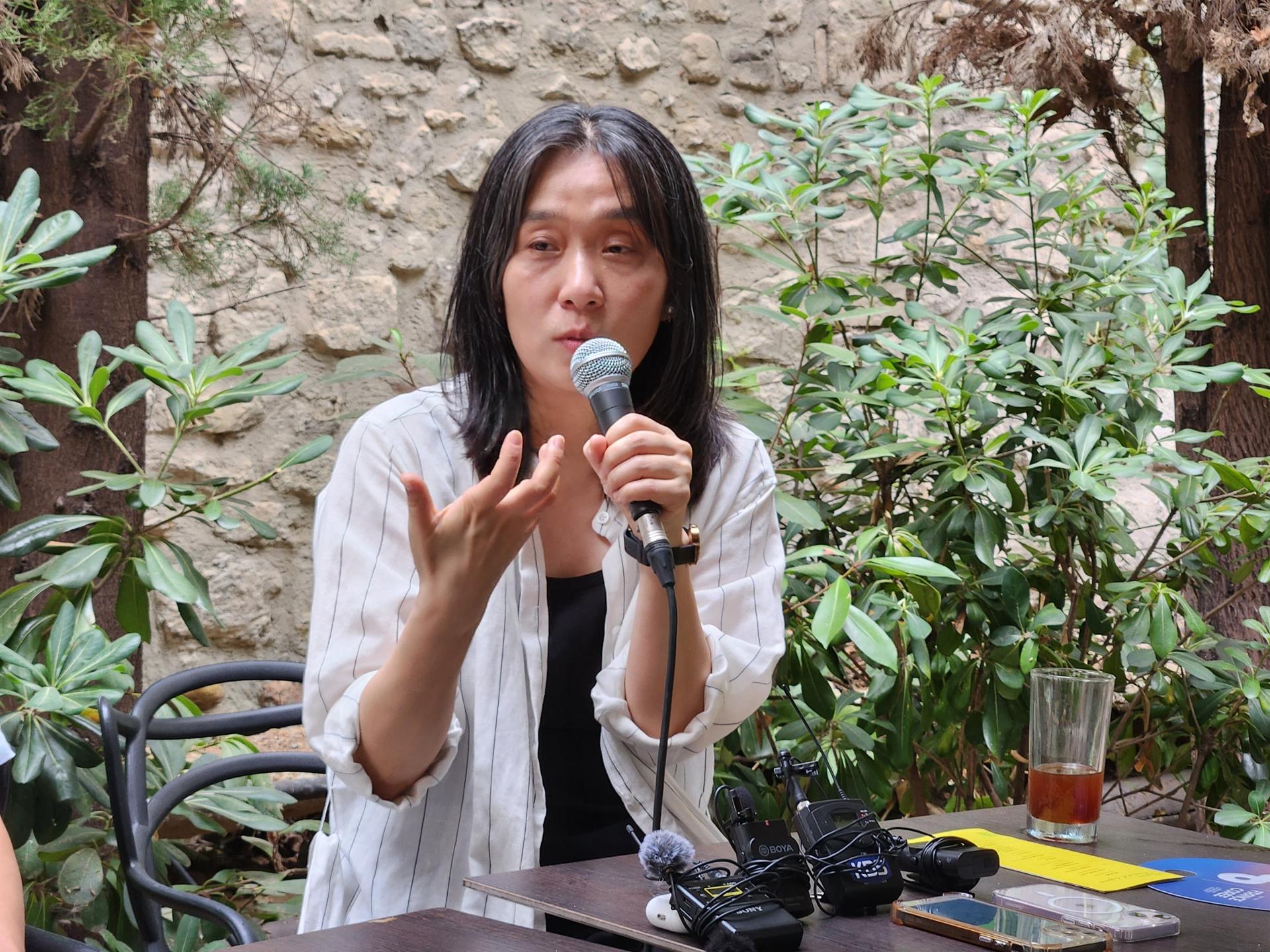
The cover of the Korean edition of “Human Acts” by Han Kang, and the poet Kim Hye-soon during an interview with the Hankyoreh in April 2022. (Lee Jung-yong/Hankyoreh)
Korean President Yoon Suk-yeol’s short-lived martial law declaration last December, though unnerving for the country as a whole, was particularly traumatic for those in the publishing industry. Many industry figures couldn’t help recalling the terror and humiliation they suffered as a result of past censorship and oppression. “I was initially flummoxed, and then increasingly frightened, by the thought of having to run manuscripts by a panel of soldiers,” the president of a publishing house told the Hankyoreh. Such fears prove well-founded when we look at the work of a poet who had already once experienced such a world around the time of their poetry debut in 1979. The whip may not strike me, but I am stripped naked. My naked body is drenched with water. Steam rises, fog forms.Next: fathers appear. They close the curtain before me.[…] Next: I am whipped with words. Next: I am fed ink. My body brims over with ink. At last, stripped and beaten, clothed in the heavy garments of rebuke, I vomit writing all over my body.That’s the text of “That Place 2: Burning of a Witch,” a poem written shortly after the poet was slapped by a detective in 1979, when martial law was declared by Chun Doo-hwan.That place was so bright you couldn’t even bring your shadow inside. It was bright even behind closed eyes. My skull throbbed when I was asleep in that bright place, the best writing studio in the world.[…]Outside, all was deathly still and black as pitch. I was alone in the little illuminated box of that bright place.— excerpt from “That Place 1”The poet in question was working for a publishing company shortly after graduating from college. One of the tasks for this junior employee was delivering manuscripts to soldiers in the censorship office at Seoul City Hall.One day, the military censors demanded she hand over the contact info of the translator of the book she had been proofing, as well as the place they had met. She was eventually called to the police station.“You’ve got some nerve,” a police officer shouted, before slapping the poet seven times across the face.“I counted each slap in my head. I sprawled out on the floor of my boarding house and wrote one poem for each slap, while staying home from my job at the publishing house. I held on to those poems for a few years and finally published them in this volume,” the poet revealed, 38 years later.