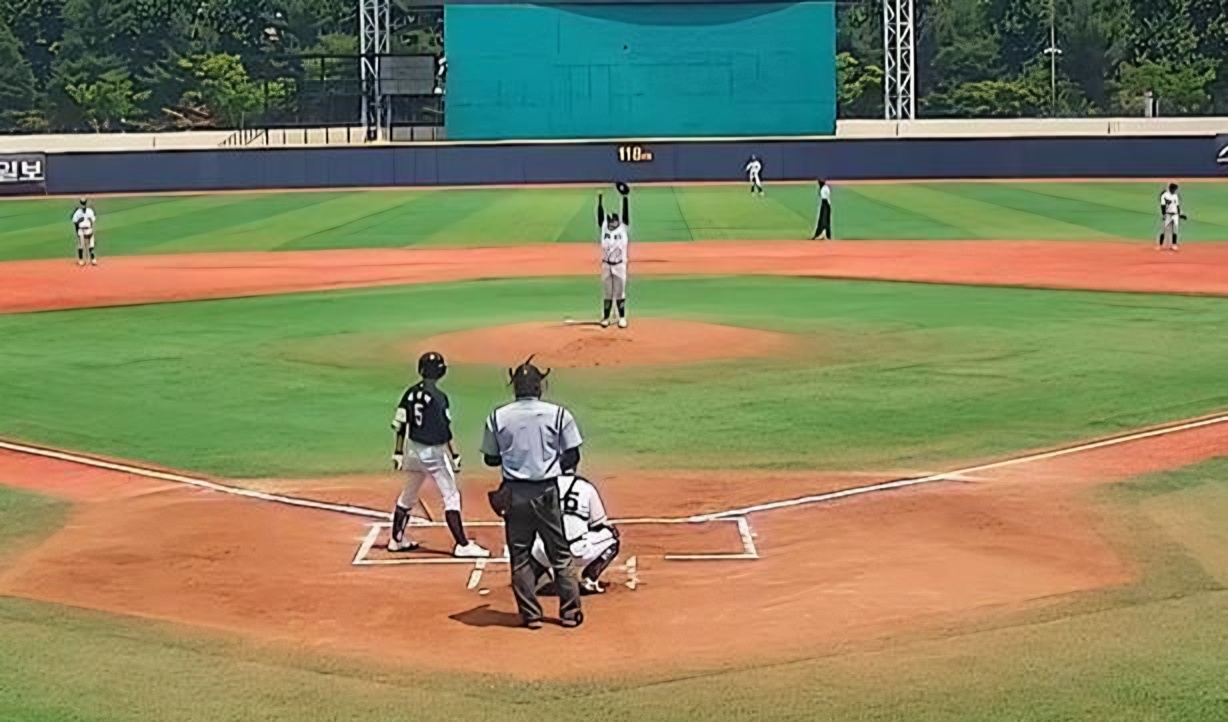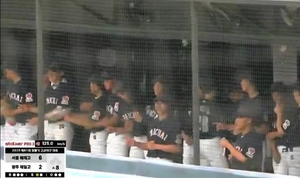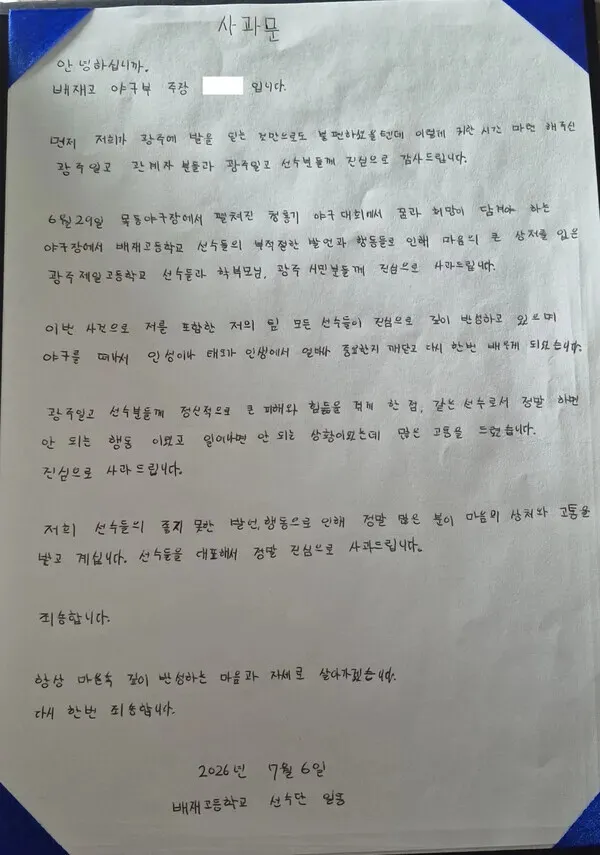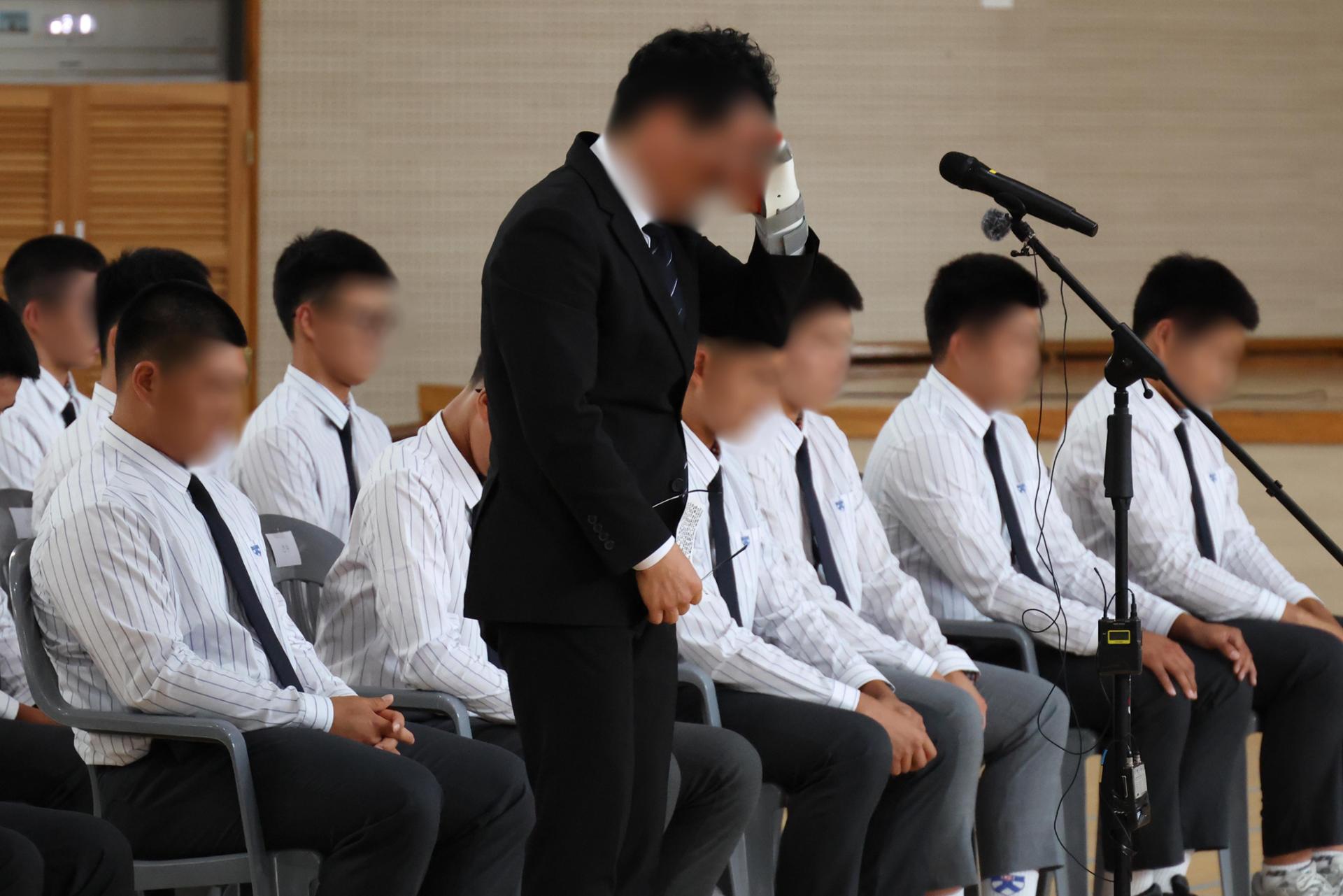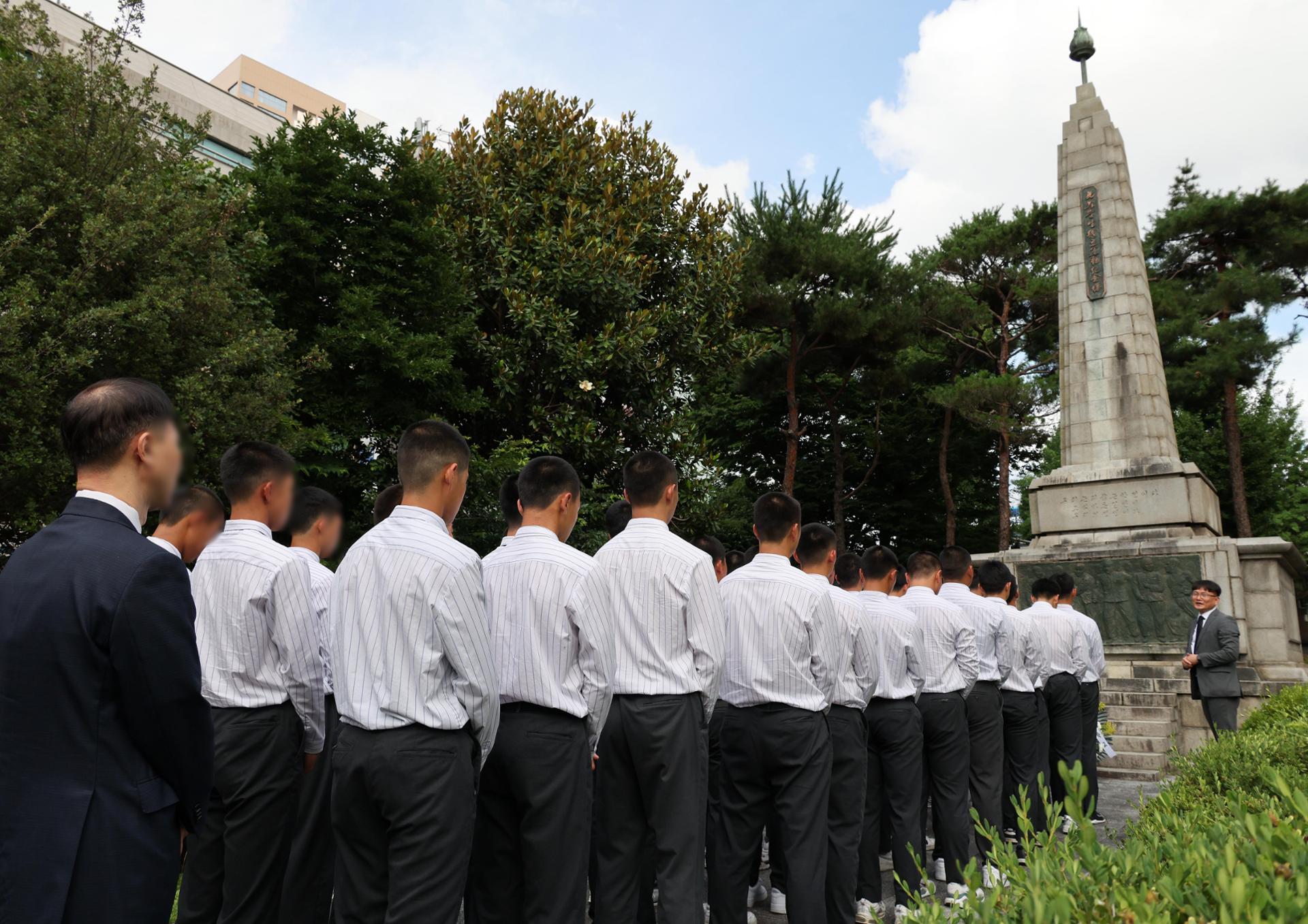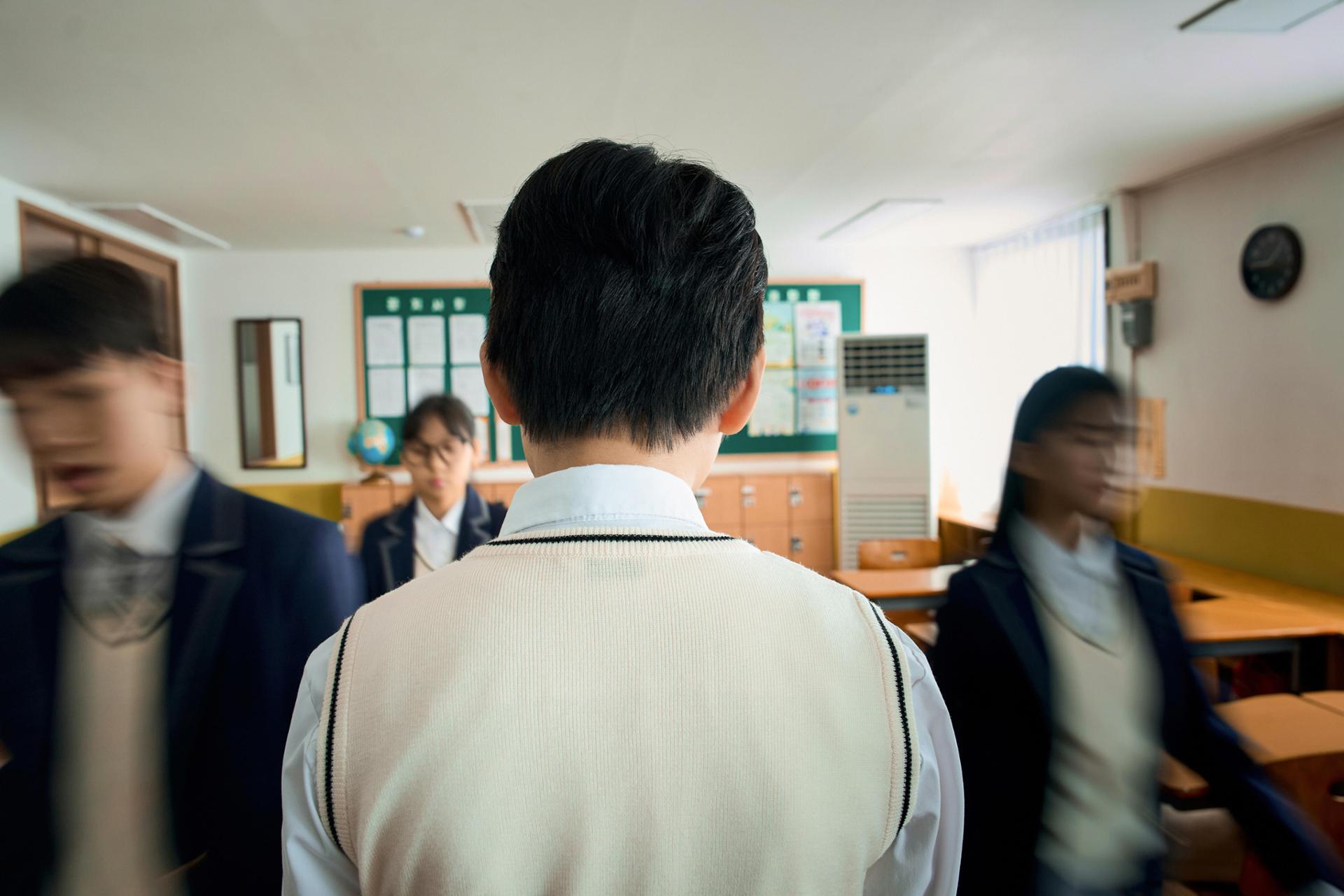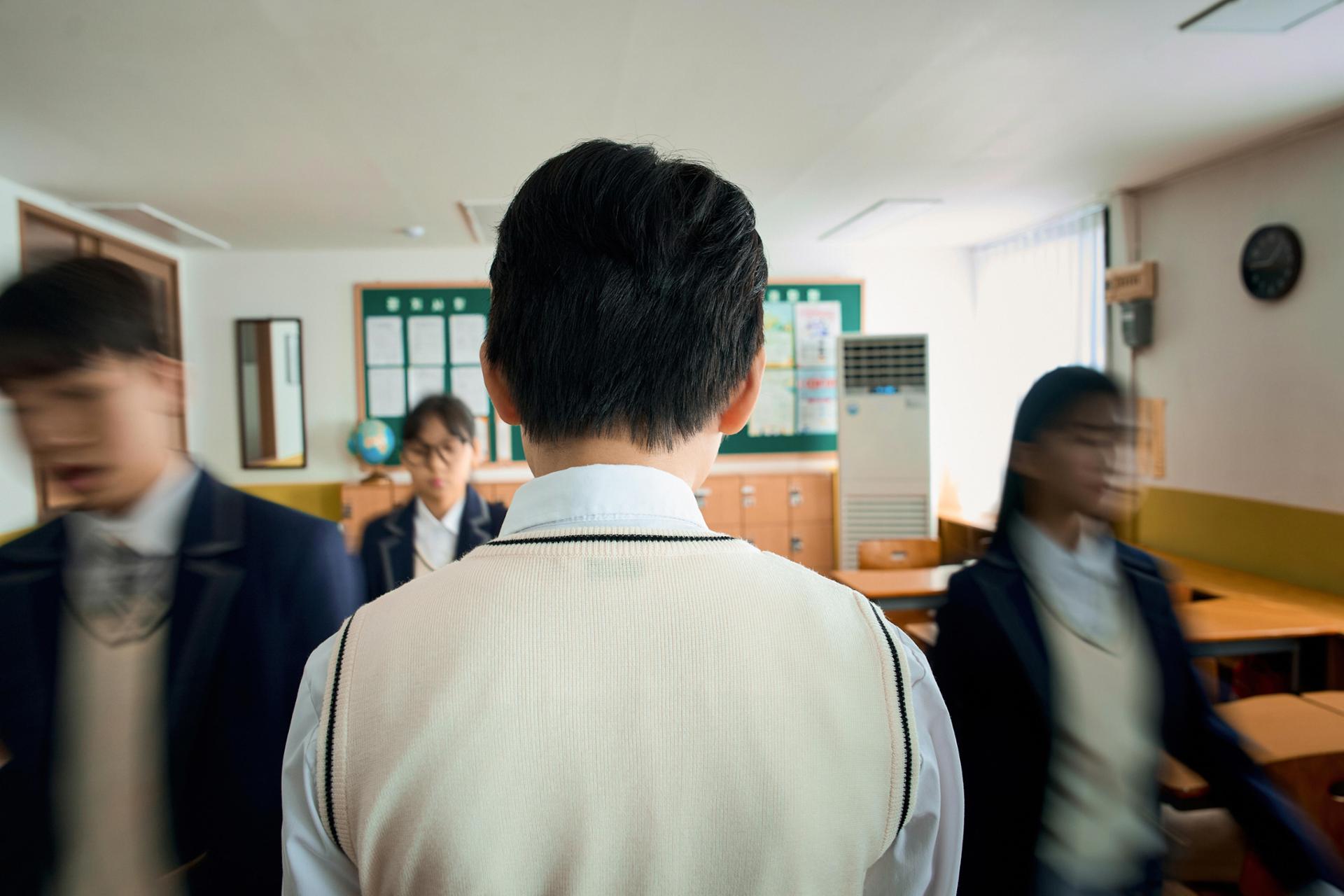
Analysis reveals that just 17.2% of middle school history textbook content covers modern history Paichai High School students sit in the auditorium of the Gwangju Jeil High School on Monday as Paichai's principal (center) falls to tears while reading an apology letter, after the school's baseball team made controversial chants mocking the 1980 Gwangju Democratic Uprising during a match against Gwangju Jeil on June 29. (Yonhap) Educators are calling for expanded modern Korean history education in middle schools after Paichai High School's baseball team's chant mocking pro-democracy protests in the 1980s reignited concerns over historical distortions and hate speech among students.“Schools today face the harsh reality that history, democracy and human rights education is becoming increasingly constrained by political controversies and parental complaints,” the Korean Teachers and Education Workers Union said in a statement on July 4.The statement came after members of Paichai High School’s baseball team repeatedly chanted, “Let’s go, let’s go to Starbucks,” during a game against Gwangju Jeil High School. The chant drew widespread criticism for echoing a Starbucks promotion that had previously sparked controversy for mocking the 1980 Gwangju Democratic Uprising.The students later apologized, saying they had not been fully aware of the controversy surrounding the slogan.Hate speech reflects broader classroom trend The Korean Teachers and Education Workers Union on Tuesday announces the findings of a survey they conducted between December 2025 and January, asking teachers whether they experienced hate speech and historic distortions in schools. (Yonhap) Educators say the incident reflects a broader pattern of historical distortions and hate-based expressions among students.According to data released Tuesday by the Korean Teachers and Education Workers Union, 80.2 percent of teachers surveyed said they “frequently” witness far-right or hateful expressions by students on campus, while 89.8 percent described hate speech in schools as a serious problem.Teachers also reported that about 15 percent of hateful expressions they encountered were rooted in distortions of politics or history. The survey was conducted among 177 teachers between December 2025 and January.Researchers say the trend may also be linked to the ways students increasingly consume historical information online.A study by Seoul National University professor Lee Mi-mi found that media literacy education remains limited in social studies-related subjects. Another study by Kangwon National University professor Park Jin-dong found that about 42 percent of students learned history primarily through YouTube videos and short-form content rather than the classroom.Only 7 percent of students said they asked teachers to verify historical information they encountered online, while just 19.8 percent reported cross-checking it with other online sources or books.Meanwhile, educators say correcting historical misconceptions has become increasingly difficult due to parental complaints accusing teachers of violating political neutrality.Under South Korean law, teachers are required to refrain from engaging in political activity or showing political orientation.The Korean Federation of Teachers’ Associations reported in 2025 that about 20 percent of teachers said they had received complaints accusing them of violating political neutrality.According to the teachers, the complaints came after they taught elements of South Korea's modern history, including the April 3 Jeju Uprising, the Gwangju Democratic Uprising and the March 1 Independence Movement.Modern history squeezed out of curriculum The only two paragraphs specifically addressing the Gwangju Democratic Uprising in Mirae-n's Middle School History 2 textbook. (Mirae-n) Even when teachers are willing to teach modern Korean history, many say the curriculum leaves little room.An analysis of seven middle school history textbooks by Yonhap News Agency found that modern Korean history accounts for just 17.2 percent of textbook content on average.In the most widely used textbook, published by Mirae-n, only 28 of 228 pages cover modern Korean history. Excluding cover pages and classroom activity materials, that figure falls to just 16 pages.The seven textbooks devote an average of 10.5 pages to Korea’s democratization movement. Mirae-n’s textbook contains the least, with six pages, including only two paragraphs specifically addressing the Gwangju Democratic Uprising — one of the most frequently distorted events in Korea’s modern history.Teachers say even those limited lessons are often not fully covered.According to Lee Jong-kwan, a middle school history teacher, democratization history is generally taught in the second semester of the third year of middle school, when many students are already focused on preparing for high school admissions.“As a result, many schools are unable to cover the material in sufficient depth,” he said.Middle school students study world history in their second year and Korean history in their third. However, education experts say much of the Korean history curriculum remains devoted to premodern periods.“Under the current curriculum, middle school history education focuses largely on premodern history, while high schools cover modern and contemporary history,” Ku Kyeong-nam, a history education professor at Dankook University, told The Korea Herald in June.“That has reduced the share of modern and contemporary history taught in middle schools. Meaningful modern history education can only happen after the curriculum is revised.”The Education Ministry submitted a proposal to the National Education Commission in June seeking to increase the share of modern Korean history in middle school history classes from about 20 percent to 30 percent.The proposal, however, has become the subject of heated debate within the commission, with members failing to reach a consensus.“There is still fierce debate among both standing and nonstanding members,” an Education Ministry official told Yonhap News Agency. “If no agreement is reached, the matter may ultimately be put to a vote.”
Paichai controversy exposes gap in modern history education
Educators are calling for expanded modern Korean history education in middle schools after Paichai High School's baseball team's chant mocking pro-democracy pro
888 words~4 min read