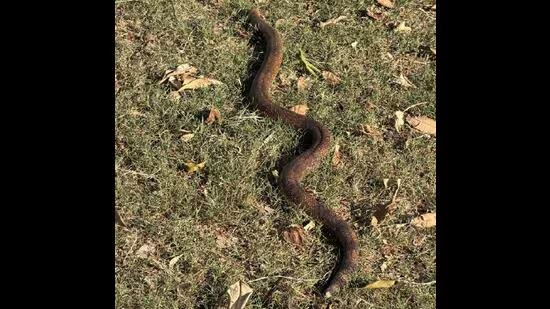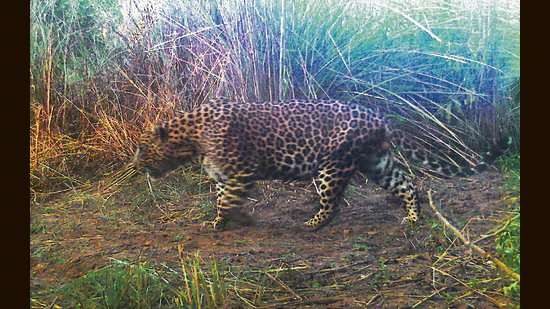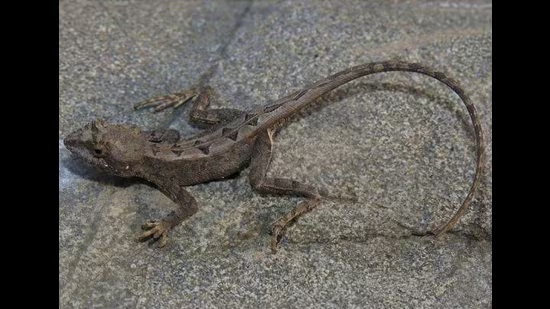
There are many unknown jewels studded in the crown of Chandigarh’s biodiversity and vast green areas. These are species which are smaller, secretive and not as “handsome” as leopards or as charismatic and eye-catching as birds such as hornbills and pittas.A fan-throated lizard in Chandigarh. (WII-CAP CELL 2025)One of these unknowns, a fan-throated lizard of the Sitana genus, was discovered by scientists of the Wildlife Institute of India (WII), Dehradun. It constitutes a new biodiversity record for UT of Chandigarh and features in the WII report submitted to the forest and wildlife department, titled, ‘Status of Wildlife in Sukhna Wildlife Sanctuary and Other Forested Areas, Chandigarh, UT’.The Sitana genus belongs to the Agamidae family and is endemic to South Asia. Male Sitana lizards possess expandable throat fans for display during breeding and for territorial assertion. The fans turn partially blue on excitement and can possess other dazzling colours depending upon the species, including hues of blue, black, red and orange.Another feature is the lack of a fifth toe on the hind feet. Their hind feet have undergone a unique evolutionary trait where they have completely lost the fifth digit. But Sitanas can raise their front legs and run on their two elongated hind legs (bipedalling) to escape danger or when moving at high speeds. Apes, bears and certain rodents also display bipedalling while kangaroos frequently resort to bipedal hopping.According to the WII report, one specimen of the Sitana genus was recorded during the survey conducted in November 2025 in collaboration with the department and members of civil society. “The lizard seems to be a cryptic species, possibly from the species complexes of North India and Nepal...Presence of the lizard possibly indicates an untapped diversity of cryptic and unreported species, warranting administration of genetic tools (i.e., molecular/DNA analysis, etc., to ascertain the specific species of a cryptic specimen from the maze of allied and very similar species),” the report stated.The lizard discovery points the way for targeted seasonal surveys in the future under the aegis of the department to take advantage of periods when the taxa under study are more active and visible, such as reptiles and amphibians just after the monsoons, and birds in early spring when altitudinal and transcontinental migration is underway.The spectre of RudraprayagArt articulates for itself, it stands alone and aloof, it needs no words as envoys, and pierces to the soul in a creative, offbeat way. It has been a powerful medium of communication and visualisation of inner thoughts since the cave art of prehistoric origins.Kolkata-based wildlife artist Ayan Banerjee recently fashioned an ingenious, mixed-medium sculpture reinventing the story of the Rudraprayag man-eater leopard that killed 125 humans before it was dispatched by Jim Corbett a century back on May 2, 1926. Using terracotta to fashion the Rudraprayag man-eater, Banerjee mounted the killer, like a regent, on a throne of 125 skulls made from synthetic clay. Like a Maharaja posing with a huge tiger and leopard shikar!Banerjee is a gifted artist who initiated his sculpting career early. As a toddler, his mother would give him an ‘atta’ ball to fashion lizards and other creatures to make him sit still and curb the wanderings of her restless, curious child! The man-eater sculpture seizes eye and imagination, and riddles the mind with diverse interpretations. It bridges time and assumes contemporary relevance. What is history but an infinite jest of time?Leopards have killed many humans in Uttarakhand, Himachal, Jammu and Kashmir and Maharashtra. Public anger is rising and seeks intemperate retribution. A lobby of vote banks, people groups and professional hunters (who seek trophies in the noble guise of shooting rogues) will prevail. Man-eaters and innocent leopards, will be dispatched or imprisoned with no doubt entertained.Banerjee’s artwork serves as a warning to policymakers: resolve the festering conflict. Lest we forget, the lessons of those supposedly distant times when leopards had earned notoriety for piles of human kills and their hunters became legends.vjswild2@gmail.com
Wildbuzz | New lizzie species for Chandigarh
The Sitana genus belongs to the Agamidae family and is endemic to South Asia; male Sitana lizards possess expandable throat fans for display during breeding and for territorial assertion
653 words~3 min read