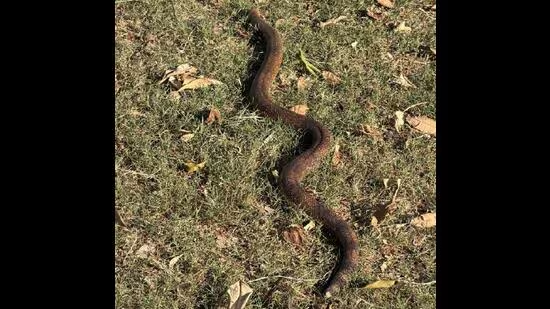
A weekend round at the Chandigarh Golf Club (CGC) can blossom into a naturalist’s delight. It was in this manner that the region secured its first record of the rare species, the mottled wood owl, in May 2018 when a golfer stumbled upon its chick on the ground in the groves bisecting the 2nd and 16th holes.A Sistan sand boa at the Chandigarh Golf Club . (CHIEF JUSTICE GS SANDHAWALIA)Similarly, last weekend, the fourball of Himachal Pradesh High Court’s Chief Justice Gurmeet Singh ‘Sunny’ Sandhawalia came across a thickish serpent making its way between the groves linking the 4th and 15th holes. A red-wattled lapwing broke out in alarm calls as the serpent’s desperation to avoid attention became evident.The golfers, used to wandering rat snakes, speculated it to be one though its lumbering gait was not characteristic of the swift species. The golfers’ other concern: could it be a venomous viper?However, upon examination of the mystery serpent’s photograph, experts broke out in elation. It was a non-venomous, rodent shikari, the Sistan sand boa (eryx sistanensis). It has been identified as a species existing in India only very recently, according to a research paper by Vivek R Sharma and Dharmendra Khandal published in ‘The Journal of Threatened Taxa’ (May 26, 2026). So, the CGC specimen constitutes the first record of the Sistan sand boa from the Chandigarh region.Hitherto, in India, it had been confused with the red sand boa (eryx johnii). So, till the research paper’s advent, the Sistan was recognised as limited to the desert regions of Iran and Pakistan. It derives its name from Sistan (Iran) from where it was first described as a species by N Eskandarzadeh and other scientists in 2020.Blood & passion flow togetherThe male-on-male murder over females is intrinsic to the natural world as it is to humanity. The contemporary case of the ‘tiff on the cliff’, which resulted in the alleged killing of Ketan Aggarwal by his fiancee Siya Goel, and her lover Chetan Chaudhary, is the proverbial ‘old whine in a new bottle’. According to the Pune rural police, Siya had earlier tried to push Ketan over the cliff but failed. When confronted by Ketan, the ‘evil Eve’ claimed that she was trying to save him from a traditional villain, the serpent! Then came Chaudhary to deliver the push to the pyre.This timeless theme was bloodily and yet aesthetically portrayed by Gian Singh Naqqash (1883-1953) through his artistic musings in the creation of ‘Elephant Fight’ (August 1950). Reproduced in the 1956 volume, ‘Gian Chitravali’, the artwork’s allegory is interpreted in the volume thus: “The peculiar feminine character relishing the fight between two rivals is finely portrayed. Each one of the opponents — in an effort to win over the she-elephant — is trying to inflict fatal blows on the other, whereas she is smiling at their folly. Since, as is clear from what has already happened to the males, neither may survive to have the darling of his desires.”The scene of the mutually assured destruction (MAD fight) is watched over by the female elephant from a distance sporting a mien of sadistic mirth. Gloomy bats swirl around. The act of breaking a branch of a tree overhead by one of the battling males violently disturbs the perch of legendary lovers, rose-ringed parakeets, revered in mythology as the ‘vahan’ (carrier) of Lord Kamadeva, the God of Love.Reddish, globular fruits of the crippled tree seem to evoke the apple as the sinful, forbidden fruit of biblical allusion in this doomed arena of passion.vjswild2@gmail.com
Wildbuzz | Wild discoveries at golf club
A golfer at Chandigarh Golf Club discovered a rare Sistan sand boa, marking its first record in the region, previously confused with other species.
588 words~3 min read