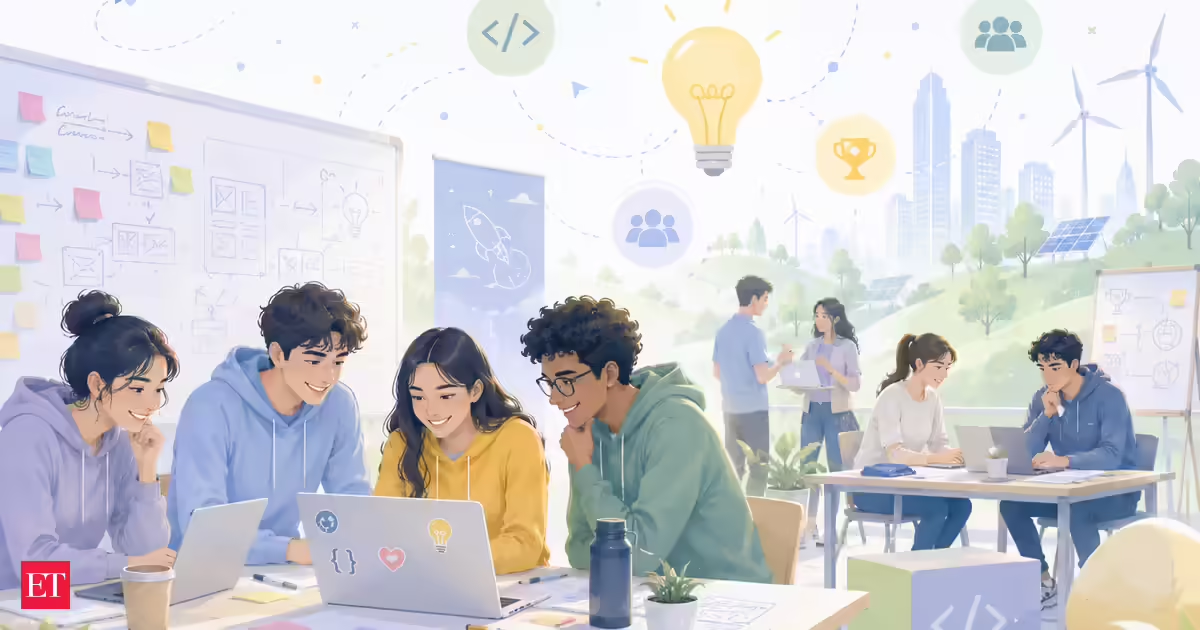
In hackathons, teamwork is not optional but essential.
| Photo Credit: Getty Images/iStockphoto
In a traditional classroom, learning is spread across semesters and years, focusing on in-depth understanding and critical analysis of key concepts. Hackathons, on the other hand, compress months of theoretical understanding into a brief and intense time frame that forces participants to prioritise problem-solving, execution, and adaptability.Sense of urgencyStudents who appear comfortable in structured classroom settings are often initially challenged in hackathons but adapt quickly when placed in high-pressure, real-world situations. Instead of passively absorbing information, they are required to apply their knowledge immediately. This creates a sense of urgency that sharpens focus and accelerates learning in ways classrooms rarely achieve. More importantly, hackathons help foster a culture of innovation among the students.One of the most significant limitations of classroom education is its reliance on memorisation and theoretical assessments. Hackathons flip this model. Participants learn by building, whether coding an application, designing a prototype, or solving a real-world problem. This approach leads to deeper understanding because concepts are experienced, not just studied. Struggling through a bug late at night or pivoting midway through a solution creates insights no textbook can replicate. From repeated mentoring experience, students who participate in hackathons demonstrate stronger conceptual clarity when revisiting similar topics in class.Hackathons are centred on real-world challenges, from healthcare to sustainability and finance. Unlike classroom assignments that may feel abstract, hackathon problems demand practical and scalable solutions. Participants must consider usability, feasibility, and impact within a limited time. This exposure to constraints builds decision-making skills essential in professional environments. Hackathons also simulate real-world work environments more closely than classrooms. Participants use industry tools, work under deadlines, and present solutions to expert evaluators. This bridges the gap between academic learning and professional expectations.Building collaborationGroup projects in classrooms can feel uneven in participation. In hackathons, teamwork is not optional but essential. Participants collaborate with diverse individuals, often strangers, combining different skills and perspectives. Time pressure fosters clear communication, rapid conflict resolution, and effective delegation. Over multiple hackathon cycles, a clear shift is visible: students who initially struggle with coordination develop genuine collaborative instincts, rarely achieved through conventional assignments.In academic environments, failure is often penalised, encouraging caution. Hackathons encourage the opposite mindset. Many teams do not complete their projects, and many ideas fail, but each failure offers valuable learning. Participants learn to iterate quickly, accept feedback, and move forward. From a mentor’s perspective, some of the most meaningful growth occurs in teams that do not win but reflect and improve. This ability to treat failure as feedback is critical in innovation-driven fields but largely absent in traditional systems.Classrooms often rely on grades as motivation, which can lead to surface-level learning. Hackathons are driven by curiosity and the desire to create. Participants choose problems they care about and work on ideas they find meaningful. This intrinsic motivation leads to deeper engagement. Many students voluntarily return to hackathons not for grades, but for the experience. This is rarely seen with traditional assignments.Not a substituteHackathons are not a substitute for formal education. Classrooms provide foundational knowledge and structure that remain essential. However, combining theoretical depth with applied time-bound learning can create a more balanced educational experience. The comparison between 48 hours and four years is not just about time; it’s about effectiveness. Hackathons condense learning into a dynamic, immersive experience that emphasises action, collaboration, and real-world relevance. In doing so, they reveal an important truth: sometimes, the most meaningful learning doesn’t happen over years of study, but in a few intense, unforgettable days.The writer is Professor of Computer Science and Engineering, JK Lakshmipat University, Jaipur. Published - July 11, 2026 03:30 pm IST