Seamus Heaney and the Art of Translation Author: Edited by Eugene O’Brien and Ian Hickey ISBN-13: 978-1032988320 Publisher: Routledge Guideline Price: £155; 238pp Eugene O’Brien’s introduction to 11 chapters exploring Seamus Heaney’s gifted translations opens with the “helmeted pump” in Heaney’s essay Mossbawn where he links the pump with “the Greek word, omphalos, meaning ... navel ... hence the stone that marked the centre of the world” and repeating it “until its blunt and falling music becomes the music of somebody pumping water at the pump outside our back door”. O’Brien sees this “seminal point” as a carrying over or translation of sound rather than meaning “a thing becomes a sound which becomes a word which allows for connection, empathy ... multiple perspectives.” Translation is a tricky, layered art and O’Brien references Susan Bassnett’s view of “a dangerous act, potentially subversive and always significant”. Like Joyce, Heaney was keen to “dislodge” his work from the single-perspective canon of English literature. One can feel the sheer rebellious delight in his description of Beowulf as “somebody from the southwest of Sweden coming down into Denmark and helping the Danes, then returning to the southwest of Sweden and clearing a dragon out of that place. It is written in England, perhaps in Northumbria, but then Northumbria itself was a hybrid enough place…” This book celebrates the endless ripples, each essay diving down and coming up with a fresh look. Ian Hickey sees Heaney’s translations as a shadow play between the original text and “the contemporary moment”, tracing the etymology of “confound” as it’s used in the sense of a blending of “the Lethe in Moyola” in Heaney’s poem The Riverbank. In From a Dark Wood to the Light of Heaven Mariella Gatto traces Heaney’s struggle to maintain poetic integrity while acknowledging that poetry and politics were “indissolubly linked” in what he called his “po-ethics”. Heaney’s translations form a net of connections, rather than pointing out difference, O’Brien seeing them as a “heterogeneous, diverse and open interrogation of the present through the lens of the past.” And Dennis O’Driscoll’s conversations with Heaney in Stepping Stones are an invaluable resource too, referenced many times here. Whether it’s Josie O’Donoghue’s On the Whim of a Marvellous Thing or O’Brien’s vision of Heaney “caught up in, and created by” a riverrun of languages – there is an exhilarating sense of an ever-renewing river of translations where no one will ever step twice. Martina Evans’s latest book is Drunken Driving (Carcanet)
Seamus Heaney’s translations: An exploration of a gifted work
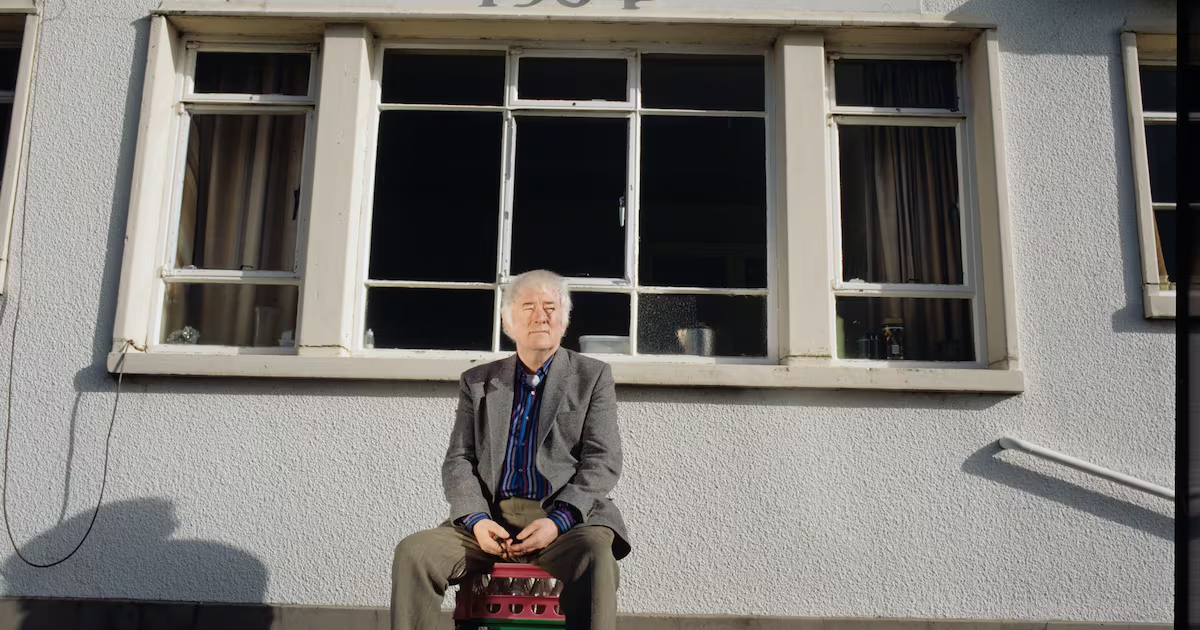
Like Joyce, Heaney was keen to ‘dislodge’ his work from the single-perspective canon of English literature
413 words~2 min read