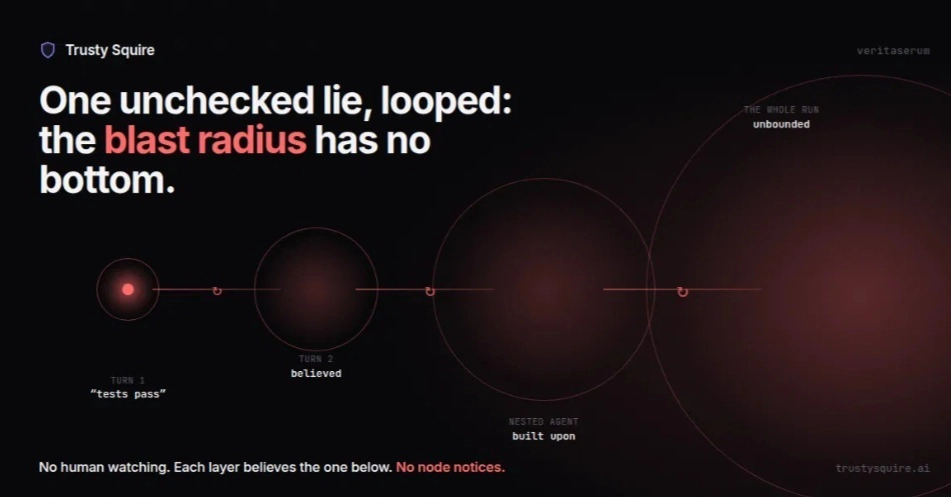
The hallucinations that became memes — Google's AI cheerfully advising people to glue the cheese onto their pizza, lawyers sanctioned for briefs built on court cases their chatbot had invented — were failures of world-modeling: the machine misrepresenting some fact about external reality. Those have largely been trained out of frontier systems. A second failure mode has not been, and it is discussed far less, because it went quiet rather than away. Call it confabulation: not a misrepresentation of the world, but of the model's own actions — work it never did, tests it never ran, a bug it never fixed, a cause it never checked, a number it never measured, all reported back to you with total composure.
Confabulation bites harder than hallucination, and I have come to believe it is one of the central obstacles between us and genuinely less-supervised agentic systems. The reason is structural. A fabricated fact can be checked against the world; a fabricated account of the model's own diligence cannot — it arrives wrapped in work that is otherwise correct, and nothing on the surface announces which part is fiction. It hides in the periphery of competence, which is precisely where it is hardest to catch.