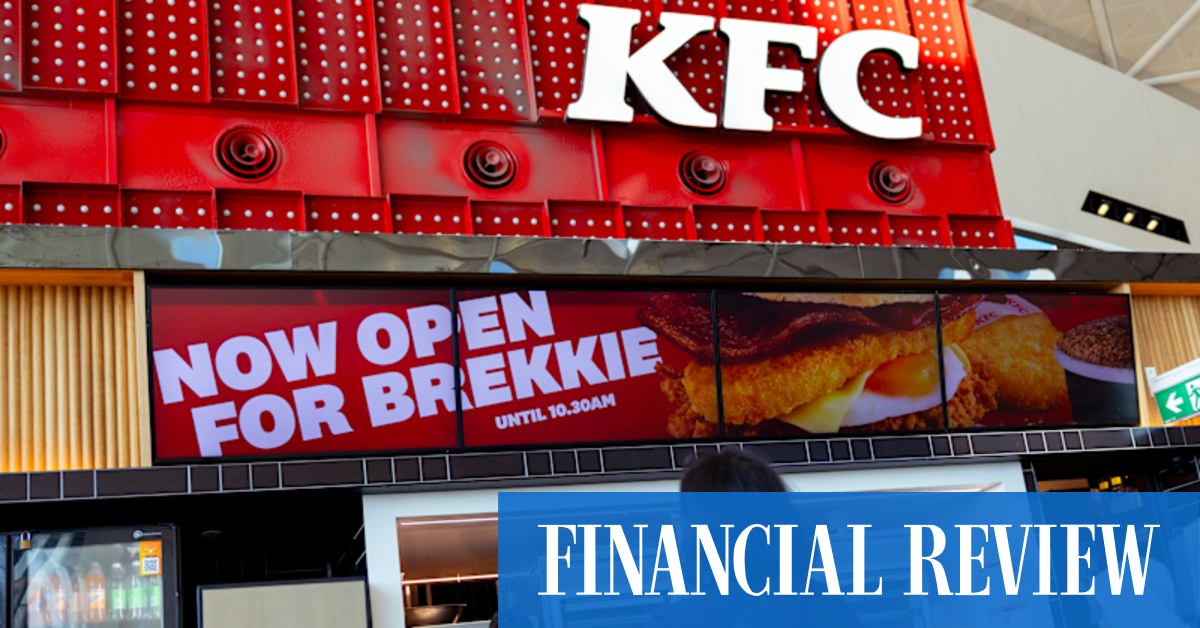
KFC is taking a massive gamble as it starts selling breakfast and stays open longer in a bid to win over Gen Z and night owls — a move a leading brand expert thinks is a risky one that could cause franchisees major headaches.The fast food industry in Australia is facing challenges like many others amid a cost of living crisis and rising inflation, and major brands are trying to stay ahead of the curve by mixing up their menus and opening hours.This week, Zeus Greek Street revealed it has taken a huge cash injection — potentially up to $60 million — from a private equity firm to expand as Aussies are pushed towards cheaper dining options and expanding food delivery platforms.MORE: Revealed: How much a KFC store really makesHowever, KFC is possibly shaking things up the most as it looks to cash in on changing fast food habits.The KFC brand globally — including the intellectual property, recipes, and master marketing— is owned by the US retail giant Yum! Brands, which also owns Pizza Hut.However, Collins Foods is the largest KFC franchisee in Australia. They operate nearly 300 KFC restaurants across the country, which means roughly one in every three KFCs you walk into in Australia is run by them.Collins revealed it will build on the success from menu innovations like the Zinger Banh Mi, Zinger Nachos and a highly popular “liquid gold” sauce that gave a boost to KFC’s sales momentum in Australia last year — a year in which many competitors struggled amid the cost of living crisis.One brand that saw success was Guzman y Gomez thanks to its menu innovations led by the Brekkie Burrito, which has become a staple among tradies and shift workers.Now KFC wants a slice of the action. Collins Foods believes the breakfast market accounts for 27 per cent of total spend on fast food and KFC needs to keep up with the trend.While older Aussies are facing mortgage pressures, Gen Z is the dominant force in the nightlife and late-night dining economy and accounts for 56 per cent of shift workers who are gobbling up items like GyG’s brekky wraps.KFC confirmed to news.com.au it will trial a new breakfast menu, expand its opening hours to include mornings at Sydney Airport and introduce KWENCH, KFC’s answer to a coffee break or afternoon sweet treat. It will soon pilot its breakfast menu in 16 stores on the Gold Coast.KFC South Pacific’s chief marketing officer Vanessa Rowed said the brand’s “leadership” in the fast food space is “built on us pioneering the category in Australia 58 years ago”. “As the category becomes increasingly crowded, we’re leaning into what has always set us apart: the most craveable fried chicken,” she said.“Our next chapter is about staying true to that entrepreneurial spirit and continuing to reinvent for the next generation of customers.“We’re making KFC more accessible than ever, catering to ever-evolving consumer preferences and habits. We’re also continuing to focus on menu innovation with exciting concepts that give customers new ways to enjoy KFC.”Expert’s concerns about KFC breakfasts Despite KFC’s optimism, a leading brand expert has warned it may hit some speed bumps.Gary Mortimer, a professor in marketing and consumer behaviour at the QUT Business School, said the expansion of KFC into the breakfast market may be difficult because it might not make sense to the consumer.He explained that this is due to a concept called “brand congruency” that refers to the psychological alignment between a brand’s core identity and a new product, service, or market they are trying to enter.“We talk about brand congruency because we know what KFC stands for,” he told news.com.au. “It’s dinner boxes, lunch boxes, and a poultry offer. We think about Zinger burgers and fries. Breakfast tends to be somewhat incongruent with that brand. We don’t traditionally think about having chicken for breakfast.“The breakfast market is already strongly dominated, not just by successful corporate offers like McDonald’s, but also independent cafes that will do a bacon and egg roll and a coffee for 10 bucks. It’s a tough market to crack anyway, considering the incumbent players already offering a strong breakfast product.“Then there’s the challenge of consumer psychology. How do you convince a core KFC consumer, who loves a Zinger burger with cheese, to also consider the brand for breakfast? It’s a significant challenge, and I think franchisees will struggle to capture that market.”He said he would be “concerned” if he was a KFC franchisee.“If I was a KFC franchisee and I’m being told that’s a market I need to chase, I would be a little bit concerned,” he said. “It’s going to cost me extra hours in wages, extra capital to buy potentially muffins and a new range of products, and require retraining staff to cook a breakfast menu. “Possibly, I’ll have to get a coffee machine and have a barista working for me as well. Beyond the capital concerns, there are human resource challenges in securing that staff.“If the business has a very clear value proposition and a good strategy on how they’re going to convince consumers to shift away from a current behaviour — moving from ‘I’ll stop at Maccas or GYG’ to coming to us — then it’s possible. What is the comprehensive value proposition? Will it be a lower-priced product, or a high-protein product? I’m sure they would have thought that through before launching.”KFC facing challengesKFC’s big move in Australia comes as it faces headwinds overseas. Its growth strategy in Europe has hit a snag with sales in the last eight weeks at its 80 stores across the Netherlands and Germany hit by the heatwave, rising fuel prices and the consumer downturn – as well as some anti-American sentiment – caused by the Iran war.Despite this, the latest release on the ASX shows Collins hit record group sales of $1.59 billion for the 12 months to May 3, up 8.6 per cent from last year. Net profit was up nearly 281 per cent to $47.1 million. Annual underlying earnings rose 6.3 per cent to $244.5 million, which is also a record.In an interview with The Australian, Collins chief executive Xavier Simonet said he was excited about KFC’s new plans.“That is exciting for us and it is on the back of an airport trial. Breakfast is a very significant part of the day in Australia … and we have been very focused on our core chicken products and there is now an opportunity to bridge the gap between KFC and other quick service brands around the world, but particularly in Australia.”Collins Foods has also extended its KFC closing times to midnight, “because that is what Gen Z, younger customers want,” Mr Simonet said. “A lot of business is done between 10 and 12 and we were closed.”‘Fake-away’ trend, entire fast food industry under pressure It’s not just KFC feeling the change in spending habits, as fast food giants look to lure cash-strapped Aussies away from cheaper food options.“If you are operating a business in that discretionary spending category — and fast food certainly sits within that — you would find it is somewhat challenged at the moment,” Prof Mortimer said.“What we’re seeing now is the growth of ‘fake-away’. Grill’d launched their burgers into supermarkets about six months ago, and Zeus has had a play in that space also. When you walk into Coles, Woolworths, or Aldi today, you see take-home options like Chinese duck rolls. The whole kit is there for you to take home, make it yourself, and have a fast-food experience at home.“Fast-food brands are not isolated from the cost-of-living crisis. What consumers are doing is saying, ‘I might forgo takeaway for the kids tonight because if I go to a burger joint it’s going to cost me $50, but I might just get a couple of pizzas and hit a value option for $25.’ Consumers are looking for a cheaper option.”He said independent cafes still have a unique selling point despite shrinking spending power among Aussies.“Cafes still have the benefit of habituation; we habitually love to grab a coffee on the way into town in the mornings or catch up for work. People are still buying coffee, but they may not be buying it as frequently because they’re not coming into the office all the time. There is a clear work-from-home impact on cafes,” he said. “We can see that impact reflected in the growth of home coffee machines. Almost every household I know, including my own, now has a relatively decent espresso coffee machine at home.”He said the economic woes of everyday Aussies had not deterred international fast food brands from trying to enter the Australian market.“We’re certainly still seeing international interest in the marketplace. Up in Brisbane, we’ve had Bubba Shrimp open at Sandgate, and Firehouse Subs opened a branch down on the Gold Coast,” he said. “Wendy’s has just opened a store in Melbourne and has stores slated for Queensland, including one at Rothwell. They have aggressive plans for the marketplace, which suggests they see it as viable.“However, it’s very important for any incumbent fast-food chain or new entrant to be very clear about what their point of difference is. I think that’s a mistake that some have made. I think about [Carl’s Jr] entering the marketplace and going into voluntary administration because we already have sufficient hamburger fast-food offers in Australia currently.“Wendy’s had very ambitious plans to open 200 stores by 2030, but to date, they’ve only opened three stores. This suggests they’re probably not going to hit that 200-store target. So while we’re still seeing interest in the market, it’s not without its challenges.”
‘I’d be concerned’: KFC takes a monumental gamble as it targets Gen Z and breakfast diners
KFC is taking a massive gamble as it starts selling breakfast and stays open longer in a bid to win over Gen Z and night owls — a move a leading brand expert thinks is a risky one that could cause franchisees major headaches.
1,605 words~7 min read