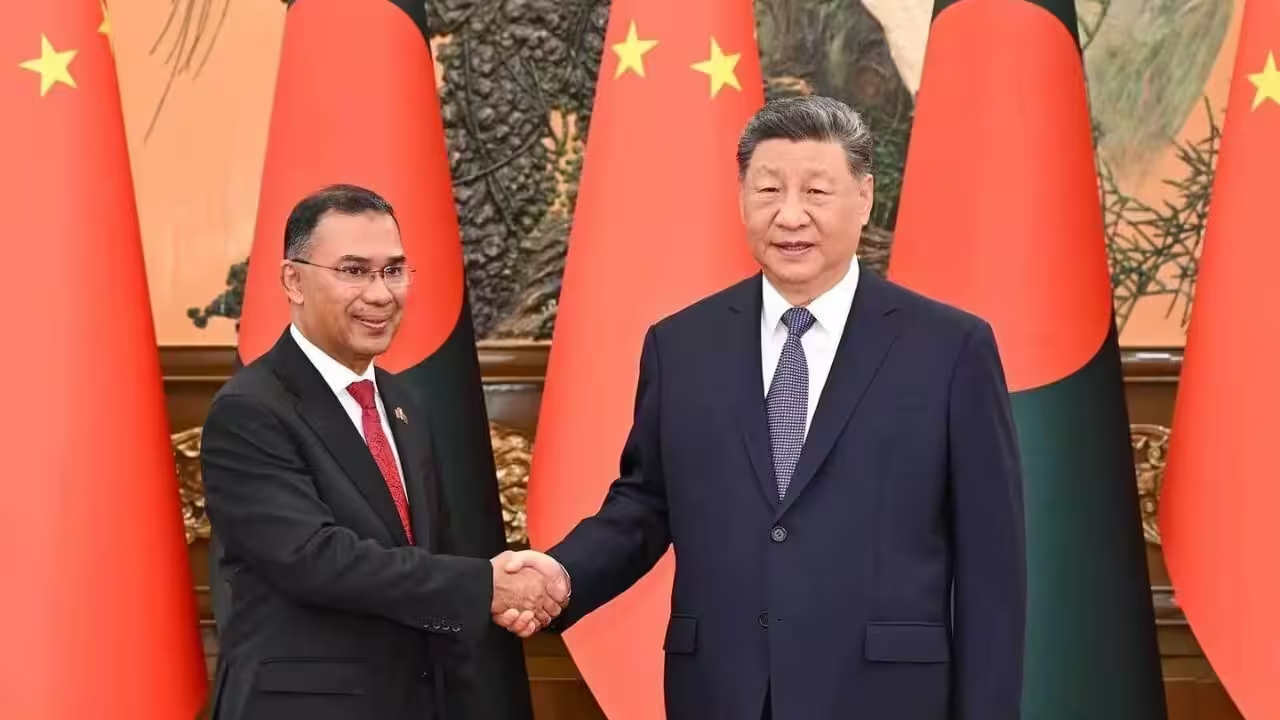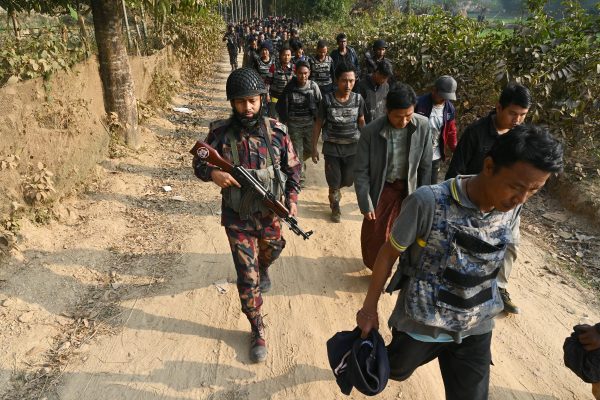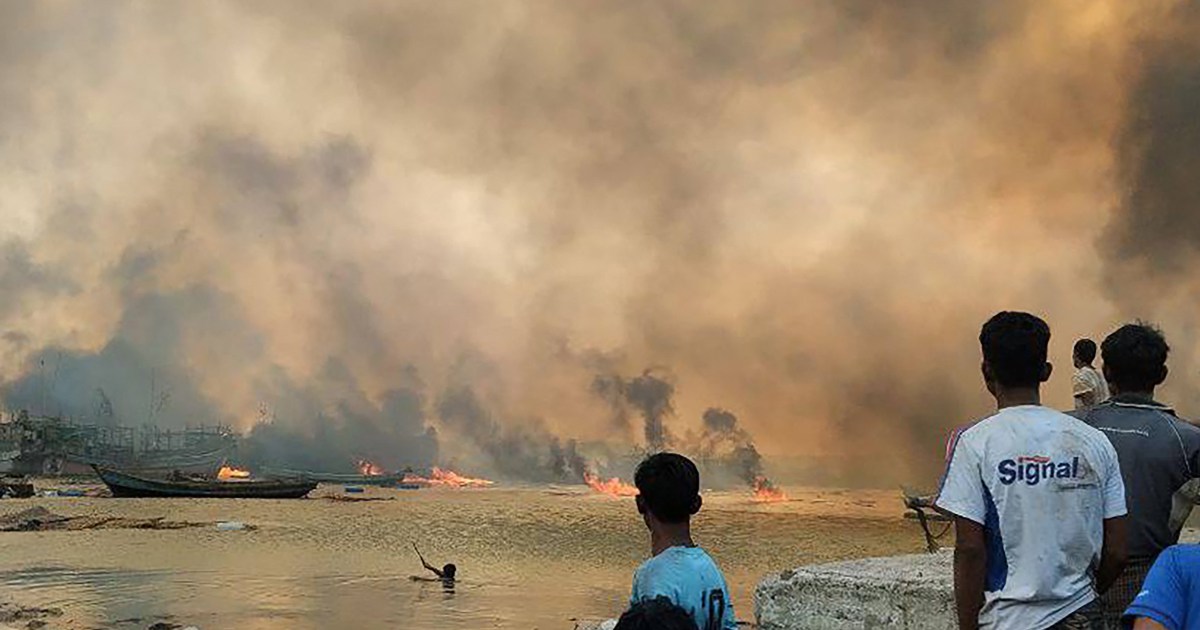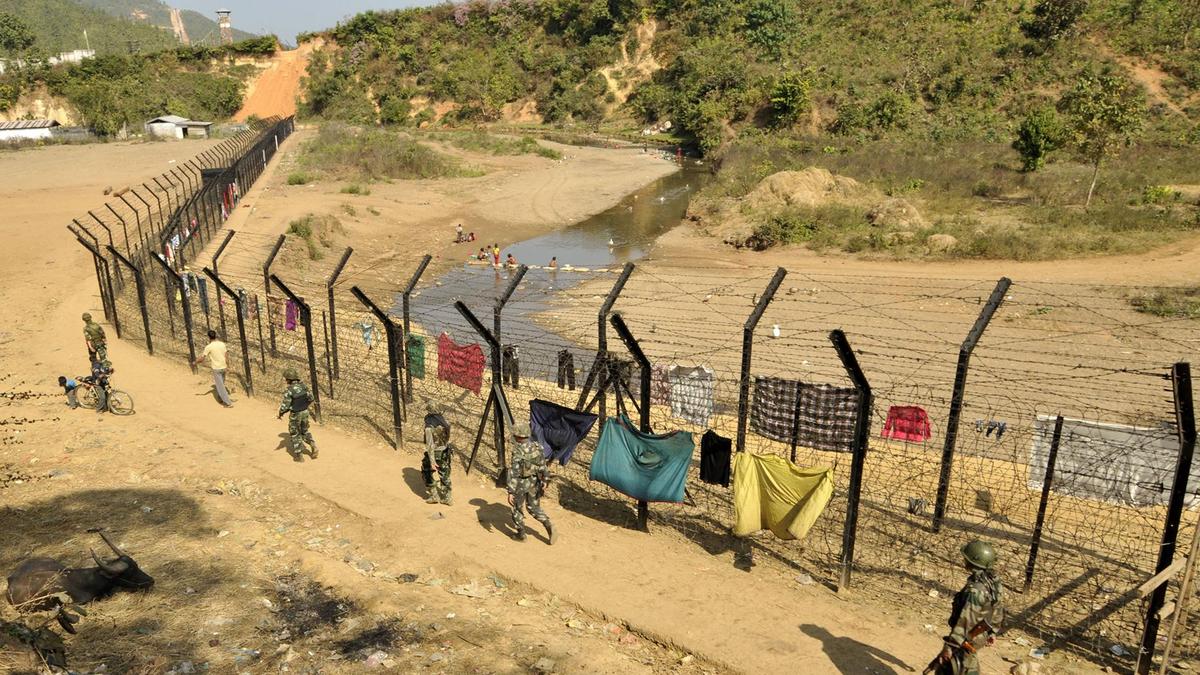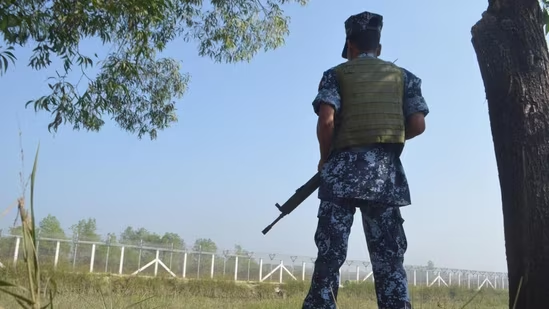
The past few days witnessed a fresh wave of strikes by the Myanmar military in Rakhine State to retake control of areas under control of the Arakan Army (AA). The districts under direct attack are Maungdaw and Buthidaung, and Rathedaung, which directly sit on the border with Bangladesh separated by a small stretch of the Naf River. This raised concerns over the fresh influx of Rohingyas to Bangladesh. What is ironic is that while the region is grappling with conflict, China's foreign minister Wang Yi concluded his Naypyidaw visit and signed a fresh set of agreements on accelerating the China-Myanmar Economic Corridor. And during the recent visit by Bangladesh Prime Minister (PM) Tarique Rahman to Beijing, the two sides discussed the prospects of Bangladesh-China-Myanmar Economic Corridor (BCMEC) linking Yunnan Province to Chittagong and Mongla ports via Myanmar. A Myanmar border policeman stands near the Taungpyo Bangladesh-Myanmar border gate on the outskirts of Maungdaw in Rakhine state. (AFP)These events are not coincidental but indicate the shifting strategic realities in one of Asia's most consequential geographic regions. The Bangladesh-Myanmar borderland is strategically located in the Bay of Bengal at the junction of South Asia and Southeast Asia. The borderland is no longer just a humanitarian emergency. Within this compact space, several structural realities intersect- a domestic civil war in Myanmar, especially heightened tensions in the Rakhine State, a refugee crisis that has pushed millions of Rohingya in Bangladesh, an assertive China with its economic weight and corridor diplomacy, and India’s connectivity and security concerns. Bangladesh and Myanmar share a relatively small but significant and complex border of 271 kilometres. Relations between the two countries have been periodically overwhelmed by the burden of the Rohingya crisis. The first major refugee influx came in 1978, when approximately 200,000 Rohingya fled military operations in Rakhine. A repatriation agreement was signed, but it was never implemented. The pattern continued at periodic intervals and reached its peak in 2017, when Myanmar military's brutal clearance operations in Rakhine drove over 700,000 Rohingya into Bangladesh. And Cox's Bazar became home to the world's largest refugee settlement.Following the 2021 military takeover in Myanmar, the State Administration Council showed no meaningful commitment to create conditions for Rohingya return. Additionally, the ongoing civil war, particularly after Operation 1027, shattered whatever security existed in the border zones. Even the Arakan’s have been implicated by HRW in abuses against Rohingya Muslims, adding a further layer of resistance to Dhaka's repatriation calculus. The result that Bangladesh-Myanmar relationship is driven by border incidents, refugee flows, and the periodic diplomacy of necessity rather than any positive bilateral engagements. As of early July 2026, people from Teknaf, the southernmost point of Cox's Bazar district, separated from Maungdaw Township by the narrow Naf River, reported a resurgence in attacks by the Myanmar military to regain controls. The military has also deployed naval forces off the Ramree coast, with at least 30 warships from Hainggyi Island. Having captured 14 of 17 townships, the AA has yet not captured, Kyaukphyu, Sittwe and Manaung Island. While Manaung is an isolated island, it is not clear why AA had not captured the other two townships in these months. Though recently AA stated its intention to bring all remaining townships under its control by end-2027. And therefore, for Bangladesh, the immediate consequence might be another major Rohingya influx. Bangladesh's foreign ministry stated it was closely monitoring the situation, and the Border Guard Bangladesh has reinforced patrols at vulnerable crossing points. On June 26, Xi Jinping and Tarique Rahman, proposed an economic corridor linking Yunnan Province to Chittagong and Mongla ports via Myanmar, an extension of the existing China-Myanmar Economic Corridor. While the foreign minister Khalilur Rahman has explicitly put a condition any overland connectivity through Myanmar must first ensure 'the restoration of peace and stability in Rakhine State’, which in current scenario seems impossible at least in near future. The Kyaukphyu deep-sea port, essential to the corridor's western anchor, remains at siege conditions. The Muse-Mandalay railway remains mired in financing disputes and security disruptions. But it is important to look at what is the long-term ambition of this corridor. For Bangladesh, it offers the prospect of positioning Chittagong and Mongla as regional transit hubs. And for China, it is far beyond economic reason. Having gained access to Arabian Sea via China-Pakistan Economic Corridor, this proposed corridor would reduce the dependence on the Malacca Strait and create a shorter overland route to the Bay of Bengal. It must also be noted that the BCMEC is not a new idea, it is a revival of the Bangladesh-China-India-Myanmar (BCIM) Corridor, originally conceived in 1999, from which India withdrew over strategic concerns. And even though China says it is open for other countries to join, there certainly are reservations on the Indian side. What is also interesting is that China said that corridor could eventually help facilitate the repatriation of Rohingya refugees, which may not be acceptable to the Myanmar side. For India, the Bangladesh-Myanmar border crisis represents three-fold challenge. First is the connectivity deficit. As China advances its infrastructure diplomacy with Bangladesh, the Anwara Chinese Economic and Industrial Zone in Chattogram, the Teesta River management proposal, the cooperation over Mongla Port, India's own projects in Bangladesh and Myanmar have stalled. The strategic cost of this delay is far greater. For instance, Kaladan Multi-Modal Transit Transport Project which ends at Sittwe port, is now under active siege by the AA. The Trilateral Highway passes through areas of Rakhine and Chin States that are either under AA control or in active conflict. Second is the security concerns in the Northeast. The bordering states of Myanmar are under active conflict with the military, with EAOs controlling most of the areas across Sagaing, Chin, and Rakhine States. This has encouraged Indian insurgent groups to take advantage of the security vacuum. Additionally, these conflict-driven borders have created pathways for smuggling of arms and narcotics, as well as illegal movement of people. Finally, there are renewed tensions in few northeast states, though not a result of Myanmar conflict, but certainly fuelled by it. Third challenge is China’s assertive encirclement of Indian Ocean. The BCMEC proposal, if it progresses even partially, would place Chinese-managed logistics and port infrastructure at both ends of the Bangladesh-Myanmar coastline, Kyaukphyu and Chittagong/Mongla. And it is well-known how China could potentially use this commercial infrastructure for dual-use maritime presence along the Bay of Bengal.For India, the message is clear and uncomfortable. Completing the Kaladan project and reopening the Sittwe corridor must be treated as a strategic priority and thereby engaging with the AA is now a political necessity. It is also essential to deepen ties with Bangladesh's new government. Most importantly, India must engage this region as the unified strategic problem, as a combined maritime-terrestrial-connectivity challenge in which Myanmar's civil war, Bangladesh's realignments, China's geopolitical ambitions, and India's northeastern security concerns are all dimensions of the same problem. While Bangladesh has stated that they are currently 'examining it'; it is important to reiterate that Bangladesh's long-term interests are more structurally aligned with India. Water, energy, climate adaptation, trade and people-to-people connectivity, all of these run through the India-Bangladesh relationship. Additionally, examples from the neighbourhood are evidence of how Chinese infrastructure projects creates strategic dependence and economic debt for the countries. Therefore, India needs to proactively engage with the regional stakeholders to secure long-term economic and security interests. (The views expressed are personal)This article is authored by Cchavi Vasisht, associate fellow, Chintan Research Foundation, New Delhi.
Bangladesh-Myanmar border, China’s gambit and India's compounding challenge
This article is authored by Cchavi Vasisht, associate fellow, Chintan Research Foundation, New Delhi.
1,246 words~6 min read