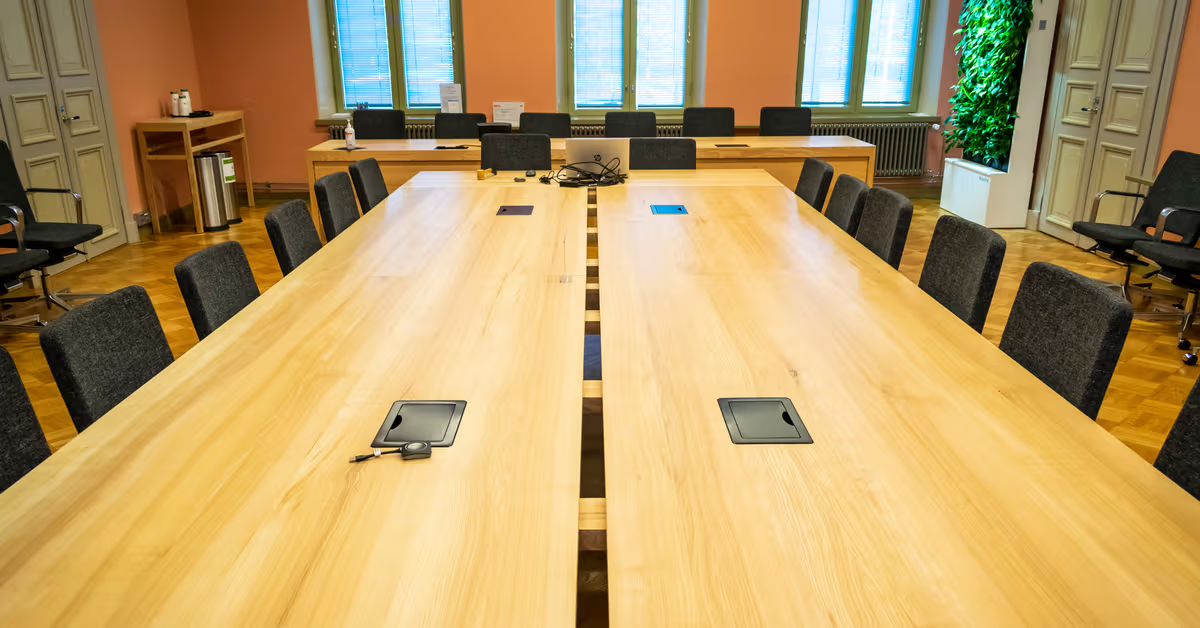
Women have accounted for close to half of all new boardroom appointments this year, but small companies are still lagging behind.More women than ever are involved in decision-making in Finland's corporate boardrooms (file photo). Image: Petri Aaltonen / YleYle News7:18The proportion of women on the boards of Finnish listed companies has risen to a record 37 percent this year.Meanwhile the vast majority of publicly listed firms, 84 percent, have an even gender split on their boards, the Finland Chamber of Commerce said on Thursday.In larger listed companies, the proportion of female directors climbed by two percentage points to 42 percent, while at medium-sized enterprises, the share edged up to 38 percent.Smaller listed companies are clearly lagging behind, with women holding less than one third of board seats.In general, though, women accounted for 46 percent of new board appointments.Smaller firms fail to meet June targetAccording to Ville Kajala, a senior advisor at the Finland Chamber of Commerce, this year's figures clearly show the impact of changes in the Corporate Governance Code, which calls for women and men to be equally represented in corporate boardrooms.This goal was to be achieved by the end of June, when the latest version of the guideline took effect.The code, which includes recommendations on good corporate governance, is not legally binding. It is maintained by the Securities Market Association as a supplement to national and EU legislation on listed companies. Any company that doesn’t follow these recommendations must say so – and explain why.Only some companies are subject to legally-binding statutory gender quota rules, so "the clear increase in the proportion of women is an indication of listed companies’ commitment to self-regulation," Kajala said in a statement.Ville Kajala, senior advisor at the Finland Chamber of Commerce Image: KeskuskauppakamariHe notes that less than a third of small listed companies and 10 percent of medium-sized listed companies failed to reach gender equality."However, the composition of a board is always influenced by many other factors than gender. The members' expertise, experience and views must complement each other, and it sometimes takes time to find a suitable candidate," Kajala went on to say.Few women choosing new directorsCompany boards typically have several committees focused on certain areas. Analysis of these shows gender gaps.The highest proportion of women, 46 percent, is found on audit committees, with female executives chairing more than half of audit committees.However, the proportion of women in committees that nominate new board members remains low at just 25 percent."Women are consistently overrepresented on audit committees and underrepresented on nomination committees," Kajala pointed out.In his view, this is partly because female board members are more likely to have experience in support functions such as finance, human resources or legal affairs."Men, on the other hand, more often than women have experience in CEO positions or in business management. However, the development is positive, as the proportion of women has increased in all key committees also during the past year," said Kajala.
Record share of women take seats on Finnish corporate boards
Women have accounted for close to half of all new boardroom appointments this year, but small companies are still lagging behind.
489 words~2 min read