Underpinning much of modern technology, from smartphones to scanning tunneling microscopes to particle colliders, there is Fermi’s Golden Rule.Named for 20th century Italian-American physicist Enrico Fermi (but actually discovered by British physicist Paul Dirac), the rule is a formula that connects what can be measured in an experiment — such as how fast atoms “jump” between energy states — to the microscopic properties of a quantum mechanical system. The formula is taught in every undergraduate quantum physics class.Yet scientists sometimes misapply it. They either misjudge the conditions under which the formula works, or they miss the “window” for its use.A “user manual” for Fermi’s Golden Rule would be a boon to researchers, says Yale physicist Nir Navon — and now he and his lab partners have provided one.
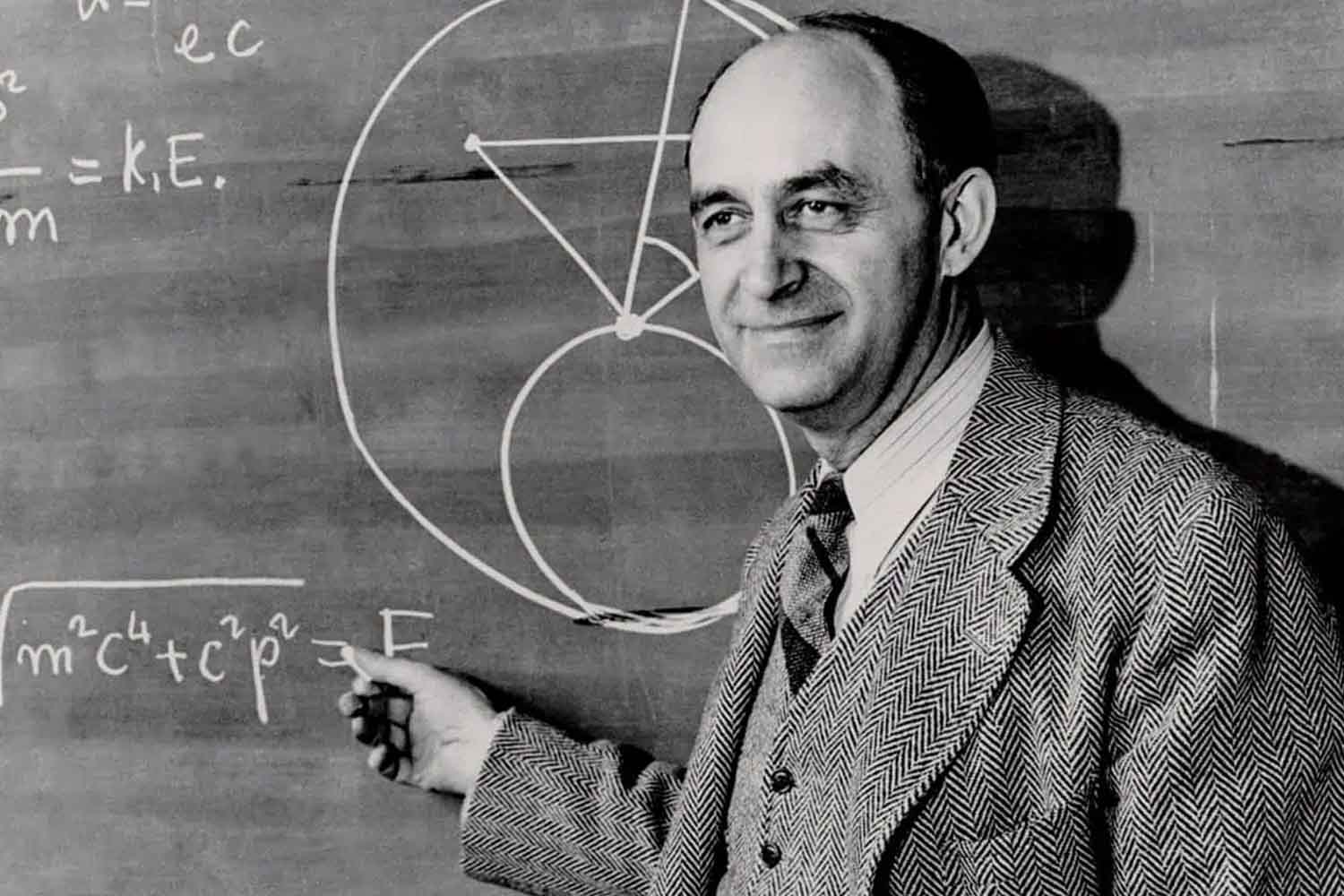
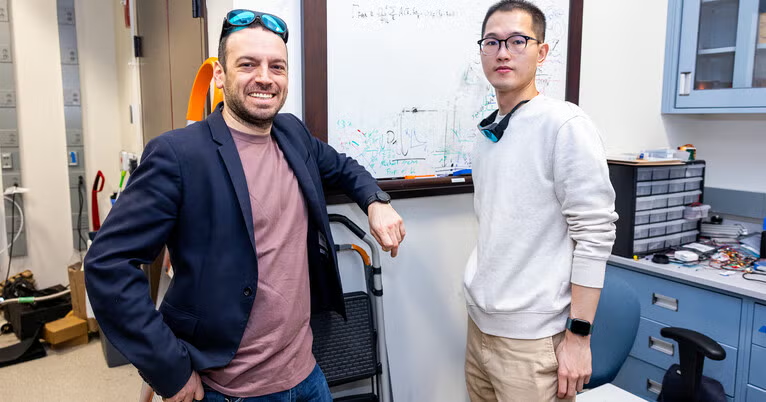
Chen works at a whiteboard at the lab.
Photo by Allie Barton
“We put one of the most famous formulas in all of quantum mechanics to the test, and found where it works and where it fails, including ways that many physicists weren’t fully aware of,” said Navon, an associate professor of physics in Yale’s Faculty of Arts and Sciences and senior author of a new study in the journal Nature Physics. “We’re telling everyone who uses it to take a breath first and check their ingredients.”It was by chance that Navon and his team even came across their blueprint for Fermi’s Golden Rule.As part of earlier research with quasiparticles — emergent quantum objects that many scientists use as proxies to understand interacting quantum systems — Navon and his colleagues used precise radio frequency control to change the spin state of atoms cooled to nanokelvin temperatures, billionths of a degree above absolute zero.Their control over the atoms was so precise they could see exactly when the Golden Rule governing the rate of energy transitions was in play.