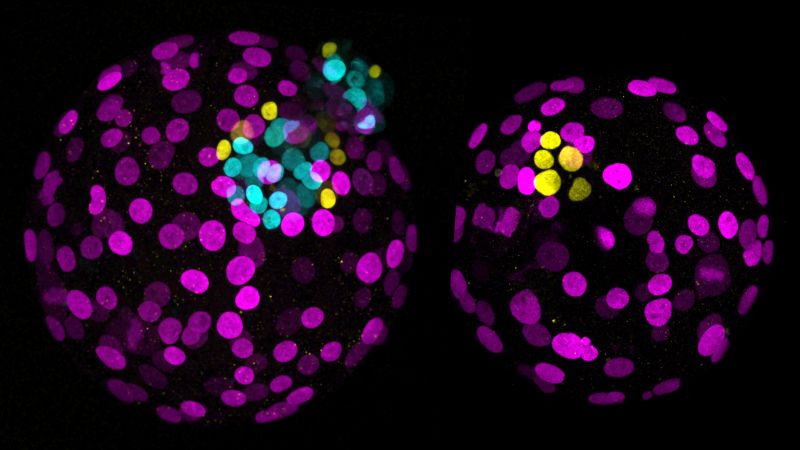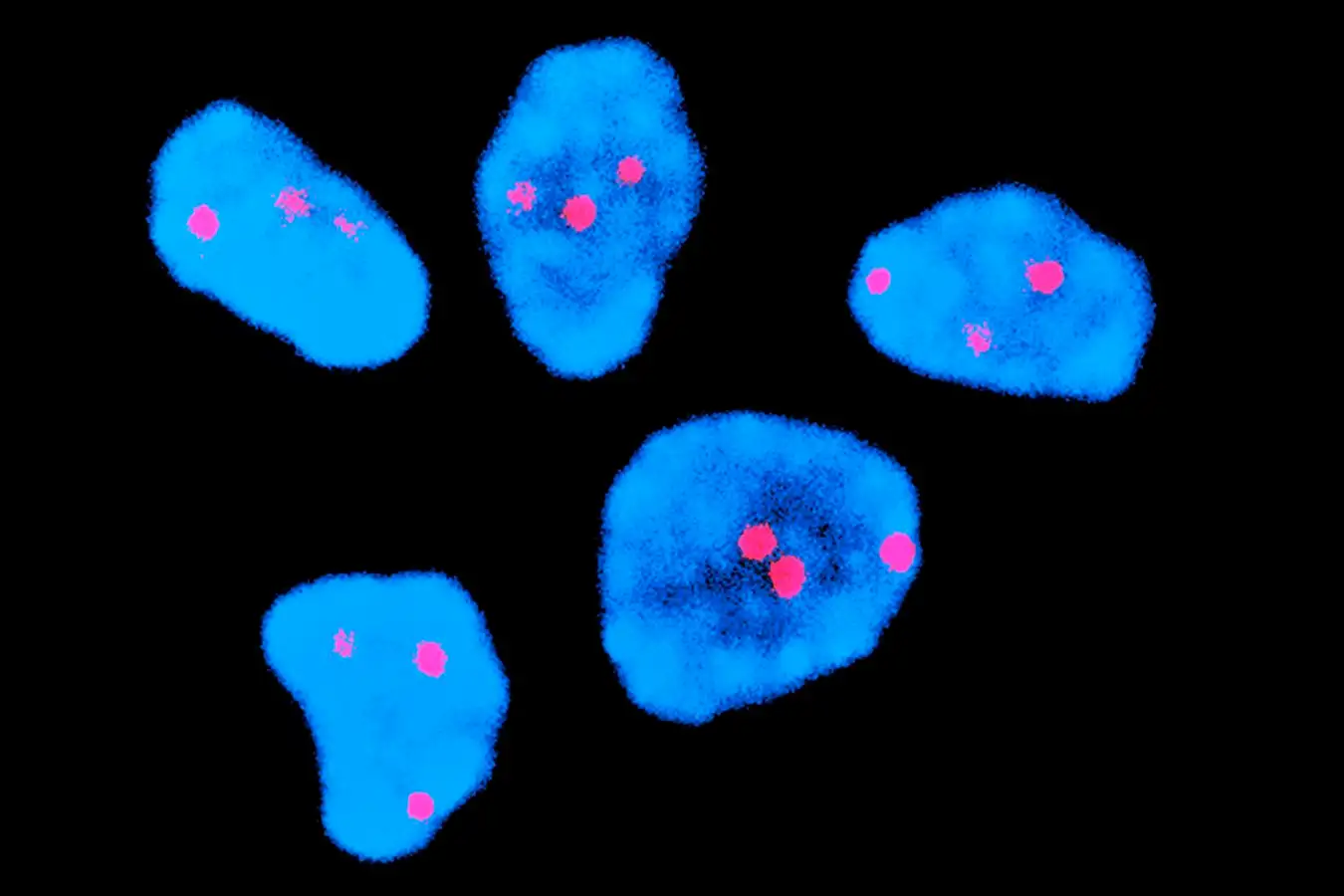
Cells with a signal indicating the presence of too many chromosomesDEPT. OF CLINICAL CYTOGENETICS, ADDENBROOKES HOSPITAL/SCIENCE PHOTO LIBRARY
Human eggs that contain too many or too few chromosomes can lead to miscarriage, IVF failure and conditions such as Down’s syndrome. Now, researchers have found that giving the eggs a single injection can substantially reduce the problem. The approach could eventually boost the chances of success for older women undergoing IVF.
“It really seems like a big deal,” says Marcos Iuri Roos Kulmann at Nilo Frantz Reproductive Medicine in Porto Alegre, Brazil, who wasn’t involved in the new research. “To my knowledge, this is the first [therapy] to show such clinical potential for correcting this major cause of IVF failure.”
During a process called meiosis, egg and sperm cells eject exactly half of their genetic material. This means that when egg and sperm combine during fertilisation, they form an embryo with a complete genome. Sometimes, however, a sperm or egg cell has slightly more or slightly less than the half genome it should contain. This is a condition known as aneuploidy.
Aneuploidy affects about 10 to 25 per cent of eggs in the early 30s and becomes more common with age. “Already in the late 30s, more than 65 per cent of all eggs are aneuploid,” Agata Zielinska at Ovo Labs, a biotechnology company in Germany, told the audience at the European Society of Human Reproduction and Embryology conference in London on 6 July.