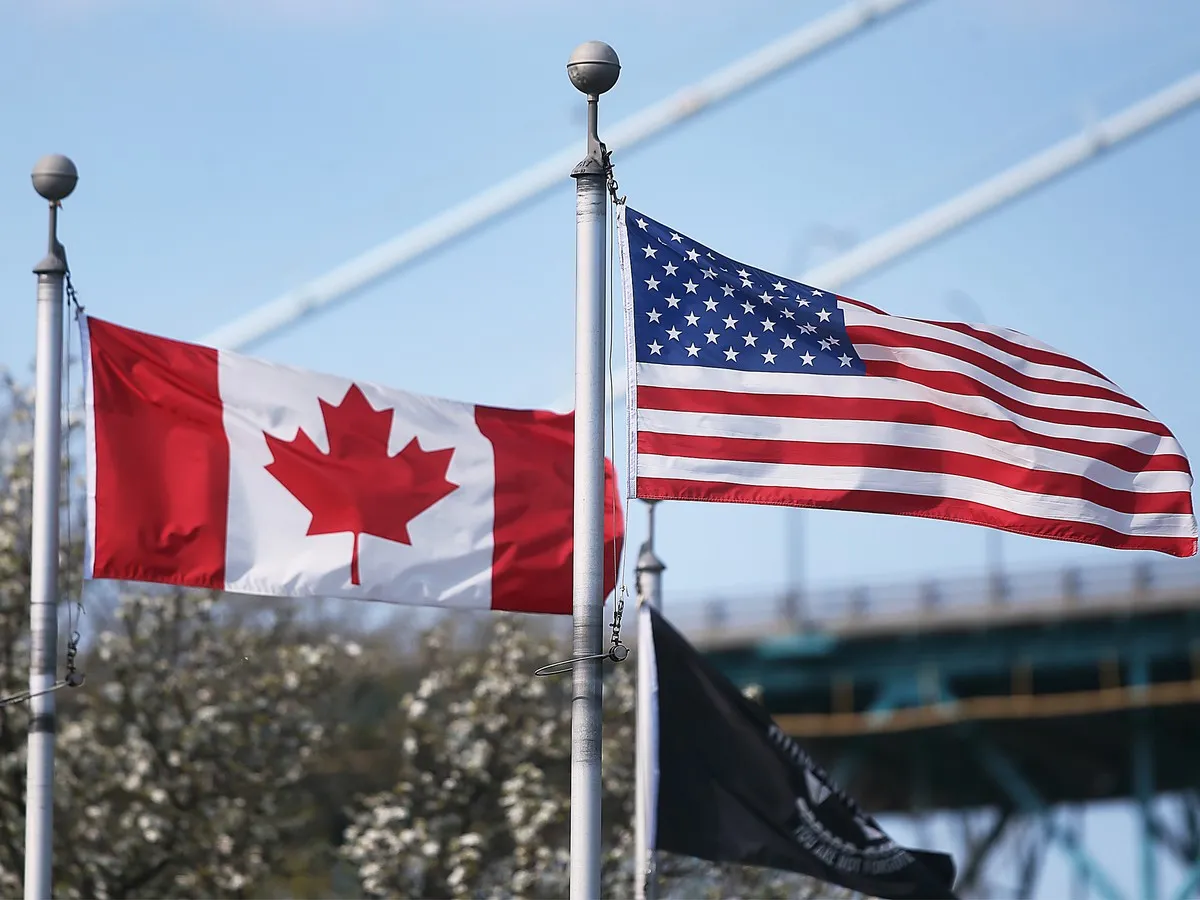
Skip to Content Subscribe Our Offers My Account Manage My Subscriptions FAQ Newsletters Canada Canadian True Crime Canadian Politics Health World Israel & Middle East Financial Post NP Comment Longreads Puzzmo Diversions Comics NP News Quiz New York Times Crossword Horoscopes Life Eating & Drinking Style Sponsored Play for Ontario Travel Travel Canada Travel USA Travel International Cruises Travel Essentials Culture Books Celebrity Movies Music Theatre Television Business Essentials Advice Lives Told Tails Told Shopping Buy Canadian Home Living Outdoor Living Kitchen & Dining Tech Style & Beauty Personal Care Entertainment & Hobbies Gift Guide Travel Guide Amazon Prime Day Deals Savings National Post Store More Sports Hockey Baseball Basketball Football Soccer Golf Tennis Driving Vehicle Research Reviews News Gear Guide Obituaries Place an Obituary Place an In Memoriam Classifieds Place an Ad Celebrations Working Business Ads Archives Healthing Epaper Manage Print Subscription Profile Settings My Subscriptions Saved Articles My Offers Newsletters Customer Service FAQ Newsletters Canada World Financial Post NP Comment Longreads Puzzmo Diversions Life Shopping Epaper Manage Print Subscription HomeNewsCanadaWorldCanada, U.S. both roll back welcome mat for international studentsTighter visa policies in the U.S. and Canada are shrinking international student numbers, hurting university budgets and talent potential You can save this article by registering for free here. Or sign-in if you have an account.A Canadian and American flag are shown along the Detroit River in Windsor on Tuesday, April 21, 2026. Photo by Dan Janisse /The Windsor StarStricter immigration policies, tightening visa allowances and political rhetoric have impacted international enrolment in both Canadian and U.S. universities.Enjoy the latest local, national and international news.Exclusive articles by Conrad Black, Barbara Kay and others. Plus, special edition NP Platformed and First Reading newsletters and virtual events.Unlimited online access to National Post.National Post ePaper, an electronic replica of the print edition to view on any device, share and comment on.Daily puzzles including the New York Times Crossword.Support local journalism.Enjoy the latest local, national and international news.Exclusive articles by Conrad Black, Barbara Kay and others. Plus, special edition NP Platformed and First Reading newsletters and virtual events.Unlimited online access to National Post.National Post ePaper, an electronic replica of the print edition to view on any device, share and comment on.Daily puzzles including the New York Times Crossword.Support local journalism.Create an account or sign in to continue with your reading experience.Access articles from across Canada with one account.Share your thoughts and join the conversation in the comments.Enjoy additional articles per month.Get email updates from your favourite authors.Create an account or sign in to continue with your reading experience.Access articles from across Canada with one accountShare your thoughts and join the conversation in the commentsEnjoy additional articles per monthGet email updates from your favourite authorsSign In or Create an AccountorThe United States still hosts the most international students globally, but both Ottawa and Washington have signalled in recent years that they are less open to foreign students.“Since 2025, the State Department has layered mandatory social-media vetting onto every student visa applicant; paused and then thinned out interview appointments; and abruptly revoked hundreds of current students’ visas,” said Loren Locke, a business immigration attorney and former U.S. Department of State consular officer. “Each of those alone would give a prospective student pause.”Ottawa’s eventual lowering of resident permits, after years of soaring admissions, has had a similar chilling effect, said Larissa Bezo, president and CEO of Canadian Bureau for International Education.Get a dash of perspective along with the trending news of the day in a very readable format.By signing up you consent to receive the above newsletter from Postmedia Network Inc.A welcome email is on its way. If you don't see it, please check your junk folder.The next issue of NP Posted will soon be in your inbox.We encountered an issue signing you up. Please try again“There’s a perception that Canada had kind of closed its door to students because of the decision to put a ceiling on the number of students that would be welcomed,” she said.The decline has been sharp. The United States saw a 17 per cent drop in new international student enrolments last year, with the steepest declines at the graduate level. The Institute of International Education’s “Spring 2026 Snapshot” showed that international applications for this past year fell for 59 per cent of U.S. institutions, and that 63 per cent of them expected a decline in international enrolment this coming autumn.Fanta Aw, executive director and CEO of NAFSA: the Association of International Educators, said she anticipates a drop of up to 30 per cent in 2026.“I think international students are getting the message that the U.S. is not a welcoming place given all the difficulties and challenges of getting visas and everything else,” she said.Prime Minister Mark Carney said in June that international student arrivals in Canada had dropped 60 per cent, underscoring the impact of the new caps. Overall, study permit holders only dipped from about a million to just under a million, but Bezo noted that applications fell nearly 30 per cent between 2024 and 2025. Permit-approval rates also fell from roughly 60 per cent in 2023 to the mid-30s to low-40 per cents by the end of last year, pointing to smaller incoming student cohorts.In the U.S., visa application concerns and travel restrictions were the top factors cited by schools reporting declines, according to the IEE. That generally aligns with Department of State visa issuance data showing a 36 per cent decline in student visas for 2025.“Among the things that students would consider the biggest barrier is the visa issuance first,” said Aw. “Many (from places), like China, India, and many other countries, are reporting that they’re not even able to get visa appointments to apply for a student visa to come for the fall.”Other factors include anti-immigration rhetoric from the Trump administration; threats to eliminate Optional Practical Training, a program allowing international students to work in the U.S. for a year; and moves to end the “Duration of Status” for these students to remain in the U.S. for the length of their studies, instead capping it at four years. “That (Duration of Status) rule change will very likely have a negative impact on the experience of international students who are already here,” said Clay Harmon, executive director of the Association of International Enrollment Management.Aw said the change would severely hurt graduate and Ph.D. programs, since every doctoral student would need an extension to finish.Rather than letting the schools handle such decisions, these would be adjudicated by the federal government, adding another layer of uncertainty.The Canadian government, meanwhile, issued 516,765 study permits in 2024, down 24.1 per cent from 681,215 in 2023. Ottawa later set a 2025 target of 437,000 permits and lowered this year’s ceiling to 408,000.Ottawa also added a Provincial Attestation Letter (PAL) requirement with the province confirming the admission falls within the federal admission quota for the region. Most new international students need their school to apply for a PAL before they can submit a permit application. New international students must also now meet a Cost of Living Proof showing sufficient funds of $22,895, and they face tighter Post-Graduation Work Permit rules. Even so, some experts say the market is beginning to absorb the new rules and may be more stable going forward.Bezo, for example, notes how the backlog of permit applications has eased, and that there has been some stabilization over the past year. She is also encouraged that the Carney government seems more focused on enhancing skills of the Canadian workforce, especially for Ph.D.s, postdocs, and research talent.Harmon also believes the Canadian market has “absorbed the new reality” of caps and PALs and may be better positioned to bounce back. He also said some Canadian academics “believe the Carney government may be proposing or planning to propose some loosening.” “Most folks are kind of anticipating that Canada will start an upswing,” he said.Aw would like to see stabilization in the U.S. student market too, but she does not expect it as long as the Trump administration continues lumping international students together with undocumented migrants as targets.More positive messaging on the international stage, maintaining the ability for students to do Optional Practical Training, doing away with the durational status change, and unlocking visa appointments, she said, would “allow the students who are waiting to come this fall to have an opportunity to come here.”In the meantime, universities and communities in both countries are feeling the strain because international students can be a source of economic activity. In the U.S., NAFSA estimated that international student spending contributed nearly $43 billion to the economy in 2024-25, while a 2022 Canadian government report put the figure at roughly $22 billion.Elite universities are more protected than their regional and mid-tier counterparts, said Aw, “but small colleges will be much more hard-hit.”McGill University’s enrolment report, for example, shows the number of enrolled international students has largely remained consistent. The same is true for the University of Toronto, said to Joseph Wong, the school’s vice-president for international admissions. “U of T’s position as Canada’s leading university and among the best in the world has protected it against the significant drops in international enrolment experienced by some other Canadian post-secondary institutions in response to an evolving policy and geopolitical landscape,” he saidHarvard University’s international enrolment last autumn, meanwhile, reportedly hit a record high. But schools outside the upper echelon aren’t as immune. Some Canadian institutions are seeing hiring freezes, program reviews, staff cuts, and delayed infrastructure spending as a result, said Bezo.Harmon sees the same in the U.S., with some schools cutting faculty, merging departments, or shrinking international admissions staff. Educators also worry that the impact on the international student pipeline will have long-lasting negative impacts on both economies.“I think half of the companies in Silicon Valley were started by students — founders — that came over on a student visa,” said Shaun Carver, executive director of International House at the University of California, Berkeley. “There’s no doubt the impact they’ve had on us as a country.”In Canada, Bezo hopes a recalibration will build talent pipelines that are respectful, well-supported, and useful to regional economies.“We need that talent pipeline, and we need to make sure that we have a future labour force that is thriving and one that actually feeds many of the regional economies that are quite diverse across this country.”National Posttmoran@postmedia.comOur website is the place for the latest breaking news, exclusive scoops, longreads and provocative commentary. Please bookmark nationalpost.com and sign up for our newsletters here. Join the Conversation This website uses cookies to personalize your content (including ads), and allows us to analyze our traffic. Read more about cookies here. By continuing to use our site, you agree to our Terms of Use and Privacy Policy.
Canada, U.S. both roll back welcome mat for international students
Tighter visa policies in the U.S. and Canada are shrinking international student numbers, hurting university budgets and talent potential.
1,787 words~8 min read