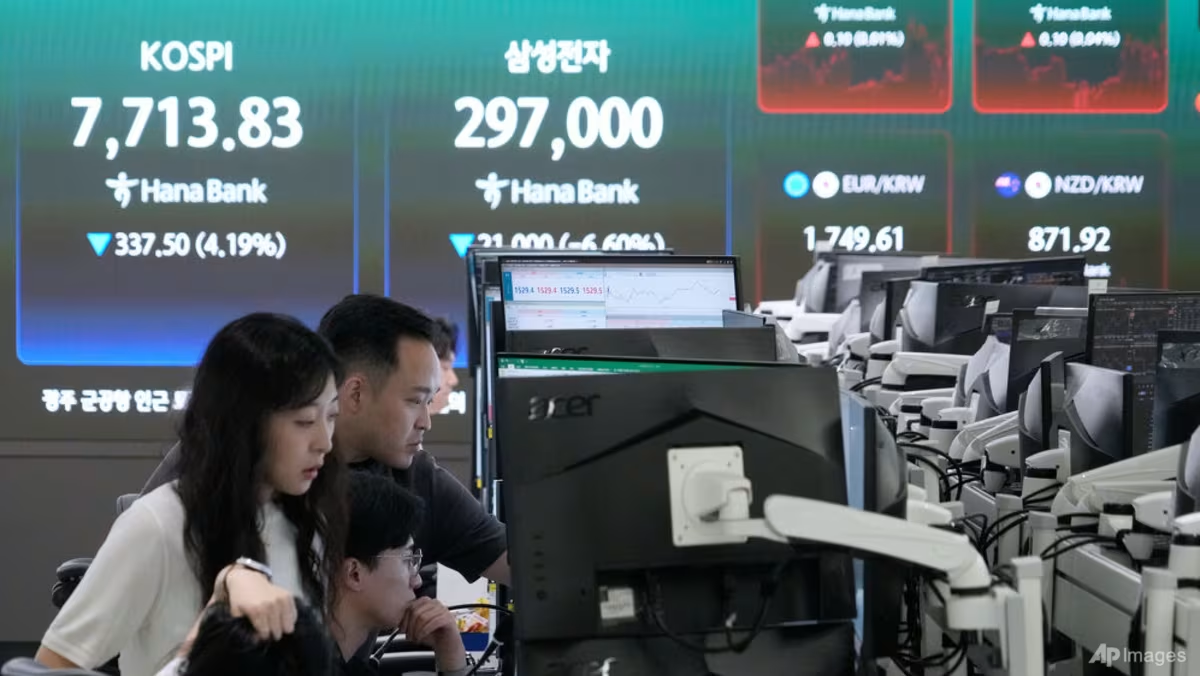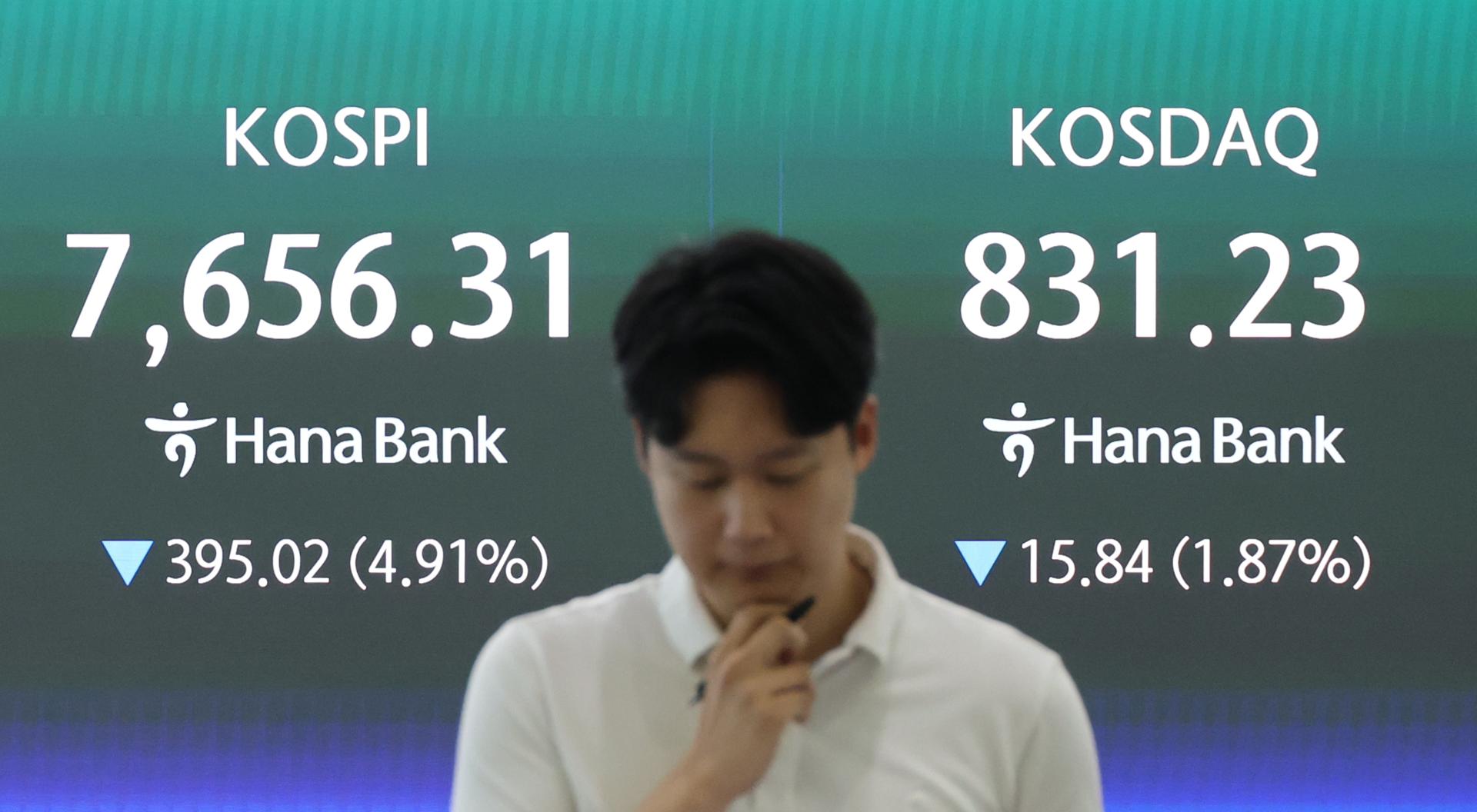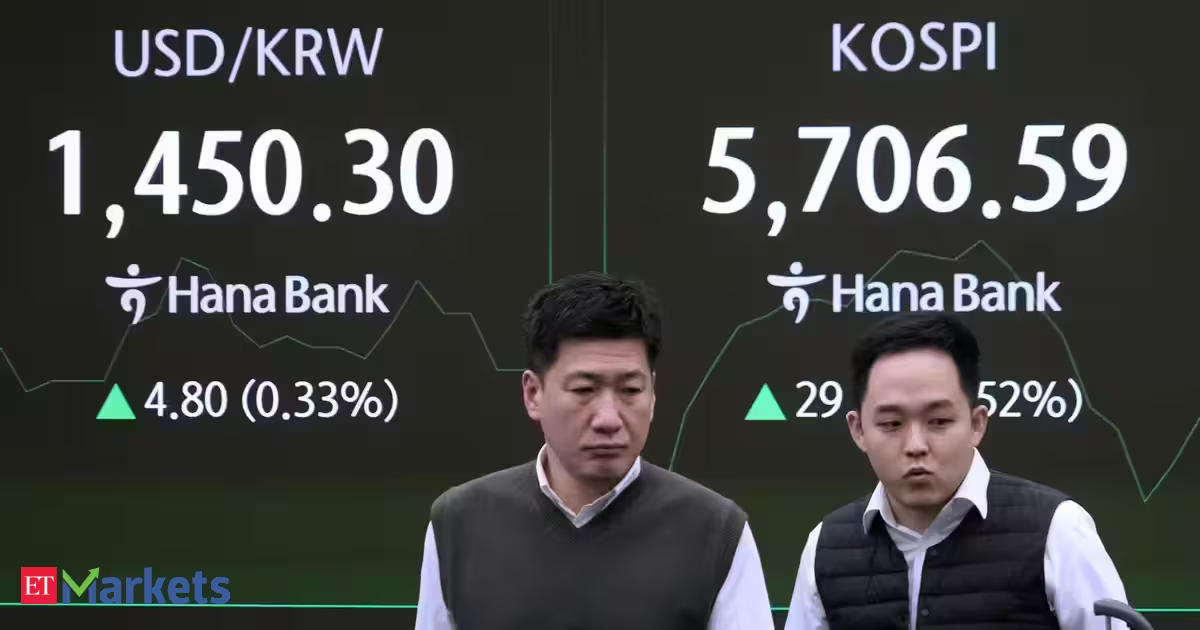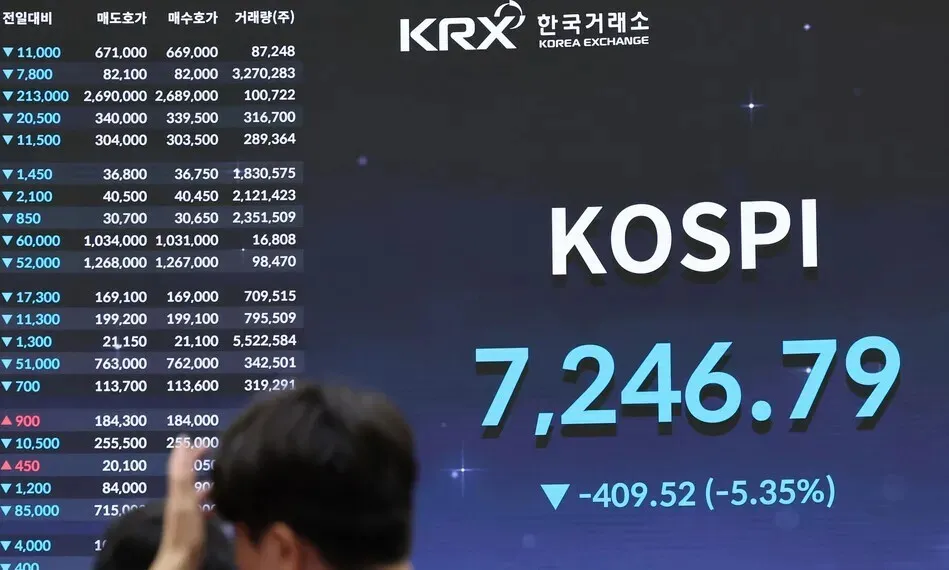
South Korea’s benchmark KOSPI fell for a second consecutive day despite Samsung Electronics posting record earnings, as investors grew increasingly concerned that the semiconductor upcycle may have peaked. Fears that the chip cycle has peaked are shaking the KOSPI, as the index remains heavily dependent on Samsung Electronics and SK Hynix. The KOSPI ended trading on Wednesday at 7,246.79, sliding 5.25% from the day before. That marked its first close below 7,500 since June 8, when it closed at 7,484.41. In the interim, the KOSPI had hit as high as 9,385.59 intraday, but dipped as low as 7,186.21 during trading on Wednesday. The market has been on a rollercoaster ride over the past month, with the KOSPI swinging more than 2,000 points between its intraday high and low. Samsung Electronics ended the trading day at 277,000 won, a 6.25% decrease from the previous day, while SK Hynix ended at 2,076,000 won, falling by 5.68% from the previous day. Peak-out fears in the semiconductor sector continue to dominate the KOSPI. Even after Samsung Electronics posted a record operating profit of nearly 90 trillion won for the second quarter, doubts persist over whether memory chipmakers can sustain such extraordinary earnings. On Wednesday, Kiwoom Securities lowered its target price for Samsung Electronics from 430,000 won to 390,000 won, citing signs that higher component costs, including memory prices, are starting to erode demand. The recent controversy over how Apple hiked the prices of its flagship models is a prime example. It also projected that competition with Chinese memory semiconductor companies would intensify. “During the second half of 2026, when Samsung Electronics will experience slower EPS [earnings per share] growth, the volatility of the stock market will be further impacted by changes in the memory industry,” predicted Pak Yu-ak, an analyst at Kiwoom Securities. According to FnGuide, this is the first time since the outbreak of the US and Israel’s war with Iran that a securities company has lowered its target price for Samsung Electronics. Other securities firms that retained their target prices for Samsung Electronics noted that its record earnings were not enough to alleviate concerns over peak-out fears. “The market is now focusing on the long-term sustainability of earnings, rather than on short-term earnings surprises,” said Son In-jun, an analyst at Eugene Investment & Securities. That said, most securities firms do not view the downturn as a sign that the semiconductor supercycle is over, as profit forecasts for the sector continue to rise. The market is now zoning in on hyperscalers, massive technology companies, and key semiconductor purchasers. “The earnings reports from Big Tech companies, scheduled for the end of July, and future plans for AI investments will be crucial,” noted Byun Jun-ho, an analyst at IBK Investment & Securities. In an investment note sent to its clients on Monday, global investment bank Morgan Stanley wrote that since the semiconductor industry relies on AI investment, if hyperscalers begin to temper the speed of their investments, earnings expectations for semiconductors will inevitably fall. Volatility in the broader KOSPI intensified as shares of Korea’s two largest chipmakers, which together account for about half of the market’s capitalization, fluctuated. The sell-side sidecar mechanism was activated for the second consecutive session as market volatility intensified, bringing the total number of triggers this year to 33. Considering that Wednesday was the 126th trading day of the year, that means the sidecar mechanism has been triggered nearly once every four days.“There have only been 10 instances in which the KOSPI fell by more than 10% over two trading days since 2000. Most of these instances occurred during periods of significantly heightened systemic market risks, such as the dot-com bubble, the 9/11 terror attacks, and the global financial crisis,” said Kim Seok-hwan, a market research analyst at Mirae Asset Securities.“Since semiconductors were the key driver of the KOSPI’s rise this year, speculation about the semiconductor market peaking immediately led to increased volatility across the entire index,” he added.
KOSPI falls 10% in 2 days as record Samsung earnings fuel fears of chip cycle peak
The Korean bourse has swung more than 2,000 points between its intraday high and low over the last month
658 words~3 min read