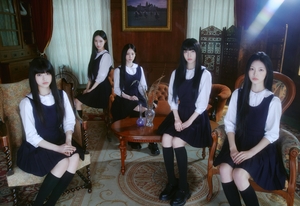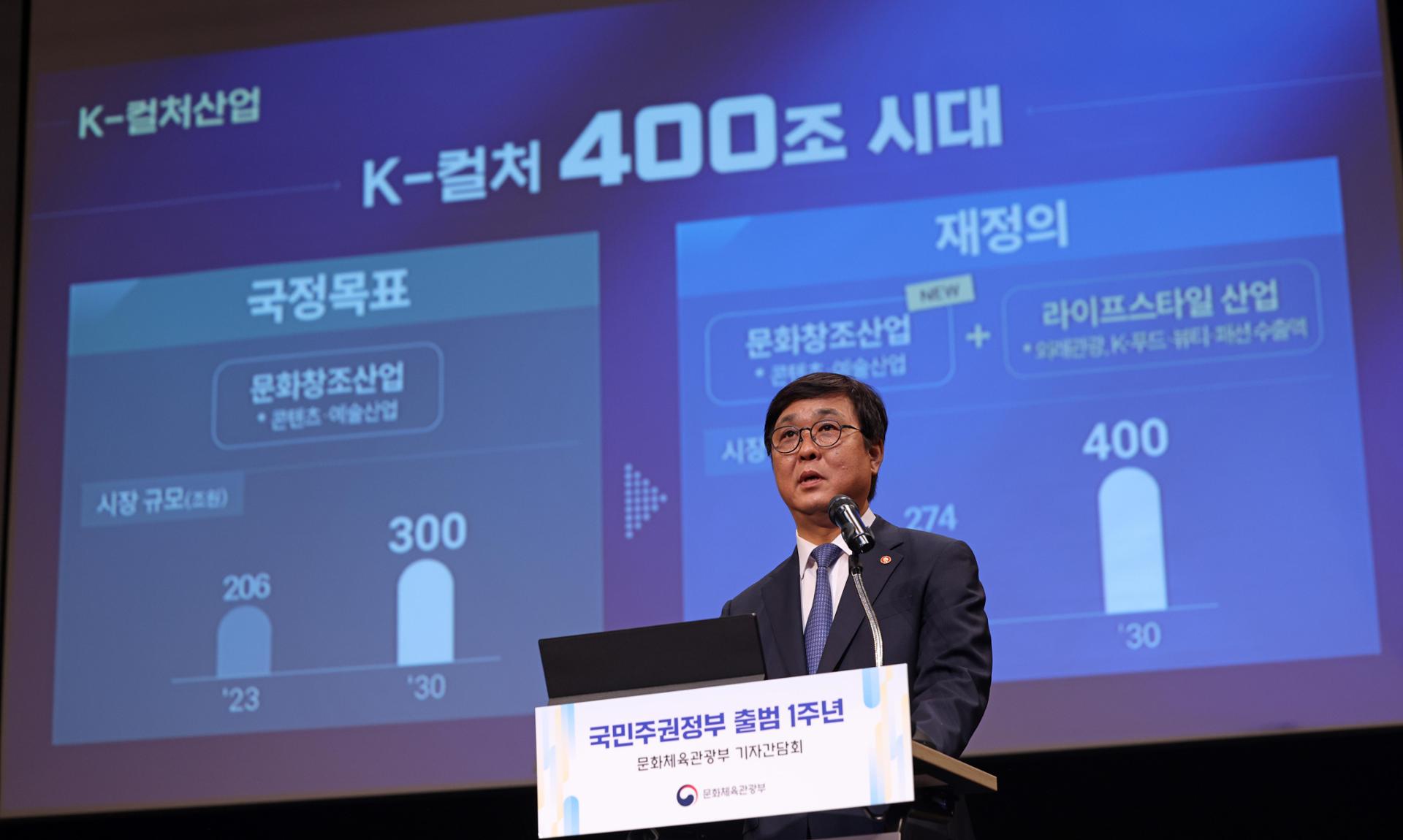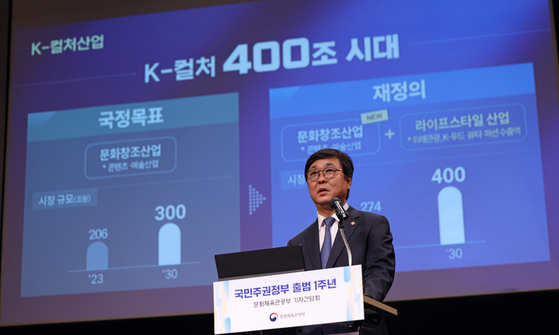
Music executives say tax credits, new investment funds are needed to sustain industry growth Culture Minister Chae Hwi-young speaks during a roundtable with representatives of K-pop agencies and related organizations at the National Museum of Modern and Contemporary Art, Korea in Jongno, Seoul, Wednesday. (Ministry of Ministry of Culture, Sports and Tourism) The Culture Ministry plans to double expansion support for small and mid-sized music agencies next year, as the government seeks to bolster the competitiveness of the country's music industry, Culture Minister Chae Hwi-young said Wednesday.Chae said the ministry is looking to expand the Global Leap Program for Small and Midsized Music Agencies, a program introduced this year to help promising companies enter overseas markets."We launched the program this year, and we're looking to roughly double its scale next year," Chae said during a roundtable on strengthening the music industry's ecosystem in Seoul. "We are also actively discussing the introduction of tax credits for music production costs with the fiscal authorities."The program selects 10 promising small and mid-sized agencies each year, providing up to 300 million won ($199,534) annually for up to three years.This year's recipients include indie labels representing groups such as Rescene, whose song "Love Attack" recently topped Melon's Top 100 chart after a surprise resurgence, as well as Xikers, Big Ocean and Can’t Be Blue.If the planned expansion is approved, the program's total budget would increase from up to 9 billion won this year to as much as 18 billion won next year.The meeting focused on three key policy priorities: expanding global support for small and mid-sized K-pop agencies, introducing tax incentives and new financing programs for music production, and strengthening support for Korea's indie music scene.According to the ministry, South Korea's popular music industry continued to post solid growth last year, with revenue rising 15.4 percent and exports increasing 32.4 percent from a year earlier.At the same time, participants warned that soaring production costs, widening disparities between major and smaller companies, genre concentration, insufficient concert infrastructure, and regional imbalances could slow the industry's long-term growth. Culture Minister Chae Hwi-young attends a roundtable with representatives of K-pop agencies and related organizations at the National Museum of Modern and Contemporary Art, Korea in Jongno, Seoul, on Wednesday. (Ministry of Culture, Sports and Tourism) Chae said rookie artist numbers have also been declining as debut costs continue to climb."The number of rookie artists on the Circle Chart fell 40 percent last year compared with 2023," Chae said. "The gap in production costs between large entertainment companies and smaller agencies is also widening. We have to ask ourselves how long K-pop can maintain its current momentum."The Circle Chart is South Korea’s official music standard that ranks songs and albums based on aggregate physical sales, downloads and streaming data.Woo Seung-hyun, chairman of the Korea Popmusic Industry Association, said launching a single idol group now often requires more than 10 billion won in investment while album sales continue to decline."While infrastructure projects are important, we hope the government will prioritize direct support for music production," Woo said. "Like books, films and live performances, purchases of recorded music should also qualify for tax deductions."Kim Jin-woo, CEO of RBW, said it typically takes around three years for an artist to begin generating meaningful profit."If an agency spends 1.5 billion won producing each album and releases one or two albums a year, it easily becomes a 10 billion won investment over three years," Kim said. "The industry is increasingly becoming a game where only artists backed by major companies capable of spending 10 billion won on a single album are likely to survive."Kim also urged the government to include K-pop in state-backed content investment funds, saying that music exports require significant upfront investment and carry considerable financial risk.The ministry said it would place greater emphasis on fostering Korea's indie music scene."Indie music forms the foundation of Korean music, but I believe it has not received sufficient policy attention," Chae said. "Beginning next year, we plan to provide more focused support so that new genres and emerging artists can continue to grow and perform on the global stage."Chae also said the framework for "Fanomenon," a K-pop festival being organized by the Presidential Committee on Popular Culture Exchange, of which he serves as co-chair, has been finalized and will be unveiled later this month. The festival is scheduled to be held in December 2027.
As K-pop costs soar, government plans bigger boost for smaller agencies
The Culture Ministry plans to double expansion support for small and mid-sized music agencies next year, as the government seeks to bolster the competitiveness
729 words~3 min read