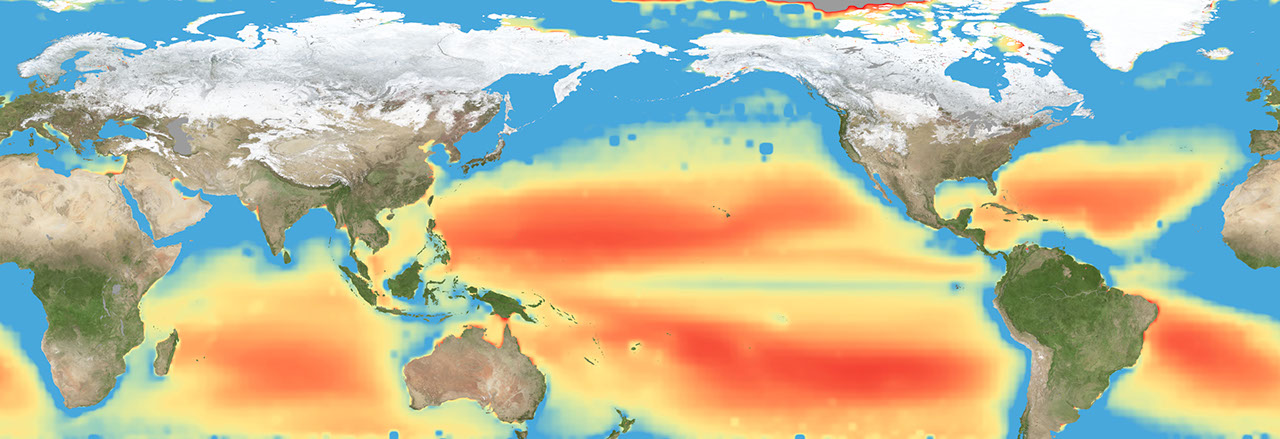
Scientists have found that ocean temperature patterns may help keep droughts from spreading across the world all at once. The research, led by the Indian Institute of Technology Gandhinagar (IITGN) with international collaborators, suggests that natural climate shifts in the oceans act as a kind of global brake on synchronized drought.
Published in Communications Earth & Environment, the study examined climate records from 1901-2020. The researchers found that synchronized droughts affected only 1.8% to 6.5% of the planet's land area at the same time. That estimate is much lower than earlier claims suggesting that as much as one-sixth of Earth could dry out simultaneously.
Mapping Drought as a Global Network
The study was led by Dr. Udit Bhatia, along with co-authors from IITGN and the Helmholtz Centre for Environmental Research -- UFZ, Leipzig, Germany. The team investigated how droughts in distant regions line up in time and what factors influence whether they spread together or remain separated.
"We treated drought onsets as events in a global network. If two distant regions entered drought within a short time window, they were considered synchronized," explained Dr. Bhatia, the lead author and the principal investigator of the Machine Intelligence and Resilience Lab and the AI Resilience and Command (ARC) Centre at IITGN.