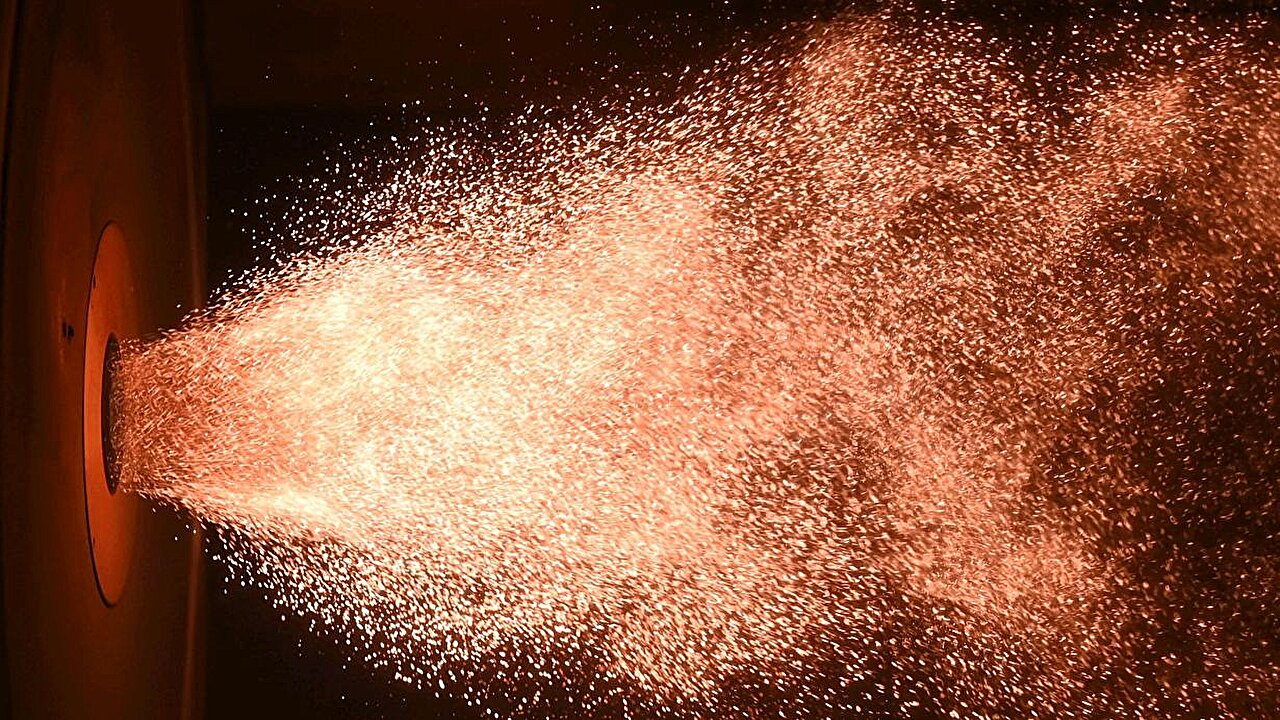
Iron dust flame at lab scale. For presentation purposes, the photo has been rotated by 90 degrees. Credit: Janik Hebel, TU Darmstadt
In the future, iron might be used as a chemical energy storage material, making large quantities of renewable energy available in the long term. Iron powder is combusted in a cyclic process that is carbon neutral and then reconverted to its original state using energy input. Scientists at Karlsruhe Institute of Technology (KIT) were the first to conduct an extensive study to evaluate the potential of this technology for power generation. Their results show that iron, while not superseding hydrogen, may usefully complement it in a climate-neutral energy system. The findings have been published in Chem Circularity.
Be it for wind energy from coastal regions or for solar power from desert areas, iron could serve as a transportable energy carrier in the future to make these renewable energy sources usable worldwide. "This works in a cycle that emits no carbon dioxide or environmentally harmful substances," said Julia Schuler from KIT's Institute for Industrial Production (IIP). For power generation, iron powder is combusted, producing iron oxide, i.e. rust. Using hydrogen from renewable sources, it is reduced to iron again in a process that removes the oxygen it contains. The iron powder can then be reused.