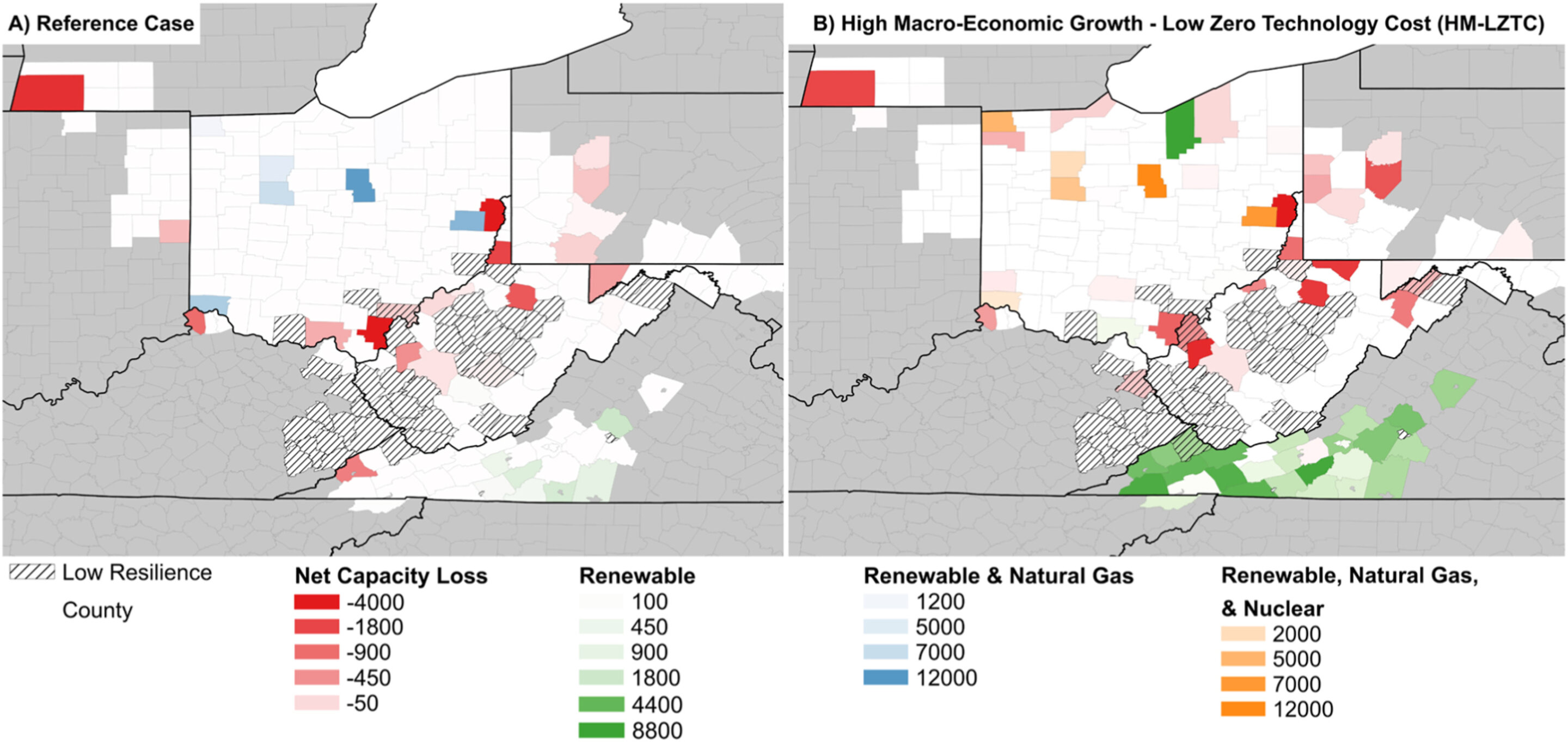
Change in Installed Capacity (2024–2050) for the BaU policy preference in A) the Reference and B) HM—LZTC technoeconomic pathways. Credit: Energy Policy (2026). DOI: 10.1016/j.enpol.2026.115399
Policies aimed at expanding energy infrastructure are more effective, and can remain cost-neutral, when they take community and environmental impacts into account, a new analysis suggests.
A scenario-based framework researchers developed to model how counties across the Midwest might respond to several grid expansion strategies revealed that even the most expensive policies that take community health concerns and employment needs into account are only 0.7% more costly than typical, cost-minimizing approaches.
Researchers determined this by examining five different policies that could guide the evolution of the energy grid, comparing factors like resulting costs, job creation and fossil fuel emissions.
While each policy had important trade-offs, the analysis showed that supporting the development of renewable energy technologies, like wind and solar, can make it easier to address future socioeconomic impacts for little to no cost.