Picture a power plant burning fuel to spin a turbine. It is tempting to assume that with enough engineering — better seals, smoother bearings, cleaner combustion — the plant could be pushed toward converting nearly all its heat into useful work. It cannot. A large modern thermal power station turns only something like 40 to 45 percent of its fuel energy into electricity, and the missing majority is not lost to sloppy design. It is lost to a law of physics.
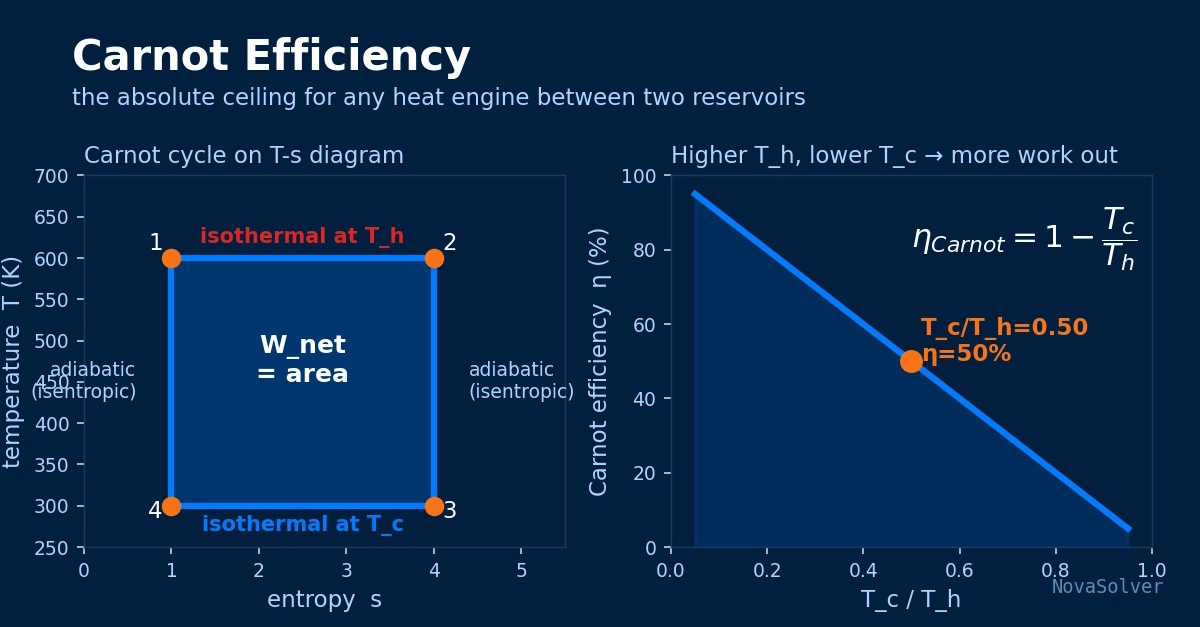
That law sets a ceiling on every device that turns heat into work, from a car engine to a steam turbine to a jet. The ceiling is called the Carnot efficiency, and the remarkable thing about it is how little it depends on. Not on the working fluid, not on the mechanism, not on the cleverness of the builder — only on two temperatures. This article explains where that limit comes from, how to compute it, and why it reshapes how engineers think about efficiency.
Why this calculation matters
The Carnot efficiency is the benchmark against which every real engine is judged. When an engineer reports that a gas turbine runs at 38 percent efficiency, that number means little on its own. Compared against the Carnot limit for the same hot and cold temperatures, it suddenly tells you how much room is left — whether the design is already near the physical wall or still has slack worth chasing.