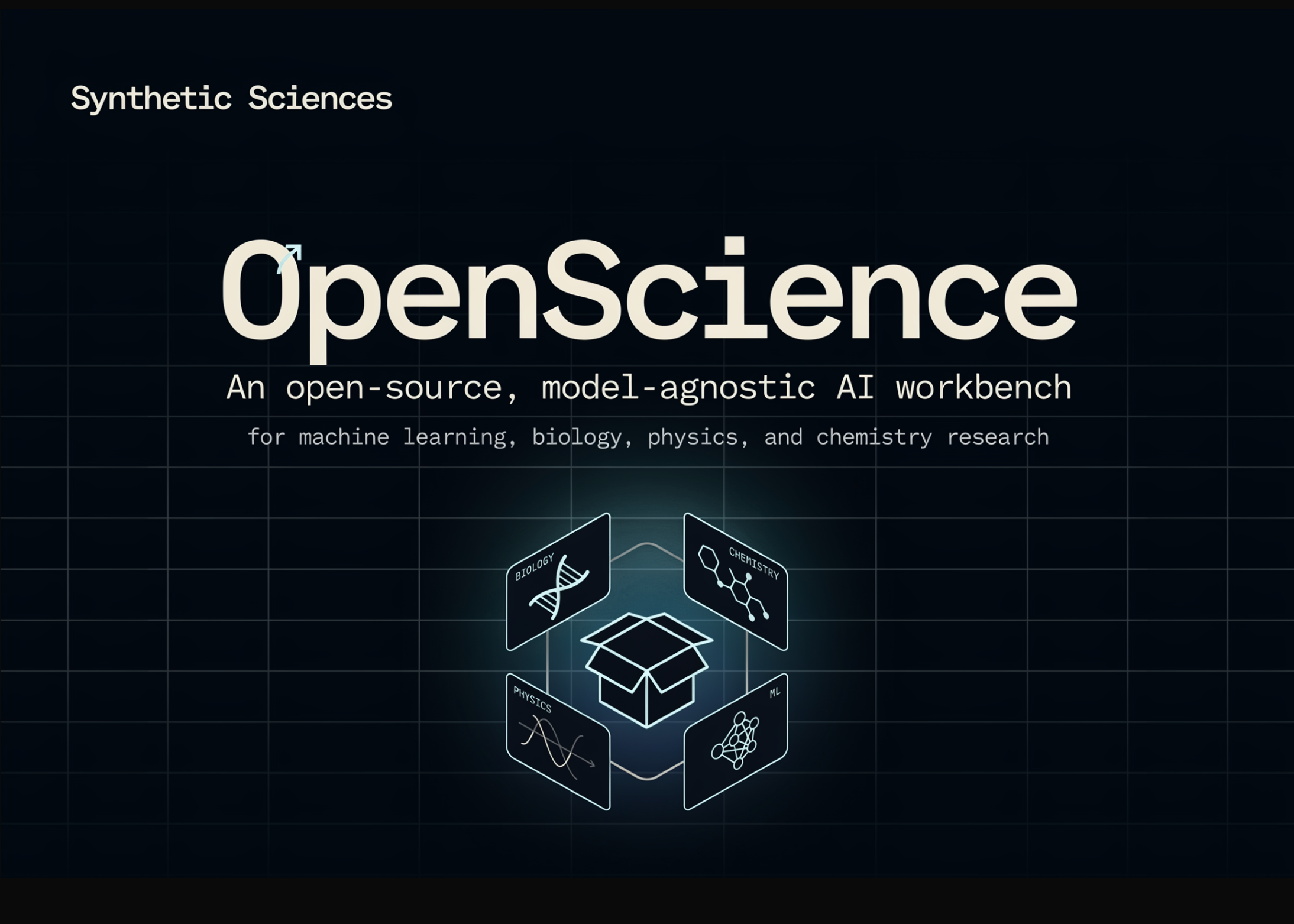
OpenScience hands an AI agent the whole scientific loop and lets it run: read the literature, form a hypothesis, write and run code, execute the experiment on real compute, then write up the result. It is a research workbench, not a chat window, and it treats the messy middle of science as the part worth automating.
What the loop actually covers
Most AI research tools stop at "help me understand this paper" or "draft this section." OpenScience aims wider. You give it a goal and it works through literature review, hypothesis, code, experiment, analysis, and write-up in one continuous session. The README describes a default research agent backed by biology, physics, and ml specialists, plus critique and literature-review sub-agents and a read-only plan mode for when you want to see the approach before anything runs.
The connective tissue is a set of tools the agent can call directly. It queries scientific databases as first-class tools: UniProt, PDB, Ensembl, ChEMBL, PubChem, arXiv, OpenAlex, Semantic Scholar, and around thirty more. It carries what the project counts as 290+ skills spanning model training (DeepSpeed, PEFT, TRL), evaluation, dataset work, molecular and clinical biology, cheminformatics, LaTeX and figures, and cloud compute through providers like Modal and Tinker. That inventory is the difference between an agent that talks about an experiment and one that can actually run it.