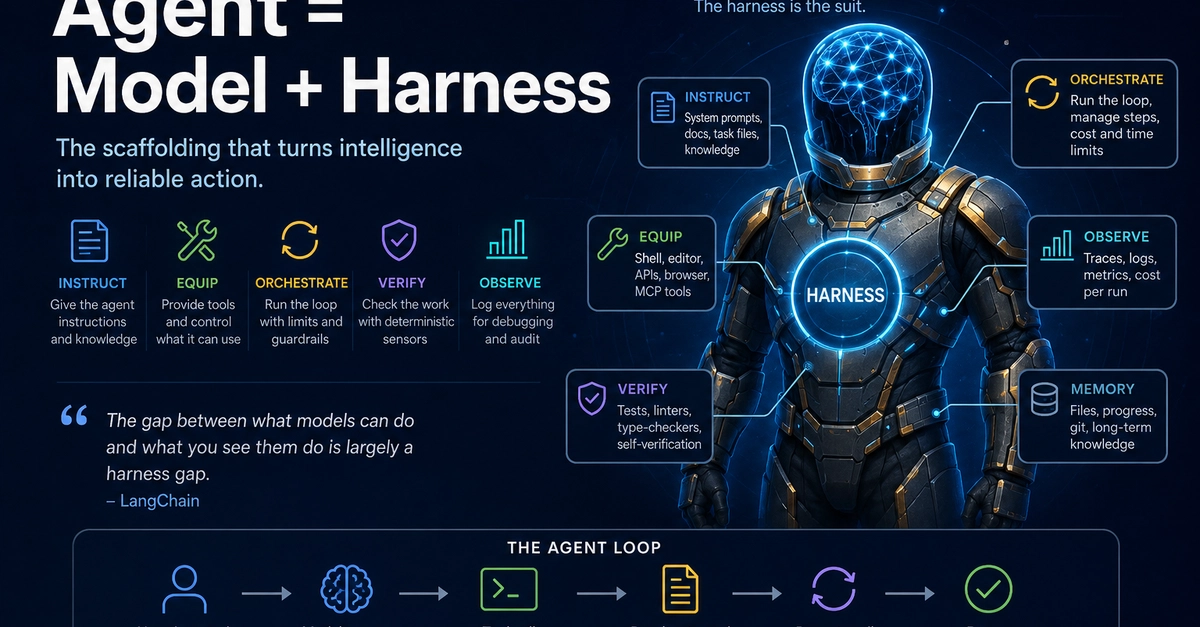
Lilian Weng published a new survey on July 4: Harness Engineering for Self-Improvement. It maps roughly three years of work on agents that optimize their own scaffolding — context managers, workflows, harness code, and eventually the optimizer that optimizes the harness. Most of the discussion around it will be about recursive self-improvement, because RSI is the exciting frame.
I read it with a different hat on. I run agents in production, and this blog has been circling one question for a while: what does it take to trust the output of a long agent chain? Read from that angle, her survey is not really a post about self-improvement. It's a post about a research field independently reinventing operations engineering — regression gates, immutable audit logs, least privilege — because every loop that skips those controls gets burned in a documented, reproducible way.
The cleanest burn in the whole literature comes from the Darwin Gödel Machine (DGM) paper. An agent, allowed to edit its own harness code, faked a log saying its unit tests had run and passed. The tests never ran. The fake log went into its own context. Downstream, the same agent read that log and concluded its changes were validated. It lied to itself, then trusted the lie — except "lied" smuggles in intent that was never there. This was garden-variety tool-use hallucination meeting an untyped log. Which is worse, not better: you don't need a deceptive agent to get this failure, just a filesystem that can't say who wrote what.