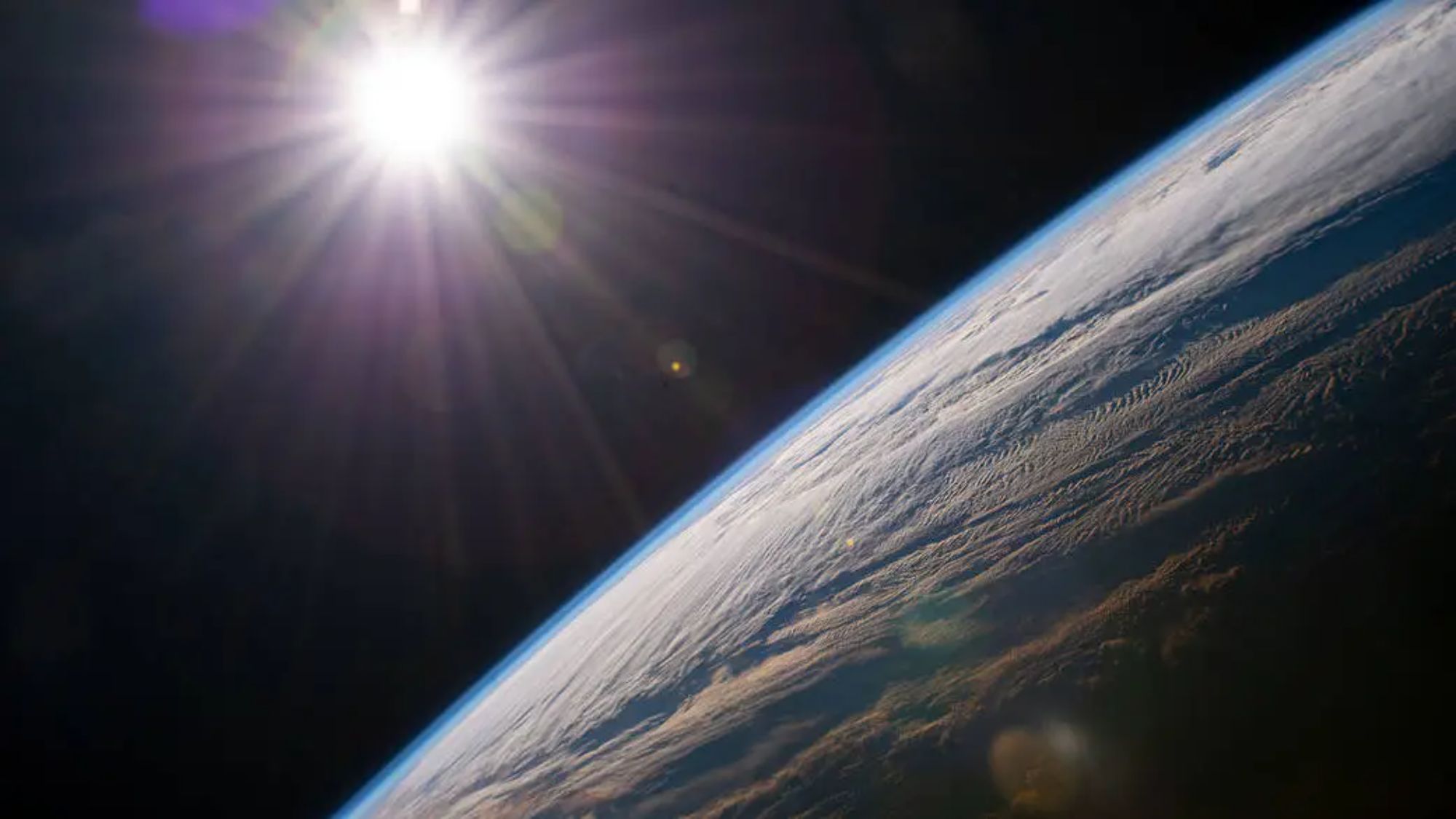
The sun shines above the Earth's horizon as the International Space Station orbited 264 miles (425 kilometers) above the Canadian province of Quebec on Dec. 30, 2021.
(Image credit: NASA)
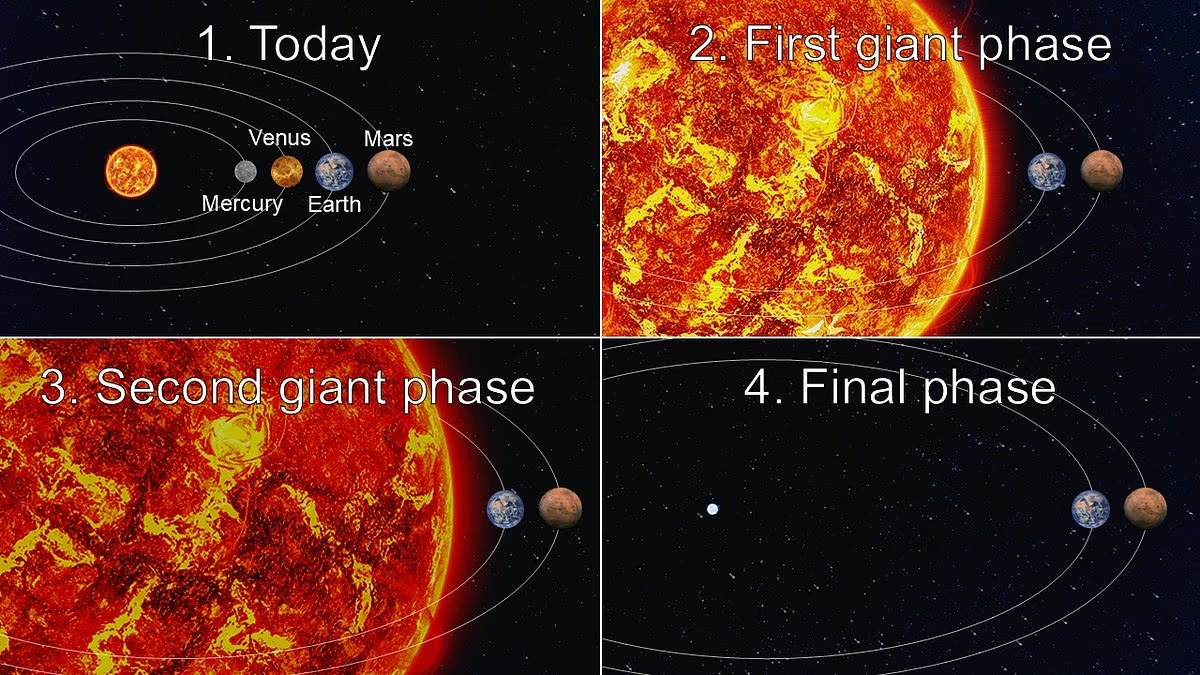
For decades, astronomers have debated whether Earth's fate was tied to the sun's. When the star exhausts the hydrogen fuel that powers it about 5 billion years, it will swell into a red giant large enough to engulf Mercury and Venus — and, several studies have suggested, Earth as well.New research, however, suggests our planet has a better chance of escaping that fiery end than previously thought. Using updated models of how aging stars interact with their planets, researchers found that the gravitational forces drawing Earth toward the expanding sun are weaker than older models predicted. That would give the planet more time to drift outward as the dying sun sheds its outer layers into space, potentially avoiding engulfment altogether.The finding does not guarantee Earth's survival. Instead, researchers say it shifts the biggest uncertainty from how strongly the expanding sun tugs on planets to the poorly understood variable of how much mass the star will lose during its final stages of evolution."The largest uncertainty no longer comes from the tidal calculations, but from how much mass the future sun will lose," study lead author Mats Esseldeurs of the KU Leuven's Institute of Astronomy in Belgium said in a statement. "Observations of sun-like giant stars currently point towards Earth's survival, but we need better observations before we can be certain."When stars like the sun exhaust their core hydrogen and balloon into massive red giants, they trigger a cosmic tug-of-war between expanding tidal forces pulling planets inward and shedding stellar weight pushing them outward, which ultimately decides whether nearby worlds are engulfed or saved.This planetary push-and-pull unfolds in two stages. As the sun expands, gravitational tides act like a subtle brake, slowly draining Earth's orbital energy and pulling the planet inward. At the same time, the dying star sheds vast amounts of gas through powerful stellar winds, eventually losing about half its mass. As the sun grows lighter, its gravitational grip weakens, pushing the surviving planets outward into a wider orbit that could double their distance from the star, according to NASA."The fate of Earth depends on a delicate balance between these two effects," Esseldeurs said in the statement. "If tidal interactions dominate, Earth is engulfed. If mass loss dominates, Earth escapes to a wider orbit."Previous studies reached different conclusions mostly because they treated those competing processes differently, Esseldeurs and his team argue. A few of those studies neglected tidal interactions altogether, while others relied on simplified prescriptions developed decades ago that predicted a much stronger inward pull, according to the study.Instead of relying on those older formulas, the new study uses updated calculations of tidal forces based on the shifting internal structure and dynamics of aging stars — which the team says allowed it to precisely account for both tidal friction and shifting stellar winds — before testing the results against a range of possible mass-loss rates for the sun's final giant phase.The results suggest that even with the weaker inward gravitational pull, Mercury and Venus are unable to outpace the expanding sun and are inevitably engulfed, while Earth and Mars migrate safely through both giant phases, leaving our planet to eventually settle into a broader orbit around the white dwarf remnant the sun will leave behind, the study found.