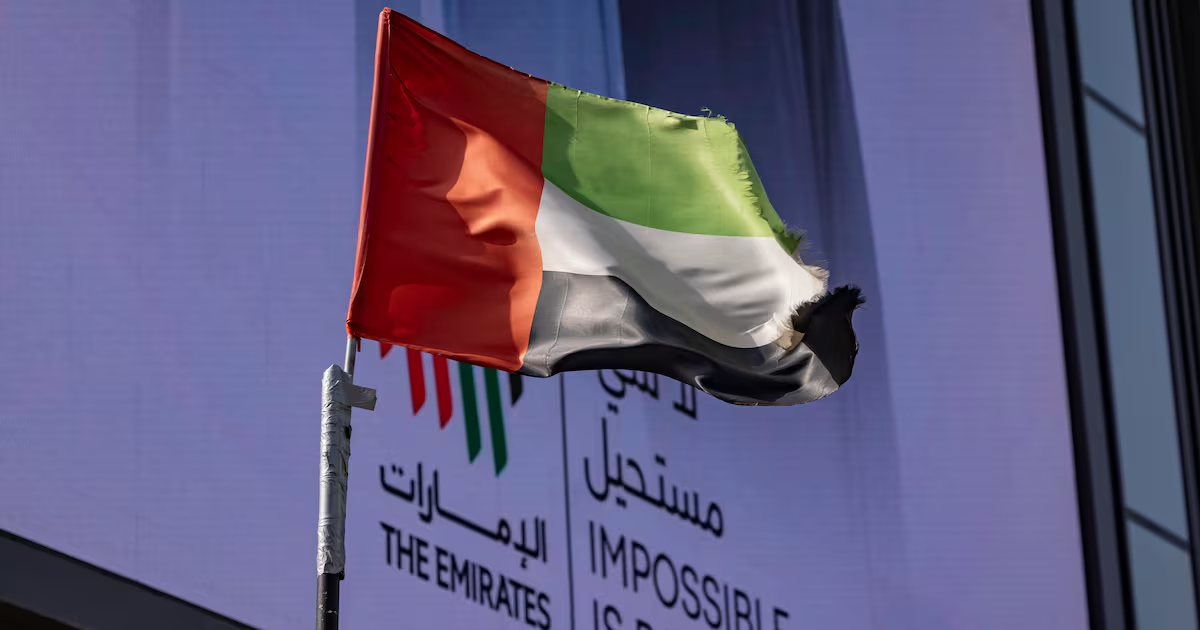
Foreign direct investment into the UAE rose by about 6 per cent to reach $48.24 billion in 2025, the ninth highest total in the world, the UN Conference on Trade and Development (Unctad) has found.The UAE was the top recipient of FDI in the broader Middle East region, ahead of Saudi Arabia, which ranked 13th among host nations, Unctad said in its World Investment Conference 2026 report on Tuesday. The UAE was ahead of Mexico, India and Australia, owing to a sharp rise in greenfield investment flows.The country's ranking was unchanged from 2024. “The UAE and Saudi Arabia recorded strong growth, driven by energy, infrastructure and diversification strategies,” the report said.Outbound FDIThe UAE also ranked among the top 10 global economies for outbound FDI flows, with more $63 billion of investments in 2025, down from $77 billion recorded a year earlier. The UAE, as well as its peers in the Gulf region, remained a significant source of outbound FDI capital alongside mainland China, Hong Kong and Singapore. Aggregate FDI to developing economies rose to $1.1 trillion in 2025, up from $1 trillion, as these countries together accounted for more than one third of developing-economy inflows, Unctad said.“The UAE remained ranked ninth in the top 20 home economies and Kuwait entered the ranking. Although Saudi Arabia dropped out of the top 20, it remained an important source” Unctad said. The Emirates ranked sixth on the list in 2024. Play01:19Al Zeyoudi: Major investments coming at home and abroad“The UAE has been especially visible through recent greenfield megaprojects … [with] notable examples including the $34 billion Infinity Power renewable energy project in Mauritania, the $24 billion Ras El Hikma real estate development project in Egypt and the $6 billion H2 Global Energy hydrogen project in Tunisia,” the report said. “Major projects in 2025 included digital infrastructure investments from UAE firms MGX Fund Management in France and Damac Holding in the US."Uncertain outlookHowever, FDI prospects for 2026 and beyond remain uncertain with "macroeconomic conditions remaining a central source of weakness”, Unctad said.Geopolitical tension, conflicts and persistent uncertainty about trade policy further complicate investment decisions for private and sovereign investors, it said.The start of the Iran war in February constitutes a "major adverse shock to the global investment environment, exerting downward pressure on FDI through higher costs, greater uncertainty and tighter financial conditions”, the report added.“Within the region, heightened security risks, disruptions to transport and logistics, and rising insurance and operating costs are leading to the suspension, delay or cancellation of many ongoing and planned investment projects.”While there is a ceasefire in place, risks remain until the US and Iran reach a permanent peace deal. Play00:48US launches renewed strikes on more than 80 targets across IranWith uncertainty and heightened tension persisting “capital-intensive investment – particularly in infrastructure, energy and industrial activities – is the most exposed”, the UN report said. The implications of the Middle East conflict vary and will weaken the projects pipeline in fuel-importing and financially constrained economies. Oil exporters, among major outward investors globally, may focus on domestic needs and adopt a more cautious approach to new cross-border commitments, a shift already visible in delayed or cancelled mergers and acquisitions deals, the report added. Global flows Globally, aggregate FDI flows rose 6 per cent annually to $1.6 trillion in 2025, ending two years of decline. Inflows to developed economies rose 11 per cent, while developing economies recorded only a 2 per cent increase, pointing to “narrow, fragile and uneven” recovery. The world's top 20 host economies attracted more than 80 per cent of global FDI in 2025, the report noted. Developing economies received more than half of global FDI in 2025, but growth remained modest. Developing Asia remained the largest recipient region, attracting $644 billion, while FDI in Latin America and the Caribbean rose 14 per cent to $188 billion, Unctad data showed.Africa received about $70 billion – one third above its 2010 to 2024 average despite falling from the exceptional level reached in 2024. The least developed countries recorded a rise in FDI inflows of 21 per cent to $43 billion, but still accounted for only 2.7 per cent of global FDI. Sectors such as AI infrastructure, semiconductors, critical minerals and energy-transition technologies and services accounted for 44 per cent of global greenfield project values in 2025, up from 16 per cent in 2020.“The growth in project values was driven mainly by data centres, followed by oil and gas and semiconductors,” Unctad said. “Most other sectors registered declines, including renewable energy, infrastructure and manufacturing, showing how narrow the recovery remains.”
UAE among world's top 10 recipients of FDI in 2025, UN report says | The National
Country also ranked ninth for investment outflows last year, Unctad finds
759 words~3 min read