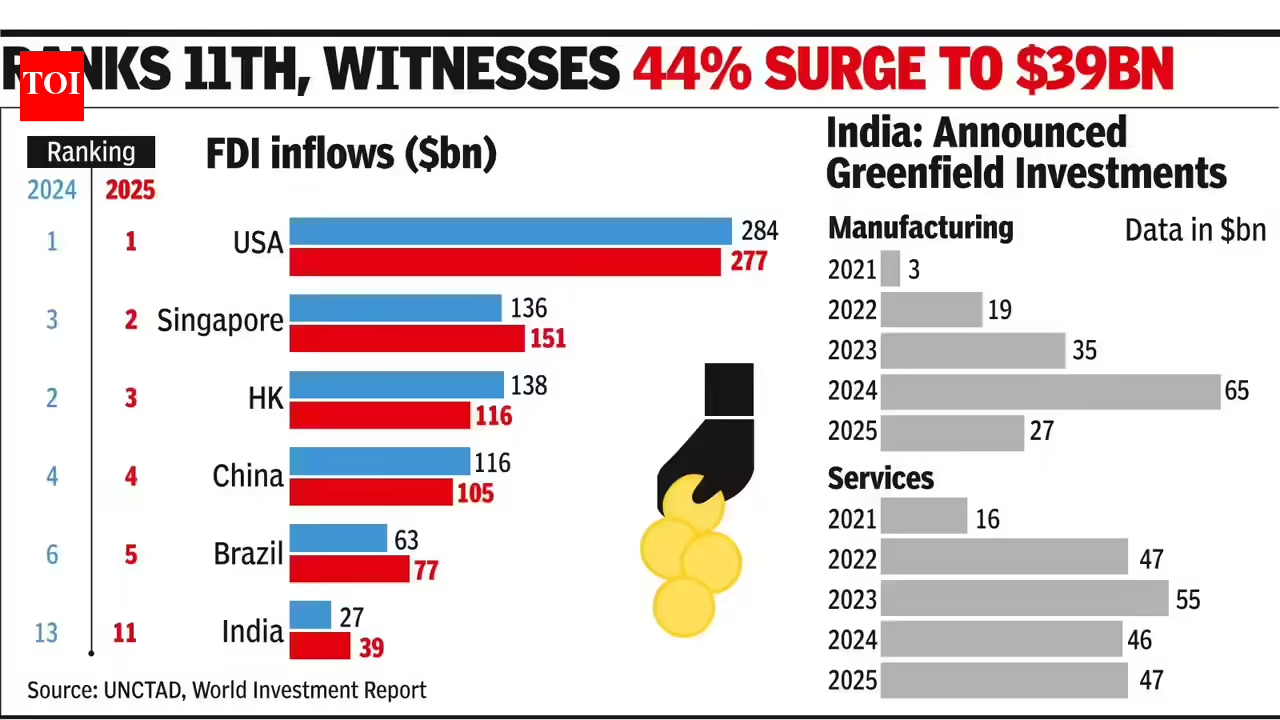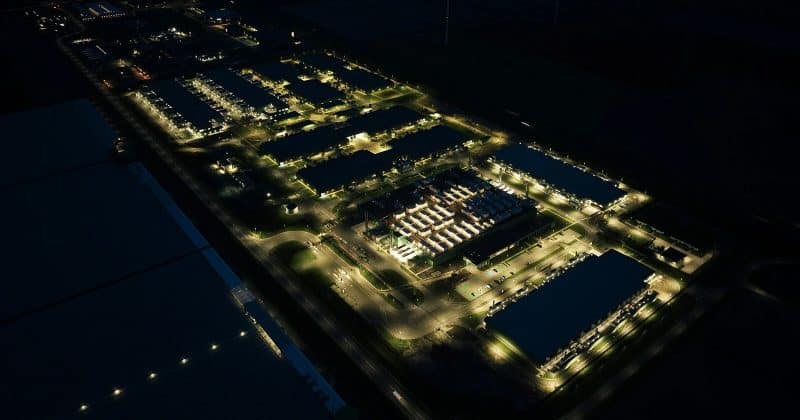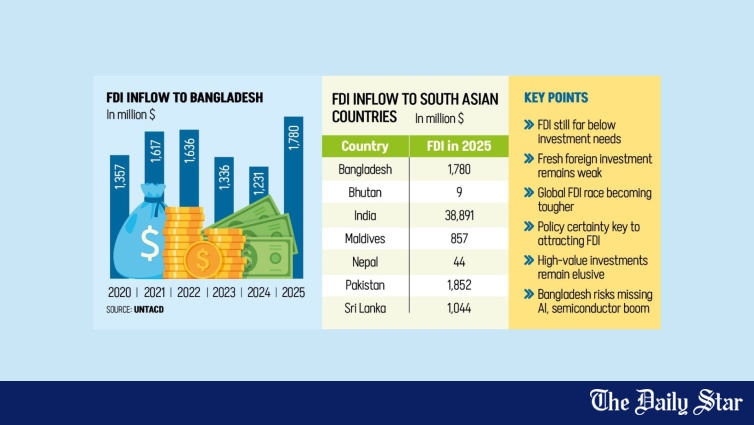
United Nations, Foreign Direct Investment inflows to India increased by 44 per cent in 2025 to USD 39 billion, according to the UN, which said the country continued to strengthen its position as a major investment destination.The 2026 World Investment Report, released Tuesday by United Nations Trade and Development (UNCTAD), said global foreign direct investment showed resilience in 2025, but the recovery remained fragile.FDI flows rose by 6 per cent to USD 1.6 trillion. Inflows increased by 11 per cent in developed economies and by 2 per cent in developing economies.Excluding conduit flows through major European financial centres, global FDI increased 4 per cent after two consecutive years of decline. The outlook for 2026 is affected by significant downside risks owing to trade policy uncertainty, geopolitical tensions and conflicts, it said.FDI inflows to South Asia rose strongly, from USD 34 billion to USD 46 billion, "driven by investment in India, where FDI inflows increased by 44 per cent to USD 39 billion", the report said.However, it noted that while total FDI inflows rose to USD 39 billion, project indicators pointed to a more "cautious investment cycle".Amid an uncertain global environment, the total value of announced greenfield investment in the country declined from more than USD 111 billion in 2024 to about USD 74 billion in 2025, while the number of projects fell marginally."India continued to strengthen its position as a major investment destination in 2025, supported by an active policy agenda aimed at broadening its investment base beyond services and accelerating advanced manufacturing," the report said.It noted that to attract investment into priority industries, such as electronics, semiconductors and related manufacturing activities, India launched programmes such as the Production-Linked Incentive schemes, Make in India, Start-up India and the National Industrial Corridor Development Programme."These initiatives have been complemented by reforms aimed at creating a more conducive investment environment," including the National Single Window System, the India Industrial Land Bank and continued efforts to reduce regulatory burdens, the UNCTAD said citing information from Reserve Bank of India, Ministry of Commerce and Industry and World Bank.It added that the reformed FDI regime has reinforced openness to foreign investors, while institutional mechanisms such as project development cells and the project monitoring group have aimed to facilitate approvals and project implementation."These efforts have contributed to boosting investment momentum, including in manufacturing," the report noted, adding that announced greenfield investment in manufacturing increased sharply from 2021 to 2024, reflecting the country's growing role in selected segments of GVCs, including electronics.The report also noted that in 2025, however, this trend was interrupted by a more uncertain global environment. Although total FDI inflows rose to USD 39 billion, project indicators pointed to a more cautious investment cycle.The total value of announced greenfield investment declined from more than USD 111 billion in 2024 to about USD 74 billion in 2025, while the number of projects fell marginally.The slowdown was concentrated in manufacturing, where announced investment values fell from about USD 65 billion in 2024 to USD 27 billion in 2025.The decline was most visible in capital-intensive sectors where investment values fell significantly. In many cases, project numbers declined only moderately, suggesting smaller project sizes rather than fewer commitments.Electronics-related manufacturing remained one of the largest manufacturing segments by value and number of projects, despite the decline from the previous year's high.Investment in services remained resilient. Greenfield investment was broadly stable, exceeding manufacturing investment. Information and communication technologies (ICT) became the largest sector in 2025, reflecting continued expansion in digital infrastructure and technology-related activities.Financial services also recorded renewed activity. The policy framework in India remains oriented towards advanced manufacturing, infrastructure development and deeper integration into Global Value Chains."However, tariff uncertainty, supply chain realignment and weaker global investment sentiment are affecting the scale of new manufacturing and infrastructure commitments," it said.The report also said that manufacturing remains central to FDI in developing Asia, particularly in electronics, automotive and machinery, but investment is shifting towards high-technology and digital economy sectors.Digital infrastructure and services expanded, supported by investment in hyperscale data centres by Amazon, Google and Microsoft (all United States), particularly in India, Malaysia and Indonesia, in that order, it said.
FDI inflows to India increased by 44% to $39 billion in 2025: UN
India's foreign direct investment increased by forty-four percent to USD thirty-nine billion in 2025. Global foreign direct investment showed resilience, rising six percent to USD one point six trillion. Developed economies saw inflows increase eleven percent, while developing economies rose two percent. Announced greenfield investment in India declined, indicating a cautious investment cycle. However, services investment remained resilient, with ICT becoming the largest sector.
687 words~3 min read