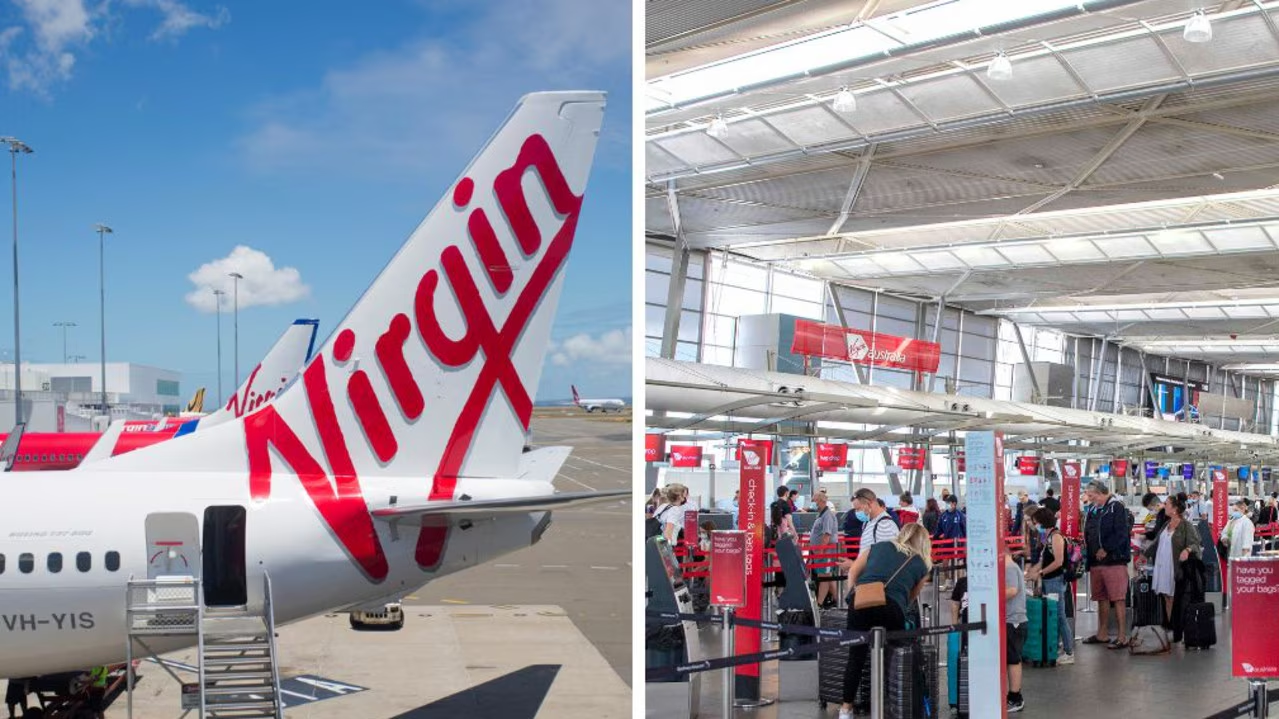
Imagine paying for a product or service you never received, then finding out years later the business gets to keep your money because you missed a deadline. That’s effectively what happened to thousands of Virgin Australia customers last week.When flights were grounded across the country as a result of Covid, many passengers were handed a travel credit in exchange for their cash booking, ensuring money stayed locked inside the airline until it was used on another flight.At midnight on June 30, 2026, Virgin let whatever remained of its own Covid credits expire for good. A few months earlier, the airline had disclosed that $93 million worth was still sitting unclaimed.Ironically, in the same week Virgin voided the last of its Covid credits, more than a million Qantas customers were being notified about their share of a $105 million class action settlement, the result of Qantas failing to properly refund customers for cancelled Covid flights. Qantas customers can also continue to convert unused credits into cash at any time, with no deadline attached.So, how did Virgin get away with transferring unclaimed Covid credits to their bottom line, when Qantas is in the process of paying out $105 million for attempting something similar?Cash in, credit outBetween 2020 and 2022, Virgin issued around $1 billion in Covid travel credits, relating to flight cancellations made as a result of the pandemic. But while customers initially paid for their flights in cash, they were never offered an equivalent cash refund. Virgin instead held the money as a travel credit, redeemable only for another Virgin flight booking. And up until just over one week before the deadline, the requirement was to both book and actually fly by June 30, 2026.In the months before the June 30 deadline approached, the airline disclosed that more than 90 per cent of the pool was eventually redeemed, leaving a cool $93 million outstanding.The extension that wasn’t really an extensionTo be fair to Virgin, it didn’t sit on one fixed deadline the whole time. In total, the airline extended the credits out four separate times, giving passengers years rather than months to use them.The last of these four extensions came just over one week before the deadline, as political and public pressure was building.To much fanfare, Virgin announced it was pushing out the travel window for credit redemptions to May 2027 - that’s 11 months of extra flying time, but the catch? The booking still had to be made before midnight on June 30. That left Virgin with nowhere near enough time to reach all the people who had forgotten their credit existed, let alone convince them to plan and book a trip.Virgin’s route map has also changed substantially since the early pandemic, when many of these credits were first issued. A customer who booked a regional service or an interstate business trip on a now defunct route in 2021 isn’t necessarily looking to jump on Virgin’s new Canberra to Bali flight to stop their money from disappearing.The ‘dormant’ passengers who were left behindOf the $93 million in remaining Covid credits reported by Virgin in the months before the deadline, more than 90 per cent belonged to accounts that hadn’t registered any activity with the airline in three years or more.Put another way: the customers who were checking their accounts or still flying regularly with Virgin had mostly already claimed what they were owed. The pool of money left belonged almost entirely to people the airline hadn’t heard from in years.It’s likely that many of these accounts had stale contact details attached, including old email addresses and phone numbers long since disconnected. Virgin stated that it planned to step up efforts to contact customers in the days before the deadline loomed, though it’s unclear what contact methodology this actually involved.And after three years, it’s safe to assume some of these passengers will almost certainly have lost capacity to travel, or moved overseas without a forwarding address. How Qantas set the precedentOf course, Virgin wasn’t the first Australian airline tempted to hold onto unredeemed Covid credits. Qantas got there first, and they got caught doing it.Back in 2023, Qantas came under enormous pressure over its handling of travel credits issued during the pandemic. Between public outrage, political scrutiny and a class action, it eventually committed to refunds.Today, Qantas Covid credits are able to be converted into cash with no tricky expiry date attached. At the same time, eligible customers are being notified by Echo Law about sharing in the Covid class action payout after Qantas agreed to settle it earlier this year.It was against this precedent that Virgin chose to let its own credits lapse.Virgin’s defenders will argue that its circumstances were different, and to some degree, that’s fair.The airline entered voluntary administration during the pandemic before being acquired by Bain Capital. Unlike Qantas, it was fighting for survival, and many Australians understandably want to see a second major airline survive.But passengers who booked Virgin flights during the pandemic didn’t sign up to fund Virgin’s balance sheet. Most were forced to accept travel credits in exchange for their cash because Virgin left them with no other alternative.Australia’s aviation consumer protection blind spotAustralia falls significantly short when it comes to airline passenger rights, especially compared with overseas jurisdictions that offer stronger legal protection when a flight goes wrong.There are signs this is starting to shift. Despite pushback from parts of the airline industry, new aviation consumer protection laws are currently before federal parliament, aimed at establishing an independent Aviation Industry Ombuds Scheme and stronger passenger protections.A case like this helps explain why reform is necessary.Under its own terms and conditions, Virgin had every legal right to wipe tens of millions of dollars in unclaimed passenger money. However, Australians are entitled to ask why one major airline is continuing to honour Covid travel credit refunds indefinitely into the future, while the other has voided them completely.Virgin’s future financial results should reveal how much of the remaining $93 million has been converted into revenue. It’s a tidy outcome for money that was never really the airline’s to keep.Adele Eliseo is a leading voice in the Australian loyalty and rewards space and advocate for frequent flyer literacy. As founder of Pointify and The Champagne Mile, she’s spent a decade demystifying airline and rewards programs to help Australians unlock the real value of their points. Read related topics:Qantas
‘Virgin extension wasn’t really an extension’
Imagine paying for a product or service you never received, then finding out years later the business gets to keep your money because you missed a deadline.
1,061 words~5 min read