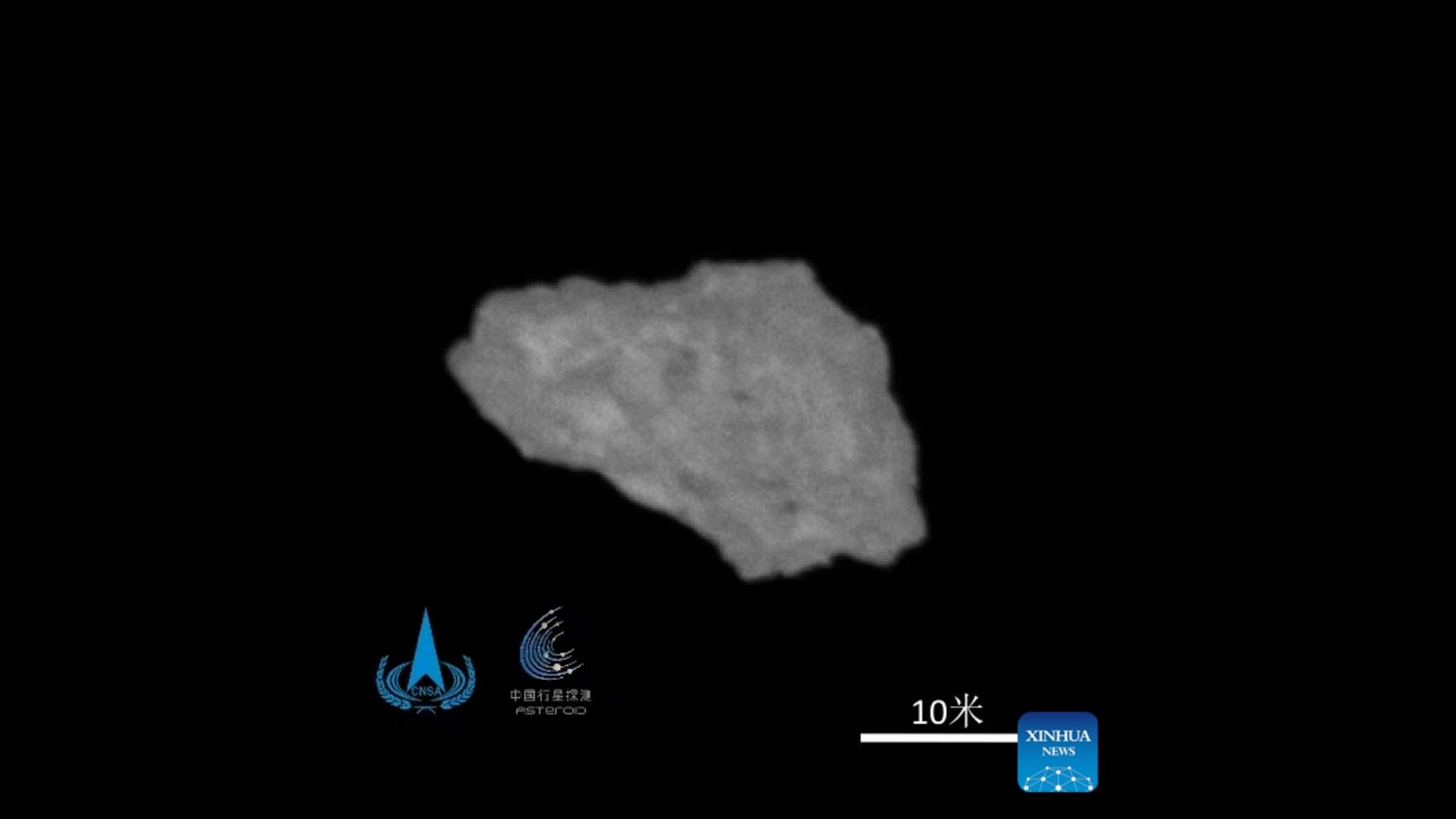
A photo of Kamo'oalewa, asteroid 2016HO3, taken by China's Tianwen-2 probe from a distance of about 12 miles (20 kilometers) on July 2, 2026.
(Image credit: CNSA/Handout via Xinhua)
China's first-ever asteroid sampling mission has sent home a picture of its first target, the "quasi-moon" Kamo'oalewa.The Tianwen-2 probe launched in 2025 and traveled 620 million miles (1 billion kilometers) to reach a safe distance about 12 miles (20 km) away from Kamo'oalewa, more formally known as asteroid 2016HO3. The spacecraft will spend nearly a year studying the asteroid with a suite of 11 different scientific instruments before attempting to collect a sample from its surface, which will be sent back to Earth.The new photo was taken on July 2, according to China's Xinhua news outlet, and reveals the asteroid to be a small, asymmetrical rock measuring around 50–65 feet (16–20 meters) in diameter. While its origin isn't known, some scientists believe this quasi-moon could have been created when a massive impact knocked a chunk of our own moon into space between 1 million and 10 million years ago.So-called quasi-moons (or quasi-satellites) are small bodies like Kamo'oalewa that circle the sun on orbits that keep them close to our planet. Earth has at least seven known quasi-satellites, and our planet's gravity will occasionally capture others temporarily before they are flung back out into orbit around the sun. In general, the orbits of these quasi-moons are less stable than the orbits of true moons.Unlike most near-Earth asteroids that are thought to originate from the main asteroid belt between Mars and Jupiter, Kamo'oalewa could have come from much closer to home. A 2024 study published in Nature Astronomy proposes Kamo'oalewa could be material ejected from the moon by the impact that formed Giordano Bruno crater.Sample of the asteroid collected by Tianwen-2 could help prove that hypothesis, if the mission is successful.