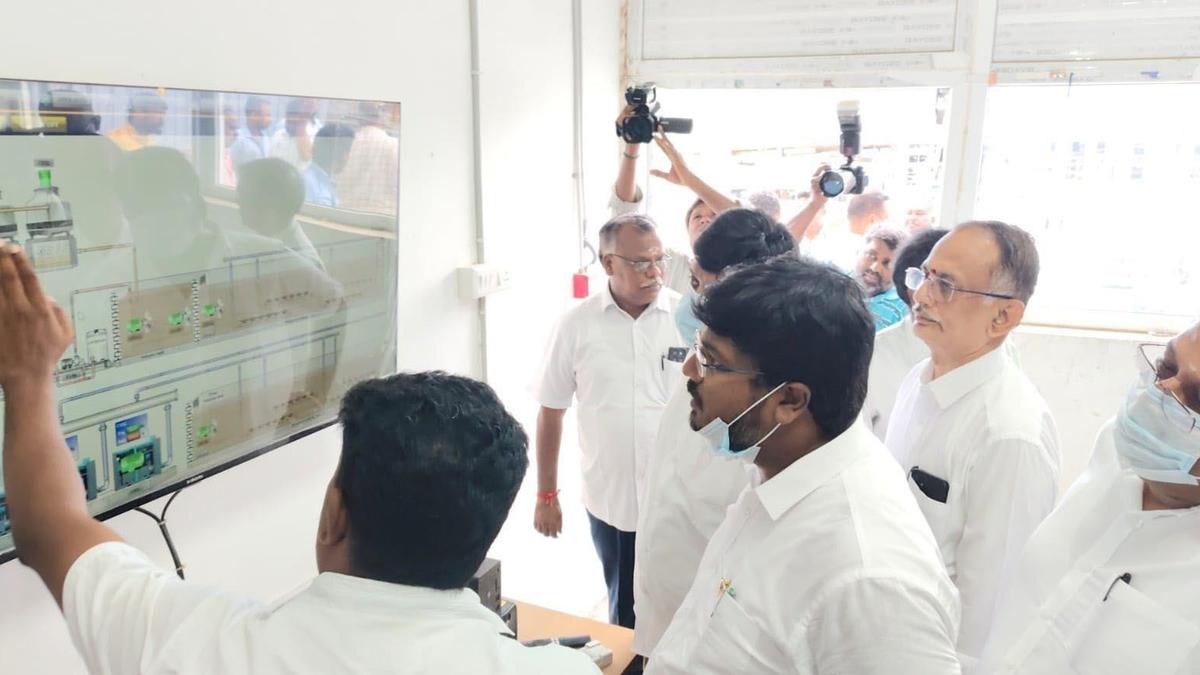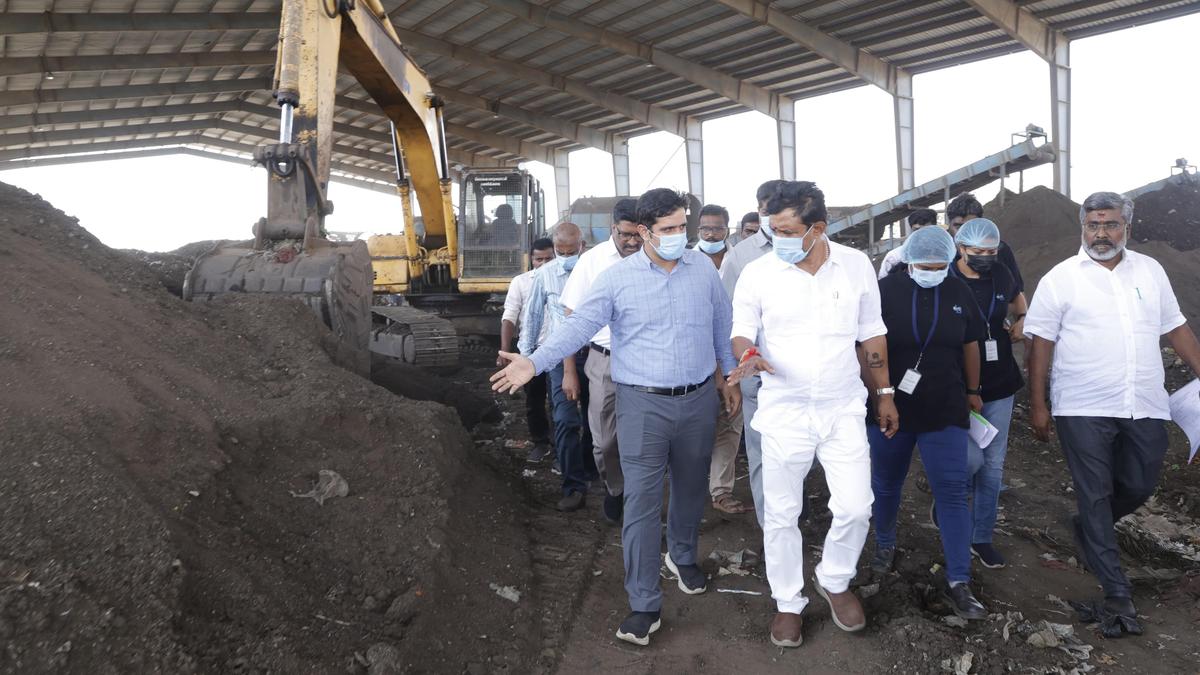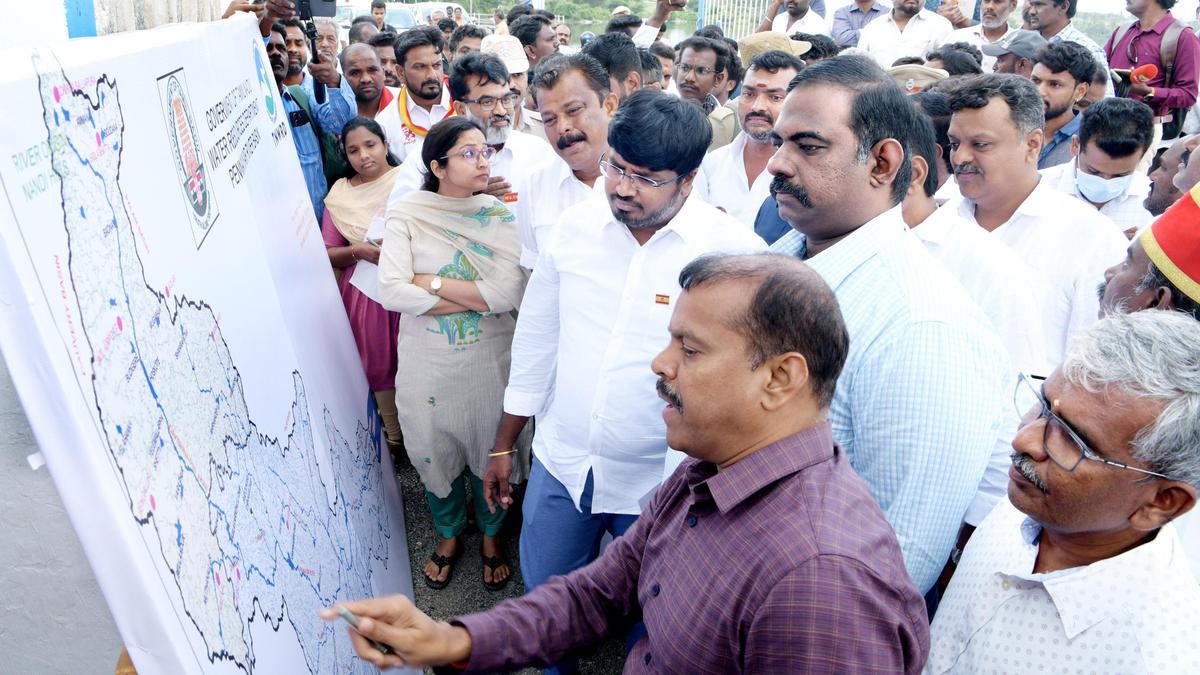
V.K. Rajeev, Minister for Environment and Climate Change inspecting the Kelvarapalli Dam being shown in the watershed area map in Hosur on Tuesday.
| Photo Credit: Special Arrangement.
Minister for Environment and Climate Change V.K. Rajeev inspected Hosur’s Kelavarapalli Dam on Tuesday (July 7, 2026) where foam from sewage inflows from Karnataka had been accumulating for over a month.The dam, located 8 kms from Bengaluru border and 10 kms from Hosur, has been brimming with foam typically caused by heavy sewage contamination of water, where the foaming is caused by the water falling from an altitude.Kelavarapalli Dam with a watershed area of 3,676 ha, is also the water source for the SIPCOT-Hosur drinking water scheme and the Hosur Corporation’s water supply and distribution.The run-off from Bellandur and Varthur Lake is discharged into River Then Pennai, which carries the domestic sewage from Koramangala, Sallakatta and Hebbal. According to the administration, partially treated and fully untreated sewage waters from Varthur, Agara and Bellandur lakes are part of the link lakes that flow into the dam.The Karnataka stretch of the Then Pennai that flows into the dam has already been labelled as Priority-I Polluted River Stretch with highest Biochemical Oxygen Demand (BOD) by the Central Pollution Control Board (CPCB).Every season, with heavy rain, the lakes overflow with the sewage that is drained into the river and in turn into the Kelavarapalli reservoir. The foaming of the waters is caused by the surface’s active agents and high phosphate, ammonia, and nitrate levels. The Tamil Nadu Pollution Control Board (TNPCB) periodically collects water samples for quality analysis, and has repeatedly written to the CPCB to seek the cooperation of the Karnataka government in stemming this pollution. A Real-Time Water Quality Monitoring Station has been set up by the TNPCB, and sample analysed between April 2025 and March 2026 revealed high amounts of ammonia, nitrogen, phosphates, faecal matter and coliform bacteria in the water. This has also affected the Krishnagiri Reservoir Project (KRP) Dam, located 60 kms down stream, where increased water hyacinth growth with high levels of BOD, Chemical Oxygen Demand (COD), ammonia, nitrates and phosphates are attributed to the Kelavarapalli waters.According to the district administration, Bengaluru city discharges about 1,329 million litres of sewage water. However, the 29 sewage treatment plants (STPs) are only capable of treating 830 million litres, and an additional 12 new STPs have been proposed by the Karnataka government.Earlier, inspecting the Kelavarapalli and KRP dams, the Minister said adequate measures will be taken, and a report of the level of pollution will be presented to the Chief Minister C. Joseph Vijay, to emphasise upon the Karnataka government to take steps to stem the pollution. Published - July 07, 2026 09:18 pm IST