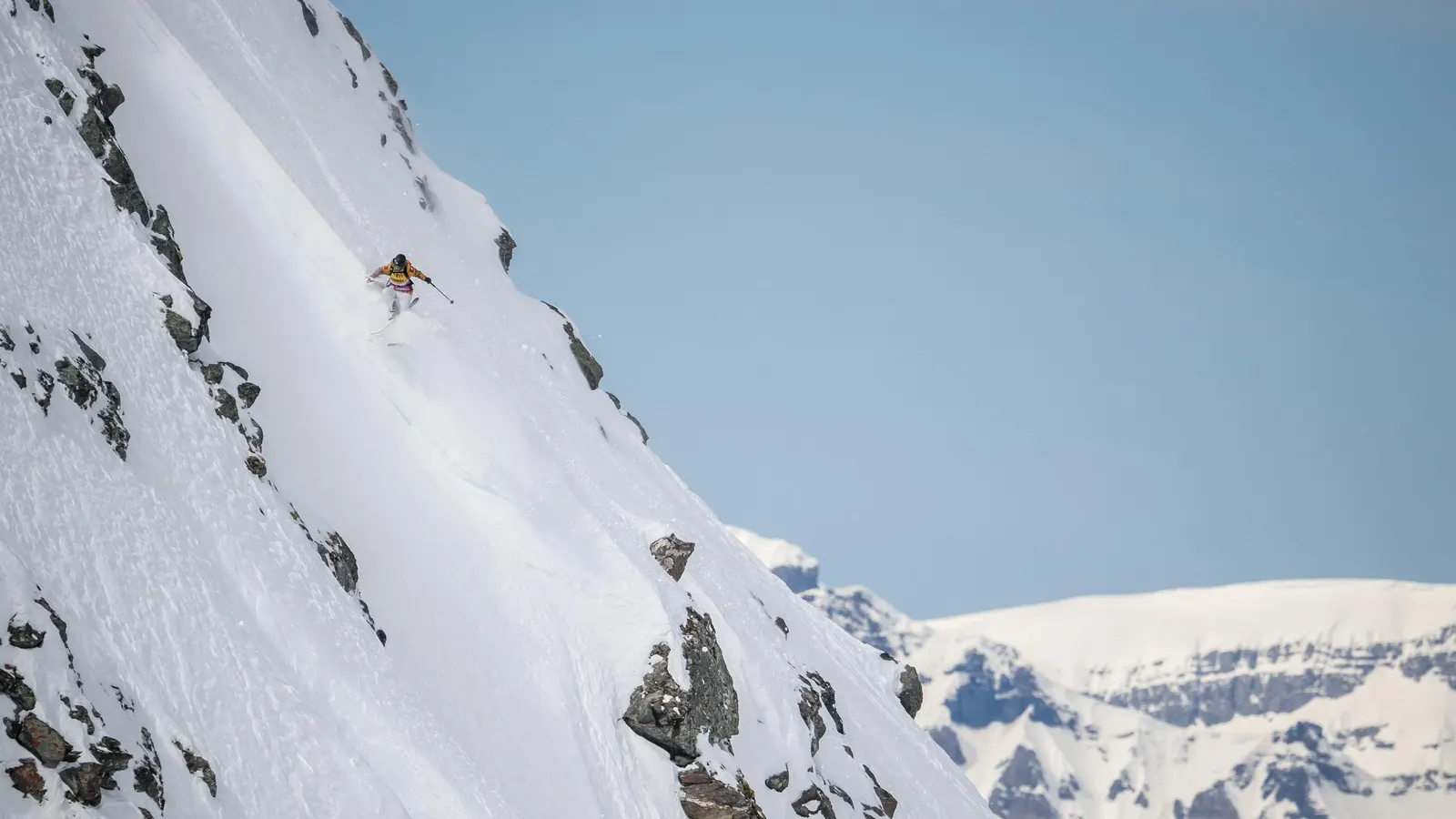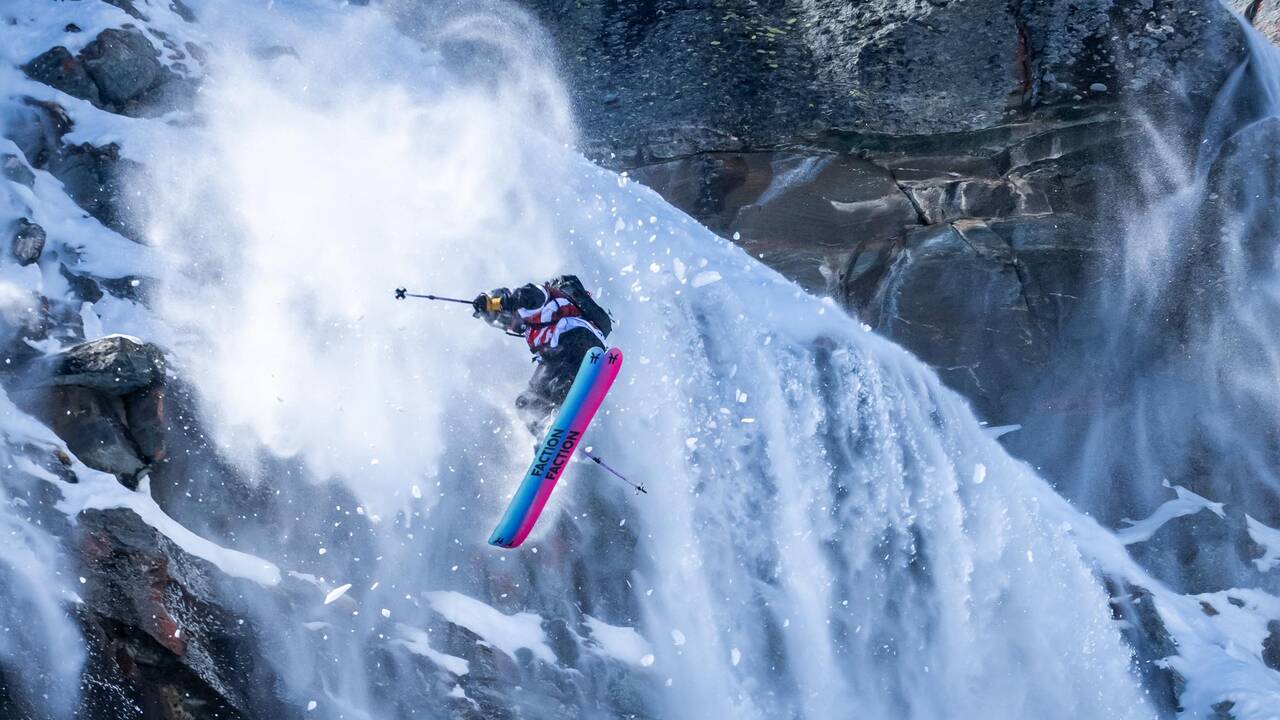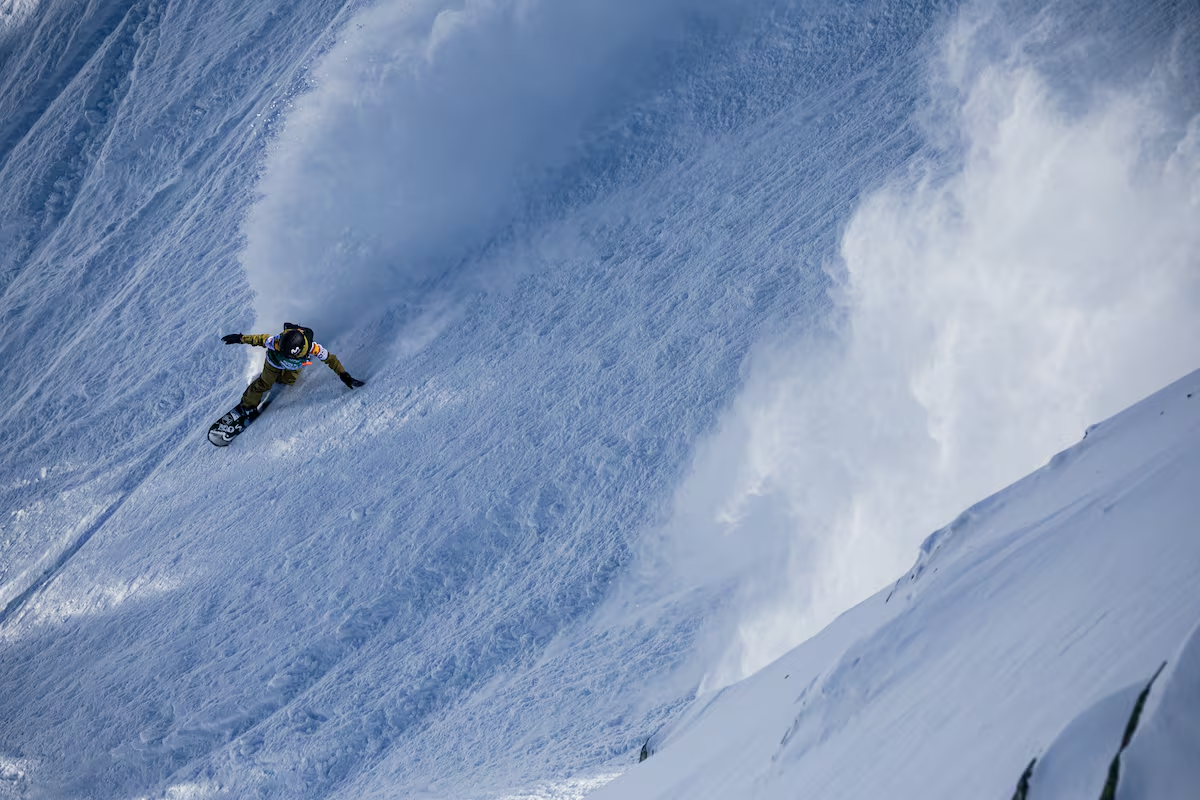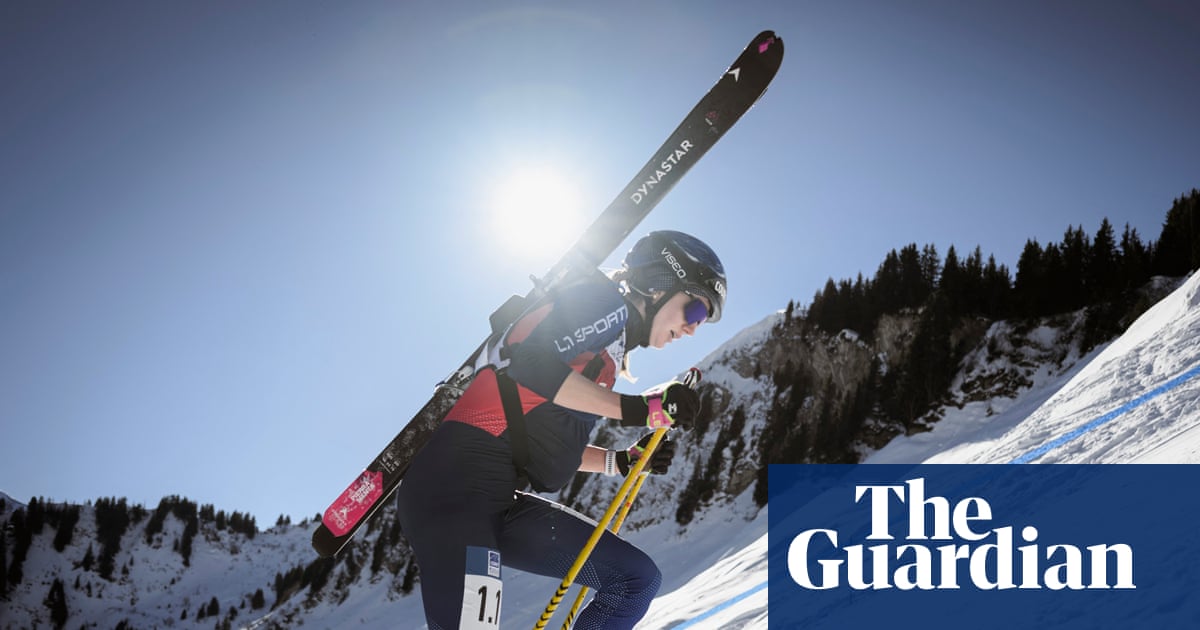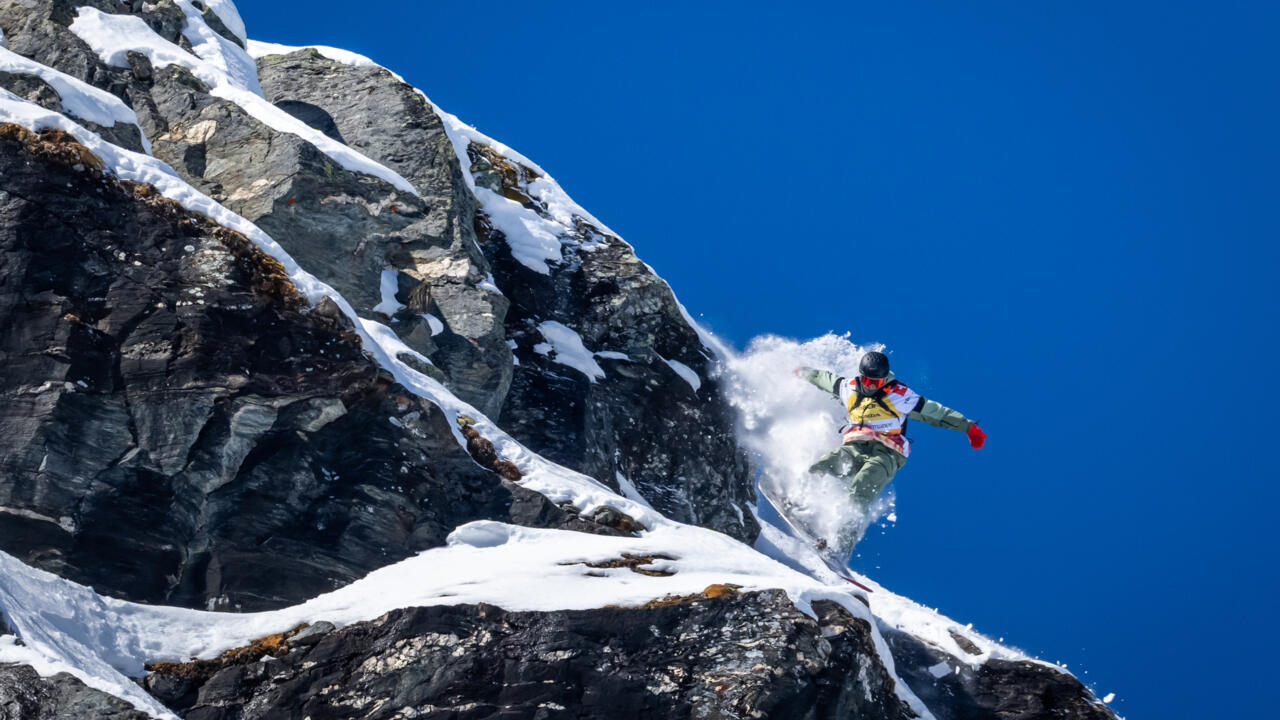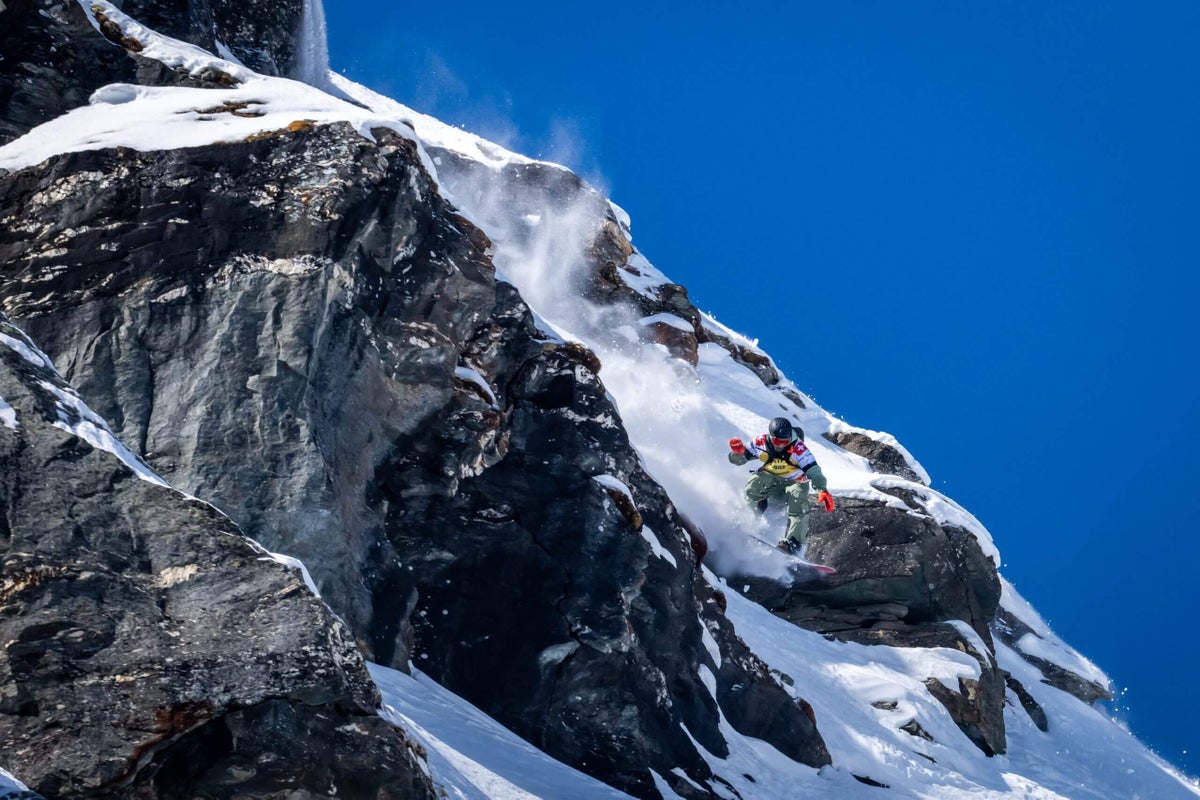
It starts in a place mostly inhospitable to human life, under a small, pyramid-shaped gate with just a handful of people standing on a craggy mountain peak, all of whom look as if they’re one wrong step away from falling off. The finish line is somewhere down below, past unspoilt snow and wild terrain that doesn’t look suitable for what they’re about to do. How they get there is anyone’s guess until it’s happening.This is freeride skiing and snowboarding — an exercise in imagination and creativity, the newest addition to the Winter Olympics, and a sport you may not have heard of before.“There’s definitely a lot of people that are like, ‘I have no idea what you do,'” says Mia Jones, an American and last season’s women’s snowboarding champion on the Freeride World Tour (FWT), the sport’s top competitive circuit. “Usually, I’m like, ‘OK, we get a venue, we get a big mountain, and you choose your own line, and it’s all about hitting cliffs and doing tricks and making it down in your own creative way.'”Or, as Ross Tester, an American who finished third in the FWT men’s ski standings last season, puts it: “There’s a part of the mountain where there’s a bunch of rocks and cliffs and chutes, and we go and look at the mountain and decide how we want to ski down it, and we get judged on how we ski it.”American Ross Tester competes at the 2025 Xtreme Verbier event on the Freeride World Tour. Tester finished third this past season in the men’s ski division. (Maxime Schmid / AFP via Getty Images)Freeriding — in which athletes compete on ungroomed slopes, carving their own paths down the mountain and using whatever techniques they like to accumulate points on a judge’s scorecard — will debut at the 2030 Games in the French Alps, the International Olympic Committee announced Tuesday, meaning a lot more people are about to hear about it.It’s a spotlight that Nicolas Hale-Woods, the founder and CEO of the FWT that has helped bring the sport to this moment, says the community has earned.“We started from scratch 30 years ago, and today there’s a hunger for legitimacy from riders and from all stakeholders of the sport,” Hale-Woods said. “We have a format that works on a sports level, in terms of fair play of the system, and we produce content and competitions that are exciting. And we have an audience that is exciting to the eyes of the IOC.”Why the IOC wants it inThe future of the Winter Olympics has been a hot topic in recent years. The event is significantly smaller than its summer counterpart, with more niche events contested in only those parts of the world with suitable winter weather. The speciality venues are expensive to build and maintain, and climate change threatens the long-term viability of all of it.It’s led to many theories about how to boost attention and sustainability, including ideas as drastic as taking traditional Summer Games sports played indoors and moving them to the winter. For now, the IOC has settled on adding a new sport that still holds true to the Winter Olympic tradition of only letting in snow and ice competitions.Freeriding was appealing to the IOC because it has impressive international participation — Hale-Woods says there are 11,000 riders from 76 countries in the sport’s pipeline, and the top-ranked skiers and snowboarders last season hailed from North and South America, Europe and Oceania — and active men’s and women’s divisions. All of its venues are provided and maintained by Mother Nature, requiring minimal setup and upkeep compared to other ski and snowboard courses.“Freeride has experienced rapid international growth, benefitting from a strong youth fanbase and visually spectacular competition,” the IOC said in its press release announcing the move. “It uses a natural field of play, which minimises its impact on the Games.”It’s also sure to play well on TV. The sport is perhaps better known for its non-competition side — a subculture of documentary filmmaking, with skiers creating exhilarating videos of daring runs down steep mountain chutes.How freeriding got to this momentFreeriding has been around as long as skiing has — it is, in essence, the natural form of the sport — and has gained renewed popularity in the last few decades as an alternative to the highly regulated world of ski and snowboard racing. Freeriders sought the freedom of the sport’s roots on open mountains.That gave rise to competitions and, ultimately, the FWT. Founded in 1996 as a snowboard-only league, the sport eventually added skiing and has been crowning yearly men’s and women’s champions in both since 2008. The barrier for entry is much simpler compared to most other ski race paths — for as little as $30, anyone can obtain a license and compete at a lower-tier event.In 2022, the International Ski & Snowboard Federation (FIS) — the international governing body for a wide swath of Winter Olympic sports, including Alpine skiing — entered into partnership with the FWT in a necessary step toward Olympic inclusion. The sport held its first FIS Freeride World Championships last February in Andorra. Jones won the women’s snowboard event.For a community with roots in rebelling against the sport’s traditional barriers, the FIS partnership met a mixed reaction. A pathway to the Olympics would greatly increase exposure for the sport and its athletes, but some feared it would come at the cost of the sport’s independent soul.“If (the Olympics) do it in the right way, it can bring so much more energy and opportunity to all of these athletes that maybe is not necessarily there and so much more exposure,” Jones said.American Mia Jones, last season’s women’s snowboard champ, competes on the Freeride World Tour. The Olympics can bring “energy and opportunity” to the sport, she says. (J Bernard / Courtesy of Freeride World Tour)How freeride competitions workIn freeriding, athletes gain and lose points for skills displayed during their runs. A unique aspect of the system is that there aren’t separate competitions to emphasize certain skills — all freeriders compete in one event, where anything goes. One rider might choose a line that emphasizes jumps and tricks. Another might prefer to focus on speed and technique while navigating the tough terrain.When they reach the finish line, they’re assessed a score that takes it all into account and declares a winner, even though the runs can look entirely different. It’s akin to slalom racers and big-air jumpers being graded on the same scale.“Sometimes, it is totally a toss-up between the runs,” said Tester. “I think in some ways, that’s what makes it kind of exciting. There can be controversies over who won. … It’s very subjective and kind of in the eye of the beholder. And I think that’s what makes it fun.”It’s also likely to confuse the millions of viewers tuning into the sport for the first time in 2030. Hale-Woods said that explaining the scoring system to wider audiences will be paramount between now and the French Alps Games.“The technique they use is pretty simple,” he said of the judges. “When the rider is in the starting gate, he’s got 50 points just before dropping in. And the maximum number of points is 100. And he will make two turns and jump, let’s say, a 5-meter rock, landed perfectly. … Let’s say on that mountain, judges have scaled it and said that jump would be 5 points. So he does that, he comes from 50 to 55 points. Then he goes in a chute, and in one of his turns, has a sort of loss of control. They take two points out. So he’s at 53 at that point of the run. And they carry on like this until the very end.”Riders have a general idea of the scoring system for each mountain, but they get no practice runs. When they drop in to compete, it’s their first and only attempt. Their only preparation is looking up at the mountain and searching for inspiration.“It’s like, look at the mountain, look at the venue, and sometimes it doesn’t work out,” Jones said. “Sometimes … I’m kind of like, OK, hopefully it comes to me soon. I’m just gonna stare at the mountain for another hour and something’s got to pop out.”What it’s like to watchFor organizers, there’s also the challenge of getting fans to the often-remote venues. On the FWT, in-person viewing options can vary greatly. Some stops have traditional fan viewing areas with large screens relatively close to ski town centers. Others require spectators to take a lift and ski to the finish area (“You have to have a good level of skills,” Hale-Woods says of one tour stop’s skiing requirement). Others are completely inaccessible to spectators — the tour’s stop in Alaska requires a helicopter ride, and only riders and select officials and media are able to go.Nicolas Hale-Woods, Freeride World Tour founder and CEO. (Nyl Baczynskyj / Courtesy of the Freeride World Tour)Speaking before the announcement of the sport’s inclusion, Hale-Woods declined to say if the venue for 2030 had been selected, but he was confident fans would be able to access the viewing area easily.“You’ll be able to watch it without binoculars, and you’ll even be able to reach the spectators’ area, even if you’re a pedestrian,” he said. “It does bring a huge dimension when the crowd is screaming and cheering, and the riders can hear the crowd from the start gate.”For those not trekking to France in four years, it’s sure to be a TV-friendly sport, with the drone cameras that were so popular at February’s Milan Cortina Games likely to capture incredible shots of riders flying through daunting landscapes.A rare opportunity for the sportThough new sports are common in the Summer Games, it’s much rarer for the Winter Olympics. Ski mountaineering was added in 2026 — and will return for 2030. Before that, snowboarding was the last completely new sport added, for the 1998 Games in Nagano, Japan. (Curling in 1998 and skeleton in 2002 were also re-added after lengthy absences.)Speaking before the announcement was official, Tester and Jones were well aware of the significance of the moment.“The opportunities that it would bring for athletes would be huge, both support and training,” Tester said, “and everything that comes with having more eyes. Yeah, I think it’s really exciting.”Added Jones: “The Olympics … growing up, it’s something you watch, and it’s the peak of what seems like athletic capability. And for me, freeriding has always been my passion. And so to have the opportunity to go out there and showcase that on the big stage, I think it would bring a lot individually and also just to the sport in general.”A sport born out of a desire to avoid the spotlight of traditional ski and snowboard competition now finds itself firmly in its glare. Hale-Woods is optimistic that freeriding can benefit from the Olympic attention without losing touch with itself.“There’s one adage in French which says that if you don’t grow, you have a problem,” Hale-Woods said. “We can still grow. And we won’t lose our soul.”
What to know about freeriding, the newest Winter Olympic sport
Freeriding, in which athletes choose their own paths down an ungroomed mountain, is set for its Olympic debut in 2030. Here's what to know.
1,855 words~8 min read