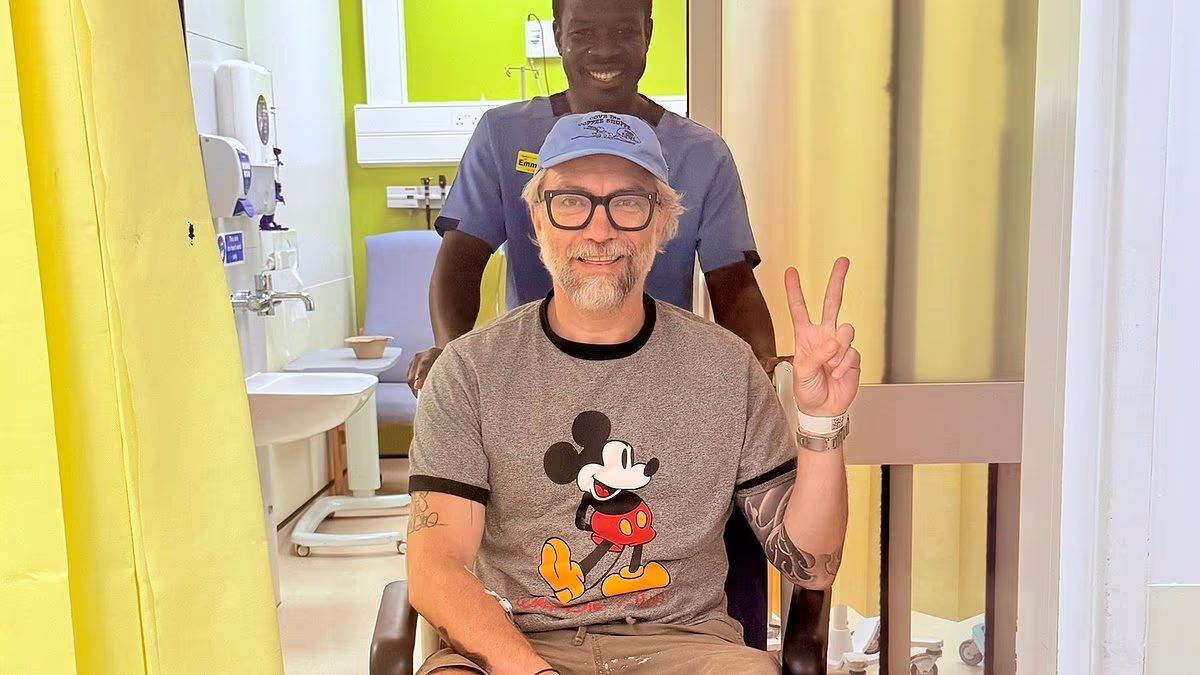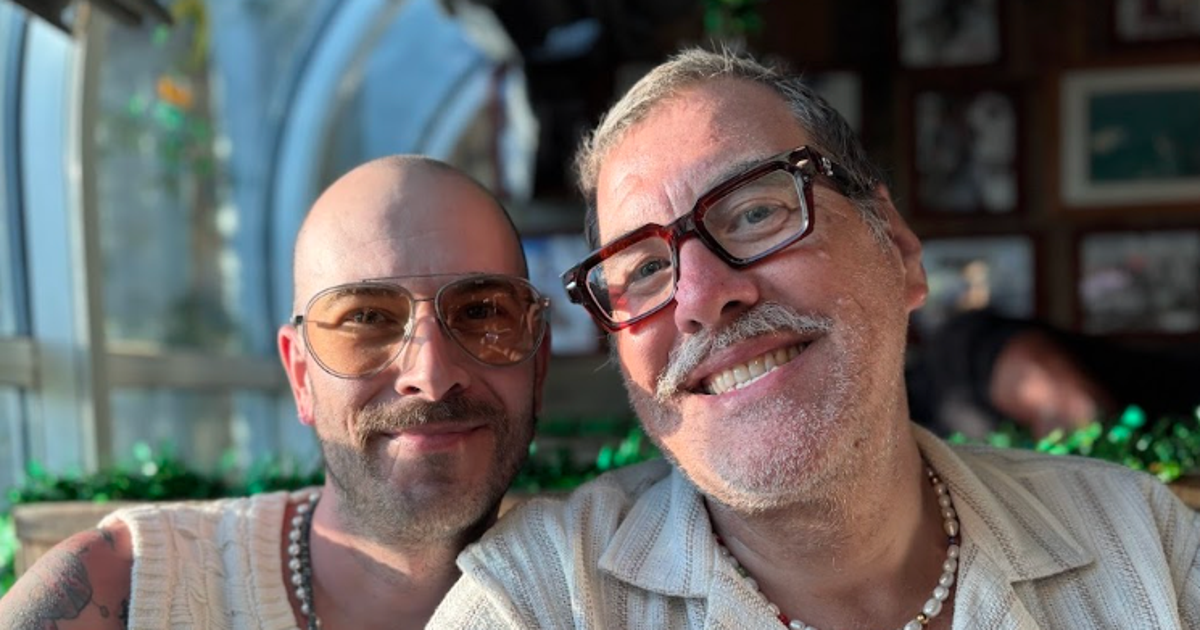
I was 13 years old, sitting in the back seat of my parents’ white Chevy Cavalier, convinced I was about to be outed.They wouldn’t tell me where we were driving. My mind was running through every scenario imaginable. The younger, more insecure version of me, carrying something I believed could destroy my family, was certain they were taking me for an HIV test. What would I say? What would they say? Was there any version of this moment that could end with my family still intact?We pulled up to a bike shop. It was my birthday. The bike was the surprise.I sat in the back seat, flooded with relief, and thought: I have to be more careful. Not, maybe it’s okay to be who I am. Just: hide better.I was very good at hiding. I practiced it for another 18 years.I’m 52 now. I have Stage 4 colon cancer, my second diagnosis with this same disease. I am, by every medical measure, running out of time. I am dying. And I am, for the first time in my life, completely out of secrets.It turns out that dying has a way of making secrecy feel like an extraordinary waste of time.The first diagnosis came at 38. Stage 3. Two years of chemotherapy, radiation, and surgery, and I faced it as you do at that age, when you still believe effort is enough — that if you fight hard enough, you can earn your way back to OK.And I did. I went into remission. I built a life on the other side of it.Ten years passed. Then, 10 years to the day, it came back.There is no language adequate to that specific cruelty. When the second diagnosis landed, I was also recovering from COVID and nursing a broken wrist, and I was completely out of the optimism that had carried me through the first time I had cancer.For six months, I barely left my home. My then-boyfriend Anthony and I ordered our groceries and meals. The only time I went outside was to walk my dogs — my two small reasons to keep moving when I couldn’t find a larger one. It was the darkest six months of my life, and it cracked me open in ways I hadn’t anticipated. Which, eventually, turned out to be exactly the point.The author (right) and his husband, Anthony, in Miami BeachCourtesy of Kris SaimThe letters started in the infusion chair.I’d show up for chemotherapy, get comfortable, and during those long hours with the medication coursing through my veins, I’d grab a pen and start writing. Not on a computer, but by hand, because some things just feel more real when you’re actually putting pen to paper, like you’re truly investing yourself in the words.I ended up writing 74 letters. Some were to colleagues, some to friends, and even some to those I had wronged or who had wronged me. I also wrote to the different versions of myself that I had left behind. My husband (we tied the knot in summer 2024, which feels like a small miracle in itself) and I explored several ways to deliver these letters. Giving Anthony the responsibility after I died seemed unfair, plus there was the logistics of finding everyone’s addresses. Sharing the letters via direct messages on social media felt too impersonal — almost defeating the purpose of writing the letters. We also discussed that we could record me reading the letters and then email the file to the recipients. However, the more we contemplated it, the more we appreciated the idea of sharing the letters over Zoom and recording the session, so each recipient could respond in real time and have a living memory of our conversation.That’s how “Dying Out Loud,” my podcast, came to be. It was born from the need to have the conversations we keep putting off. It became a space to voice the things we’ve been saving for later, for when we finally feel ready.The letters turned into episodes, which then formed a community of people who realized they needed to stop waiting and start sharing now.The first letter — the one that made all the others possible — was the one I wrote to Anthony.I wrote three versions before I found the words that felt true enough to keep.The first two weren’t wrong exactly. Each version was just incomplete, the way you can say something real and still feel like you’ve only grazed the surface of what you actually mean.Writing to the person who has seen you at your absolute worst and who has chosen to stay anyway requires a particular kind of courage. Every time I sat down to try, the reality of what I was actually doing would land on me fresh: that I was writing a letter to the man I love — one he might read years later on days when he needed a reminder of my love for him after I am no longer here to say any of it in person. I understood that this piece of paper might have to carry everything my voice no longer could.Heartbreaking is the only word for it. Not in a poetic sense. In the most literal sense, I could feel something breaking open in my chest every time I tried to find the words for what Anthony means to me, for what his presence in my life has been, and for what I needed him to know before I ran out of time to say it.The third version was the one that really clicked for me. I can’t pinpoint exactly what changed, but somewhere along the way, I stopped worrying about finding the perfect words. Instead, I just laid out the truth — no edits for his comfort or mine.When I finally read it aloud to the man who is now my husband, I was overwhelmed. It wasn’t that the words were hard to say; it was that every sentence hit home just right. I could see it on his face as he heard the things I should’ve said long ago but never did.Anthony’s response wasn’t a speech. It didn’t need to be. What he gave me was the same thing he gave me that night in the dark when I told him how broken I truly was. He made himself completely present, completely immovable, and he let me know without any ambiguity that every word had been received. That he had heard me. That there was nothing left unsaid, which allowed us to focus on nothing but the time we had remaining with each other.That is the gift of saying the true thing out loud. Not that it resolves everything. Just that it lands, and you know that the person you love gets to carry it with them for eternity.The author (right) and his husband, AnthonyCourtesy of Kris SaimThe letter to my kids — my daughter is now 29 and my son is 25 — was something else entirely.There are things you assume as a parent: that your children know how proud you are, that they understand how deeply they are loved, that the things left unsaid are somehow felt anyway across all the ordinary days of a shared life. I made that assumption for years. It turned out to be more fragile than I knew.When I read them my letter, I told them how proud I am, not in the general, reflexive way parents say it, but specifically, granularly, with examples and details that said I have been paying attention. I see exactly who you are and I am in awe of the people you’ve become.I also told them something harder: that I carry real regret about the time I didn’t give them, the moments I was present in the room but absent in the ways that mattered, the years when I was so lost in my own becoming that I sometimes forgot just to be their dad.I don’t think they expected to hear either of those things.There was genuine surprise in the room — the particular surprise of people who had wondered, maybe without ever saying so, whether they were as important to me as they hoped they were. Nothing could have prepared any of us for the emotions that reading brought forth. There were tears that came from somewhere deep and old, the kind that don’t just belong to that moment but to every moment before it that had gone unnamed.What I felt afterward was something I can only describe as relief mixed with love mixed with grief — grief not for what was lost, but for all the years those words had existed inside me unspoken and not doing any of us any good. I was so thankful to be able to say those words out loud. It was so comforting to watch my kids hear them. And it was so peaceful to give them something they could keep.The author (right) and his son, Jakob, with granddaughter, PiaCourtesy of Kris SaimI read a letter I had written to myself during another episode.In it, I said something I had never said to anyone: that I had been sexually abused beginning at the age of 4, and continuing in different forms until I was 16. More than a decade of my childhood, carried in complete silence, with no language for what it was and no permission to put it down.I considered not airing that episode. I sat with my finger over the delete button for longer than I’d like to admit. But I had come that far, and underneath the terror was a quieter voice that said, This is the last weight. Put it down.After it aired, the weight lifted.Messages came from people I’d never met who had carried something similar. People who needed to hear that the silence could end. That you could survive the telling. That the freedom on the other side was real.It is real. I am living proof. Saying these things out loud taught me something I should have learned decades earlier: the things we hide have far more power over us than the things we’ve released.The author and his daughter, Kennedy, on Father’s Day 2026Courtesy of Kris SaimBy the midway point of our second season, we have delivered more than 30 letters to a variety of people who have impacted my life. They included my high school best friend, my high school theater teacher (whose voice was in my head when I came out decades later), my collective work community of almost 800 people worldwide, friends I’ve known for decades, and influential individuals I’ve met in just the last year or two. Throughout each conversation, we shared memories, laughter, and tears. The feedback has been tremendous. Everyone who has participated in “Dying Out Loud” has expressed gratitude for their messages. Some were surprised by the significant impact they’ve had on my life and others were simply happy to receive such heartfelt and personal notes. These individuals have also conveyed that through this process, they have recognized the importance of expressing love and appreciation to those who deserve it today, while there is still time.Coming out at 31, 18 years after that car ride with my parents to the bike shop, was not a single dramatic moment. It was a slow and nonlinear process of deciding, piece by piece, that being fully known was worth the risk of losing everything I had spent a lifetime protecting. I grew up Pentecostal in a household where gay people were cautionary tales. Whispered about. Cast out. I had built my entire life around that knowledge — a life that looked exactly as it was supposed to look, with a door locked from the inside and only me holding the key.A life built on hiding is exhausting in a way that’s hard to describe until you stop doing it. It isn’t dramatic, it’s just a constant, low-level expenditure of energy to keep the performance consistent and the real thing out of sight.Cancer cuts the power to that system entirely.When you are sitting in an infusion chair with a terminal diagnosis, the energy required to maintain a false version of yourself simply isn’t there anymore. What remains is just you — the actual you — the one who was always there underneath, and the question of what to do with whatever time is left.I chose to come out. I chose to say what happened to me as a child. I chose to write 74 letters and read them into a microphone. I’m not particularly brave. I’ve been terrified at every single step of this journey. I’m just finally more afraid of leaving things unsaid than I am of saying them.The author (second from right) and his husband, Anthony, daughter, Kennedy (second from left), and daughter-in-law, Sammi at Taylor Swift’s Eras TourCourtesy of Kris SaimHere is what I want to leave you with, not as a dying man dispensing wisdom, but as someone who has lived on both sides of the silence and can tell you with certainty which side costs more.The conversation you’re postponing is costing you more than you know.The person you love deserves to hear exactly what they mean to you — while you’re still here to tell them. Not in a eulogy at the funeral. Not in a letter that arrives after you’re gone. Now, while there’s still time to sit across from them and watch their face when the words finally land.I wrote 74 letters because I finally understood that the things worth saying don’t keep.Say the thing. Write the letter. Make the call.Not because you’re dying.Because you’re alive.That has always been reason enough.Kris Saim brings three decades of experience to his work as a coach, speaker, organizational development leader, and host of the podcast, “Dying Out Loud.” The idea for his podcast was born after Kris was diagnosed with Stage IV Colon Cancer and began enduring long chemo treatments. During each session, he would write a letter to a loved one, 74 letters in total. Kris is now sitting down with each recipient to read their letter and allow them to respond and real time, giving them a living memory of their conversation. His story has been featured on local and national media, including “Good Morning America.”Do you have a compelling personal story you’d like to see published on HuffPost? Find out what we’re looking for here and send us a pitch at pitch@huffpost.com.
I'm Dying From Stage IV Cancer, So I Wrote 74 Letters To People In My Life. Here's What Happened When I Shared Them.
"I’m not particularly brave. I’ve been terrified at every single step of this journey. I’m just finally more afraid of leaving things unsaid than I am of saying them."
2,402 words~11 min read