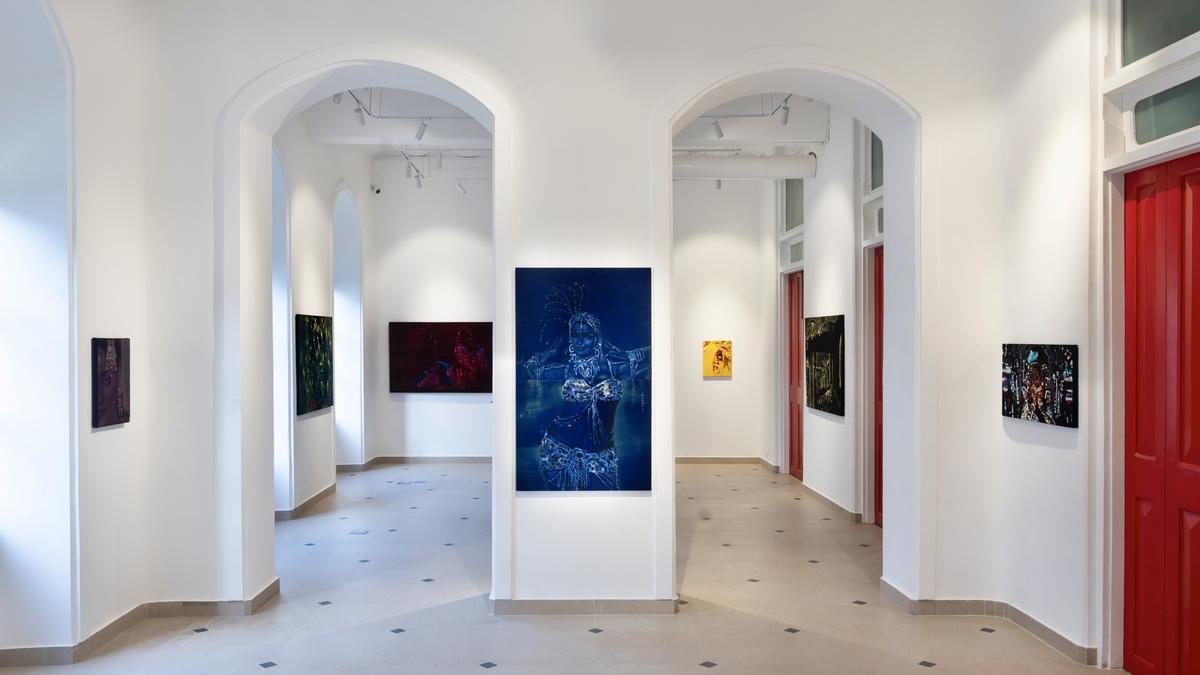
“I think I’ve wanted to open my own gallery since I was an embryo,” laughs Sunaina Rajan, founder of the 1,600 square-feet Gallery Maxima, Mumbai’s newest contemporary art gallery. “I always knew I had to do it. It was just about waiting for the right time, and feeling prepared enough to make the leap.”At 28, Sunaina has long been the person collectors, curators and journalists turn to when looking for the next generation of artists. “People would always ask me, ‘Who’s hot right now?’” she says. “I became the encyclopedia of what was happening in the contemporary art scene.”
Gallery Maxima in Mumbai
| Photo Credit:
Special arrangement
That reputation was built during her years at Chemould Prescott Road, where she co-founded Chemould CoLab, the gallery’s platform for emerging artists. Stints at the School of the Art Institute of Chicago, Lévy Gorvy Dayan and the Museum of Art & Photography, Bengaluru, followed, before she took a deliberate detour into the business of art at Nature Morte.“I knew how to work with artists and mount exhibitions, but I didn’t understand the business side,” she says. “For two years, I focussed on sales, acquisitions, building collections, and relationships with collectors. Now I understand both worlds.”Her commitment to emerging artists is rooted in experience rather than generational kinship. As co-founder of Chemould CoLab, Sunaina introduced artists such as Gurjeet Singh, Kuldeep Singh, Anirudh Shaktawat, Rithika Pandey, Shailee Mehta and Pallavi Sen through their first solo exhibitions in Mumbai. Today, she continues to keep a close eye on younger practices. “There are a few artists whose work I return to again and again, including Kuldeep Singh, Purvai Rai and Arpita Akhanda,” she says.“They’re going to be the next tastemakers,” she says. “They’re showing us what contemporary art can be and how traditional mediums like oil painting or ceramics can be reimagined.”When evaluating an artist, Sunaina looks beyond the image itself.“Running a studio practice and making art are two very different things,” she says. “Is the work archival? Will it last? Is the artist thinking about preservation, storage and transport? Are they stretching custom canvases or buying ready-made ones? Are they mixing their own pigments or squeezing paint straight from the tube? Those decisions tell you how seriously they’re thinking about the life of the work.”