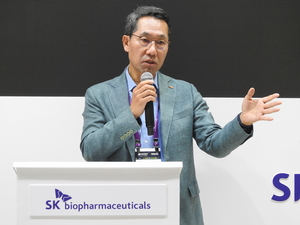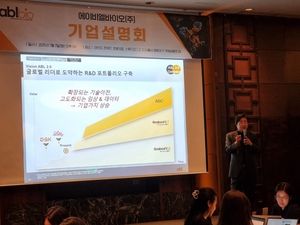
ABL Bio CEO Lee Sang-hoon speaks at a press conference at the Conrad Seoul on Tuesday. (Kan Hyeong-woo/The Korea Herald) ABL Bio is seeking to transform itself from a licensing-focused biotech company into a globally competitive drug developer while advancing both its oncology pipeline and proprietary platform technologies.“The dream is no longer signing another large licensing agreement,” Lee Sang-hoon, CEO of ABL Bio, said at a press conference at the Conrad Seoul on Thursday."The goal is building a company that can stand shoulder to shoulder with global pharmaceutical companies."The vision comes as ABL Bio enters a critical period for its lead clinical asset, ABL111, a bispecific antibody targeting Claudin 18.2 and 4-1BB for the treatment of gastric cancer.The Korean biotechnology firm recently received approval from the US Food and Drug Administration to advance ABL111 directly into a registration Phase 3 trial under its fast track program, bypassing a conventional Phase 2 study. The study is expected to begin sometime in December in partnership with China's NovaRock Biotherapeutics.According to Lee, the FDA's decision could shorten the development timeline by several years and significantly improve ABL Bio's ability to compete in the rapidly evolving Claudin 18.2 market.While ABL111 represents the company's most advanced near-term opportunity, the CEO emphasized that ABL Bio's future growth will depend on platform technologies capable of generating recurring partnership revenue and supporting internal drug development. Central to that effort is Grabody-B, the company's well-known blood-brain barrier, or BBB, shuttle platform."The industry's interest in brain delivery technologies has increased substantially," Lee said. "Companies are no longer asking whether drugs can cross the blood-brain barrier. They are asking how effectively and safely they can do so."Lee noted that ABL Bio is expanding the platform's potential applications beyond conventional antibodies. Current research efforts include the delivery of small interfering RNA, enzymes, fusion proteins and other biologics that have historically struggled to penetrate the central nervous system.The company is also investing in next-generation oncology technologies, including antibody-drug conjugates and T-cell engager platforms, while strengthening its clinical development and regulatory capabilities to support later-stage global trials, according to Lee."Clinical success remains the most important factor," he said. "But the ultimate objective is creating a company that continuously generates value through innovation, development and commercialization."
ABL Bio doubles down on self-sustainable growth beyond licensing deals
ABL Bio is seeking to transform itself from a licensing-focused biotech company into a globally competitive drug developer while advancing both its oncology pip
372 words~2 min read