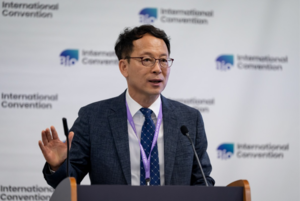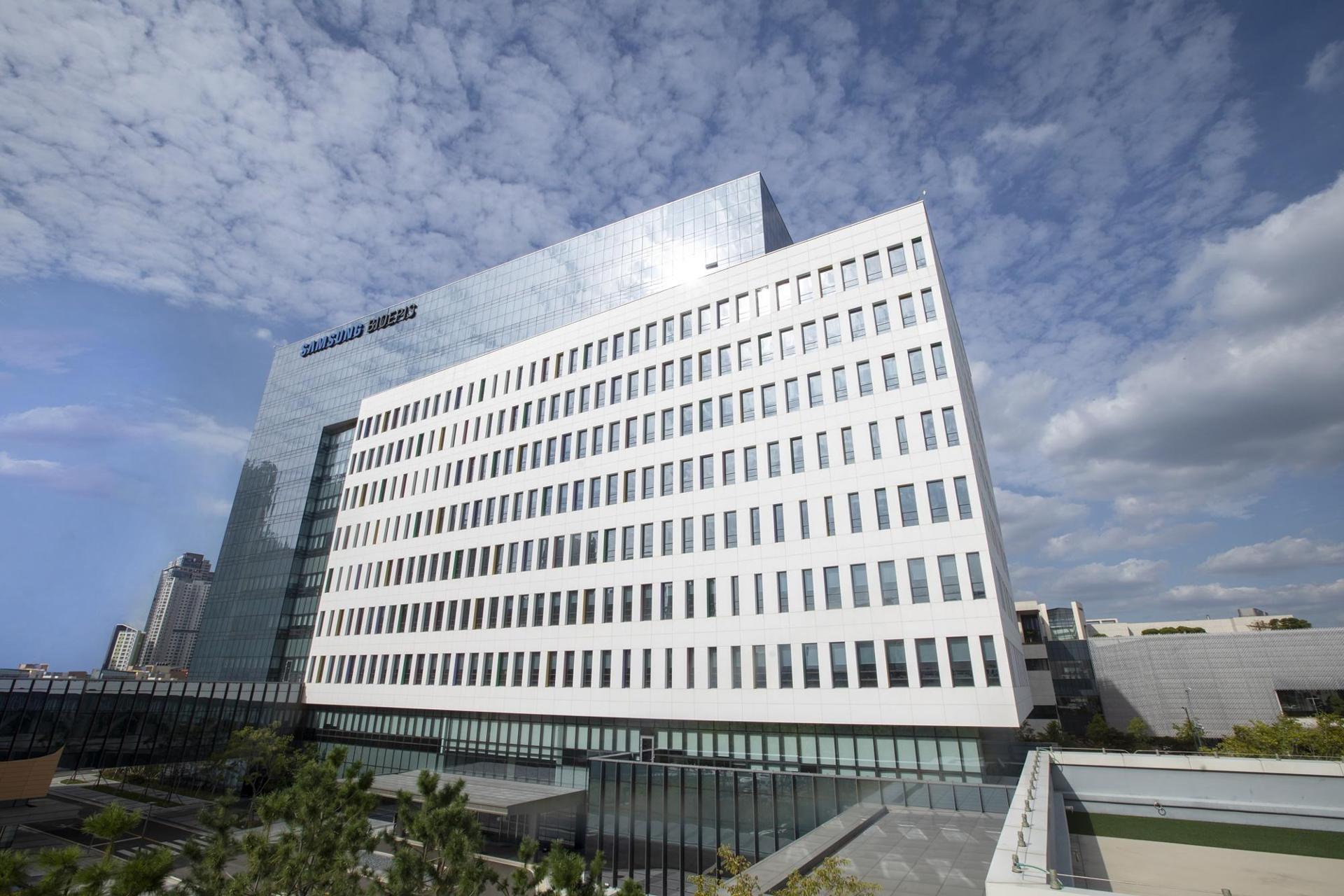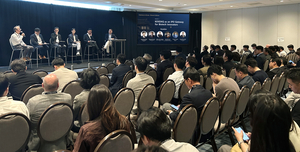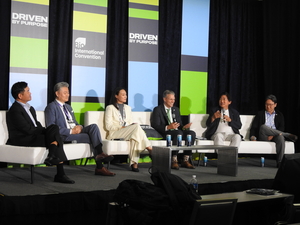
Industry leaders say global funding, M&A, innovation will be critical to Korea's next phase of growth From left: Lambert Kuk, chief investment officer at KB Investment, James Choi, chief marketing officer at Samsung Biologics, Hwang Jurie, director of public & international affairs at KoreaBIO, Scott DeWire, global head of business development and licensing at Boehringer Ingelheim, Lee Sang-hoon, founder and CEO of ABL Bio, and Lee Chaejoon, CEO of Ildong Pharmaceutical, take part in a panel discussion on Korea's rise as the next Asian innovation hub in biotechnology at the BIO International Convention in San Diego on Tuesday. (Joint Press Corps.) SAN DIEGO – Korea’s biotechnology industry has rapidly emerged as one of Asia's most promising innovation ecosystems, but industry experts say securing global capital and adopting more flexible business models remain critical challenges if the country hopes to position itself as a global biotech powerhouse.“Korea is already an innovation hub,” said Hwang Jurie, director of public and international affairs at the Korea Biotechnology Industry Organization, or KoreaBIO, during a panel discussion titled “Korea Rising: Don’t Be Late to Asia’s Next Innovation Hub,” at the BIO International Convention in San Diego on Tuesday. It marked the first time for a Korea-specific session to be featured in the world’s largest biotechnology convention.“We now have more than 3,000 drug pipelines, ranking among the world's largest biotech ecosystems and the highest on a per-capita basis,” Hwang added.Although the panelists pointed to Korea’s strength in developing first-in-class therapies and its ability to move quickly into emerging therapeutic niches behind its progress on the global stage, they echoed one big lingering challenge: capital.Lambert Kuk, chief investment officer at KB Investment, noted that differences between Korean and US corporate governance structures often complicate direct investment because Korean enterprise founders typically maintain significant control over their companies while US venture investors are accustomed to exerting greater influence through board participation.“If you really want to get the money from a fully financial investor from (the US) side, make a subsidiary in the US,” said Kuk. "That’s the easiest way."The panelists argued that Korea needs to think beyond just licensing out and seek more diverse company structures, more mergers and acquisitions and more advanced forms of open innovation, such as looking to external collaborations for new ideas, technologies and intellectual property.Lee Chae-joon, CEO of Ildong Pharmaceutical, stressed that Korea’s traditional drugmakers are in a survival mode due to mounting pressure from generic drug price cuts and regulatory changes in Korea's domestic market.“I think the bottom line for us would be open innovation,” said Lee. “Some of these people here are collaborators but also competitors fighting for the same space in the global frontier at the end of the day. As a global (business development) strategy person, I think we have to (be) very clear, very (exhaustive) when it comes to open innovation.”James Choi, Samsung Biologics’ chief marketing officer heading sales support, project management and global public affairs, advised global investors to see what Korea has to offer in person.“You’d be amazed at the innovation and all the ecosystem that is developed,” said Choi. “When the (COVID-19) pandemic happened, we had globalized supply chain where we had no shortages because we have local supply as well as global supply. So there's a tremendous amount of innovation and stuff going on that I would encourage Western companies that are serious about investing in Korea to spend a week or two (to see).”
[Bio USA] Korean biotech has innovation. Now it needs capital
SAN DIEGO – Korea’s biotechnology industry has rapidly emerged as one of Asia's most promising innovation ecosystems, but industry experts say securing global c
572 words~3 min read