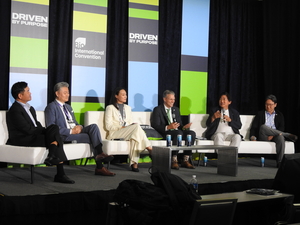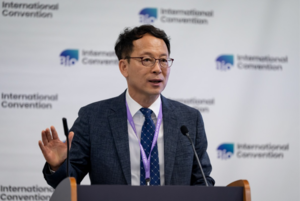
R&D center eyes new growth through platform licensing, next-generation biologics technology Jeong Hyeong-nam, leader of Samsung Biologics' Bio R&D Center, speaks at a press conference at the BIO International Convention in San Diego on Wednesday. (Samsung Biologics) SAN DIEGO — Samsung Biologics is accelerating research and development efforts to strengthen its position in the contract development and manufacturing organization market by leveraging proprietary platforms, next-generation modalities and strategic technology investments.“Supporting core technology for contract development business is the most important task at (Samsung Biologics’ Bio R&D Center),” Jeong Hyeong-nam, chief of Samsung Biologics’ Bio R&D Center, said at press conference at the BIO International Convention in San Diego on Wednesday.“So we are advancing technologies in high-titer antibody-producing cell lines, continuous manufacturing and various modalities.”As such, Samsung Biologics has developed S-CHOice, a high-productivity cell line platform, and S-AfuCHO, an afucosylated antibody-producing cell line development platform. Jeong pointed out that these platforms are designed to help clients shorten development timelines and reduce manufacturing costs while improving productivity.“We are constantly upgrading S-CHOice,” he said. “The competition among (CDMO firms) is very fierce and we are developing a model that can produce better results than our competitors.”According to Samsung Biologics, internal case studies demonstrated productivity at roughly twice the level of conventional manufacturing approaches.Beyond manufacturing technologies, the CDMO leader is expanding its in-house antibody platform portfolio, including with S-DUAL, which is designed to enable precise heavy-chain and light-chain pairing while achieving high purity and improved manufacturability. The firm said preclinical studies demonstrated favorable efficacy in gastric and breast cancer models, with low immunogenicity.Samsung Biologics is also developing next-generation antibody-drug conjugate, or ADC, technologies. Leveraging S-DUAL and other antibody platforms, the company aims to develop bispecific ADCs capable of overcoming limitations associated with conventional monospecific ADCs, including limited efficacy and dose-limiting toxicities.Jeong noted the Bio R&D Center is bolstering efforts in developing and improving emerging forms of treatment such as adeno-associate virus, vector RNA and mRNA. Samsung Biologics plans to monetize some of its proprietary technologies through licensing agreements to create additional revenue streams beyond its core CDMO business, he said.“Based on our technological competitiveness, we are going to support (Samsung Biologics) business expansion for future growth,” said Jeong.Samsung Biologics’ Bio R&D Center, which was established in July 2022, plays a key role in technology scouting and business development through the Samsung Life Science Fund. The investment vehicle has launched three funds since 2021 with a total of 442 billion won ($286.4 million), targeting sectors including ADCs, gene editing, RNA therapeutics, advanced drug delivery systems and artificial intelligence.
[Bio USA] Samsung Biologics steps up CDMO tech race
SAN DIEGO — Samsung Biologics is accelerating research and development efforts to strengthen its position in the contract development and manufacturing organiza
424 words~2 min read