Choi Jae-hee
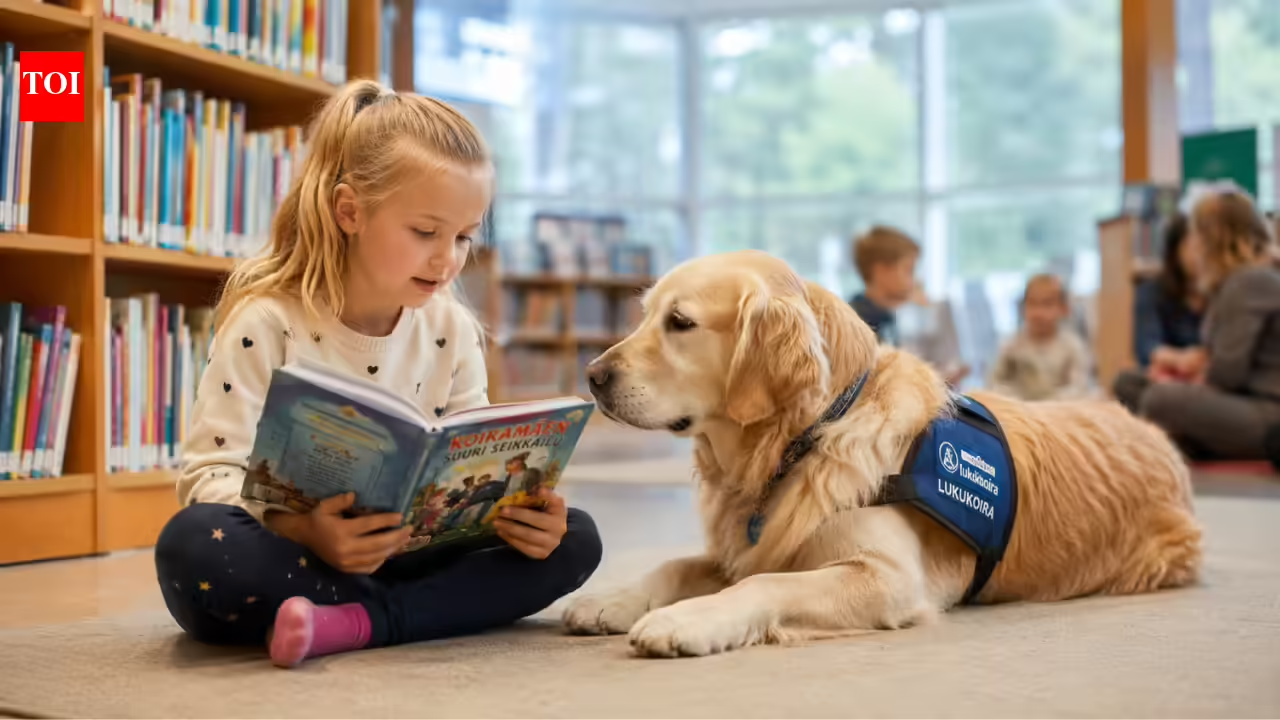
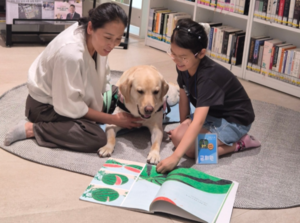
Children read to dogs in a therapy program that goes far beyond the page A young girl reads aloud to ChamE, a labrador retriever, as the dog's human companion, surnamed Shin, sits beside them during a Reading Education Assistance Dogs session hosted by the Korean Human-Animal Interaction Association at Achasan Forest Library in Seoul's Gwangjin-gu on June 30. (Choi Jae-hee/The Korea Herald) On a recent Tuesday afternoon at a library tucked beneath the wooded slopes of Achasan in Seoul, a 9-year-old girl sat turning the pages of a picture book with one hand as she read aloud, while gently stroking the soft golden fur of a labrador retriever with the other.The retriever slowly settled onto the floor, closed its eyes and drifted off to sleep. Book by book, the girl's voice, barely above a whisper when she began, grew steadily louder and more confident.The two were partners in a child-animal reading program run by the Korean Human-Animal Interaction Association on June 30. The organization comprises faculty members, graduates of the animal-assisted therapy program at Konkuk University's Graduate School of Agriculture, Food and Rural Development, and other experts in the field.Though their session lasted only 30 minutes, and no one could say whether the retriever understood the story, the girl walked away feeling a connection that defied words."When I was reading a story about a magical bathhouse for dogs, its ears twitched a couple of times. Sometimes it'd lift its head from the floor and look right at me, and it really felt like it was listening to me," she said. ChamE, a 6-year-old labrador retriever who is part of the Korean Human-Animal Interaction Association's animal-assisted reading program (Choi Jae-hee/The Korea Herald) The session, attended by three elementary school students, marked the second round of READ, short for Reading Education Assistance Dogs, since its launch in March in partnership with the Achasan Forest Library in Seoul's Gwangjin-gu."Children often worry about mispronouncing words while reading, and it's easy for them to lose confidence when they feel they're being evaluated," said Moon Hyun-min, a KHAI official who leads the animal-assisted reading program for children."Animals don't judge or correct the way children read. They simply stay by their side, listen and wait until they're finished. In that kind of relationship, children let go of their anxiety and naturally begin to open books." A young girl pets ChamE after a reading session. (Choi Jae-hee/The Korea Herald) The program pairs children ages 5 through the lower elementary grades with a dog and its handler.ChamE, the 6-year-old labrador retriever that assisted the girl during the reading session, passed the association's suitability assessment earlier in June. The screening evaluated ChamE's friendliness toward people and his ability to remain calm in unfamiliar environments and cope with stress.ChamE's handler, surnamed Shin, also spent several months preparing for his debut in March by completing the program's specialized training in animal behavior and welfare, child development, and techniques for supporting children's reading."My job is to support the interaction between the child and ChamE, but I also learn a great deal while coming up with questions that encourage children to think and helping them uncover a book's underlying messages," she said.Shin began studying human-animal interaction early last year and has since volunteered in a variety of related activities with teenagers and seniors."ChamE has changed a lot, too. He used to be shy around strangers, but now he greets them first and shows his affection by licking their hands," she added.Therapy at its coreThe program welcomes all children, but its therapeutic mission centers on those with hearing or language challenges.Among them are children from migrant-background families who are developing their Korean language skills."There was one time when a child with hearing loss was reading to Leo, one of our reading cats. Throughout the session, Leo looked quietly into the child's eyes. It was as if he was saying, 'You're doing great,'" Moon said."The child kept looking back at Leo while reading, and by the end of the session had the biggest smile on their face."For deaf and hard-of-hearing children, particularly those with residual hearing or who use hearing aids or cochlear implants, reading aloud to the dogs helps improve spoken language by providing repeated opportunities to practice pronunciation, articulation and speech fluency, officials said.While the program consists primarily of dogs, its roster of therapy animals is expected to gradually expand to include cats and other companion animals, officials said.Founded in September 2021, KHAI modeled the program on an animal-assisted reading initiative launched in 1999 by Intermountain Therapy Animals, a Utah-based nonprofit in the US.More than reading companionsKHAI's reading dogs don't just listen to books. They read hearts, too.Last year, five dog-handler teams from the association took part in an emotional support program for older patients at a hospice in Gyeonggi Province.Through light walks and quiet moments spent sitting side by side, simply looking at one another without the need for many words, the older adults experienced degrees of both emotional and physical recovery.Another regular event is Happy Time, held at Konkuk University, which gives students coping with academic and job-search stress the opportunity to interact with the therapy dogs as a way to unwind and recharge.With the number of pet owners in Korea surpassing 15 million, animals are increasingly viewed as lifelong companions rather than simply pets, fueling growing interest in human-animal interaction programs, according to the association. Children at Haseong Welfare Center in Seoul's Gaepo-dong, Gangnam-gu, hold a birthday party for Victor, an 8-year-old border collie who is part of the Korean Human-Animal Interaction Association's animal-assisted reading program, on May 20. (Korean Human Animal Interaction Association) "Since the COVID-19 pandemic, social isolation and mental health have become global challenges. Our vision is to reconnect people with one another and with society by fostering mutually beneficial relationships with animals," Moon said.The association's animal-assisted therapy initiatives have recently gained fresh momentum with support from the Seoul Metropolitan Government.In partnership with KHAI, the city plans to train around 20 animal-assisted intervention activity teams this year, who will work with child and youth organizations across Seoul to facilitate a range of interaction programs."We hope to help children and adolescents experiencing isolation, anxiety and depression achieve greater emotional well-being through healthy interactions with animals," a city official said."At the same time, we will ensure the program is carried out safely and responsibly by strictly adhering to animal welfare and ethical standards, allowing participants to naturally appreciate the value of life."