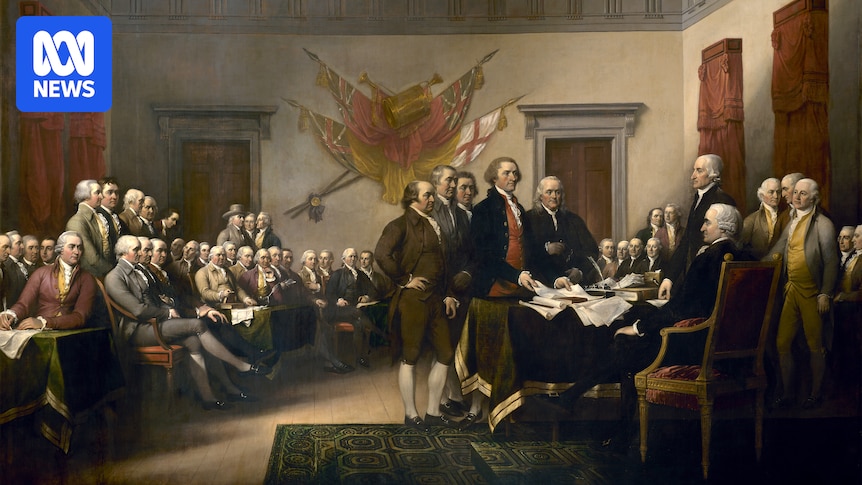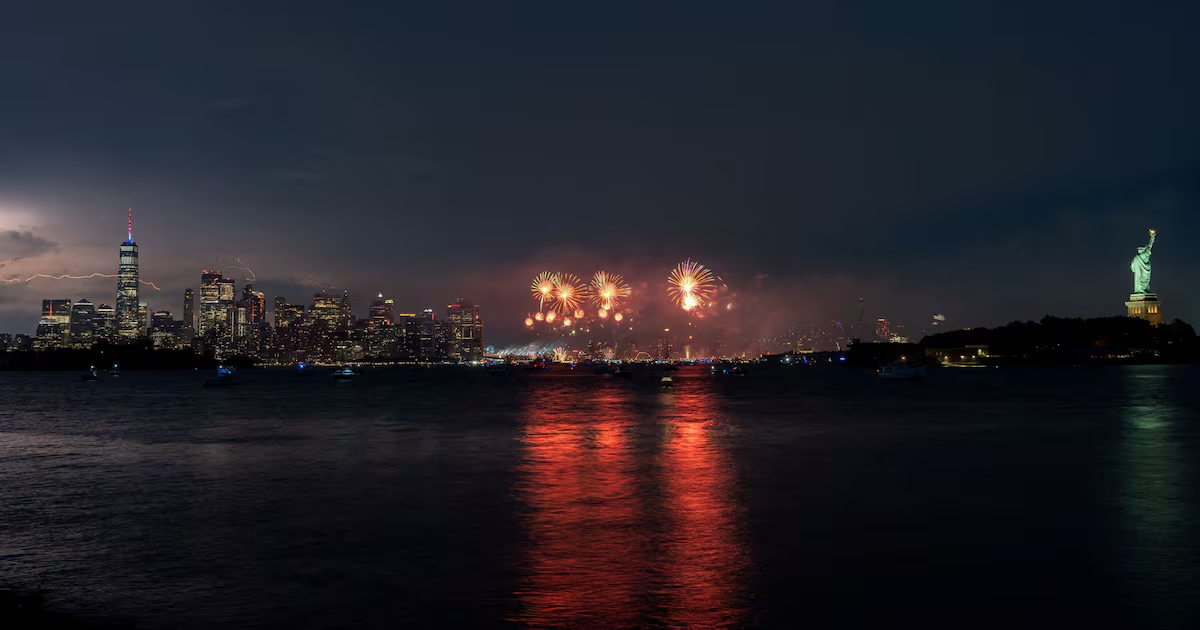
All countries have founding myths, but the one established around the hyperpower later called the United States of America is strangely 13 years off from the date that was celebrated with much hubris and some introspection this July 4 as the nation’s supposed 250th anniversary.World famous though it is, the Declaration of Independence, largely penned by slave-owner Thomas Jefferson and formally adopted by the illegal Continental Congress in 1776 (the same year as Adam Smith’s capitalist manifesto, The Wealth of Nations, a portentous twinning), did not, in fact, establish a country called the “United States of America”. Rather, it was a league of “thirteen united States of America”; note that lower-case “u” for united.Under the 1777 Articles of Confederation, and during the Revolutionary War, these independent states were co-ordinated by a weak confederal nexus that was a government in name only as it had no presidency, no executive agencies, no judiciary and no right to impose taxes even though it was supposed to fund the Continental Army against the British. Likewise, the legislative Confederation Congress had no powers of enforcement and was seldom quorate.Christopher Columbus admitted men’s primary motivation to risk the perilous journey to the New World was the pursuit of gold, though the Pilgrims, and later, Mormons, dreamt rather of a “New Jerusalem”. Ron Sakolsky and James Koehnline argue in their collection of history essays, Gone to Croatan, (1993) that “America” was founded “as a land of dropouts”, with “its own crop of dissidents — visionaries, utopians, Maroons [escaped slaves], white and black ‘Indians’, sailors and buccaneers, tax rebels, angry women, crank reformers, ‘tri-racial isolate’ communities — all on the lam from Babylon, from control”. This dissident culture in all its weirdness would become a hallmark of “American” exceptionalism, as would its divergent forms of English.Organic sinsThirty lines below the declaration’s famous statement “all men are created equal”, the document qualified this by referring to Native Americans as “merciless Indian savages”. They were in fact the descendants of great city civilisations such as that centred on Cahokia in the Mississippi River basin, opposite present-day St Louis, which at its peak in the 12th century may have housed as many as 40,000 people (if true, this would not be surpassed until Philadelphia in the 1780s).But by the time the first European settlers put down roots on the Atlantic seaboard, the city-states were abandoned grassy mounds or ruined pueblas, and most Native Americans lived as hunter-gatherers and farmers, albeit possessed of an array of sophisticated cultures and cosmologies. This fallen status and scattered populations, however, would allow acquisitive white men to justify genocidal colonial expansion by claiming the continent’s people were not sovereign and the land largely unoccupied: terra nullius.The Africans, too, were appallingly mistreated, as is well known because the Atlantic slave trade has been exhaustively researched. Olaudah Equiano’s 1789 memoirs of his own traumatic enslavement in the Kingdom of Benin and transhipment to the Caribbean, the self-deprecatingly titled The Interesting Narrative, would inform Westminster’s own debate on slavery.Howard Zinn recounts in his subaltern A People’s History of the United States (2003) that slave-ship decks were “so covered with blood and mucus that it resembled a slaughter house”, and that slaves often jumped overboard to drown rather than continue their suffering. He argues that American slavery was markedly more cruel than African slavery because it was driven by both a “frenzy for limitless profit” and “racial hatred” — enduring features of the American psyche.Even a more conventional historian such as Paul Johnson in A History of the American People (1997) is forced to admit that these are the USA’s “organic sins: the dispossession of an indigenous people, and the securing of self-sufficiency through the sweat and pain of an enslaved race”, asking the question whether the US can atone for these sins by balancing avarice and altruism.A largely unacknowledged precursor to the enslavement of Africans in the southern plantations was the indentured servitude of Europeans in the colonies, who would come to constitute perhaps as much as two-thirds of the settlers by 1700, gradually replaced by African slaves thereafter. Indentures, Jim Goad argues in his hilarious and thought-provoking The Redneck Manifesto (1997), formed the bedrock of America’s emerging “white trash” working class, of which he is a proud member.While Scots and Irish who ran away into the Appalachian Mountains, the much-derided “hillbillies”, gave the world fiddle-driven bluegrass, West and Central African slaves sold in New Orleans gave it rhythm-driven delta Blues; from these, as beautifully laid out by Michael Ventura in his 1985 essay, Hear that Long Snake Moan, originated just about all popular music, from country to Motown, gospel to rock ’n’ roll.The salient grievance of British taxation of the colonies without representation in Westminster helped obscure another primary grievance: Britain’s 1763 proclamation preventing colonists expanding westwards beyond the Appalachians into “Indian territory”. By this reading, the proto-American “pioneer” has a direct corollary in the proto-Afrikaner “trekboer”, pushing beyond the restrictions of colonial governance.The heroic spirit of the Revolutionary War is best captured in Emanuel Leutze’s iconic 1851 Washington Crossing Delaware (fabulously parodied in drag by Richard Williams’ 1994 Washington Cross-dressing the Delaware). It produced its own mythology, such as the probably fictional sewing of the first “star-spangled banner” by Betsy Ross, and it should be stressed that the US today still considers itself, like France, the USSR or Iran, to have been founded by a revolution, and that this attitude renders a distinct radical edge even to its conservatives.But success in the eight-year war, liberating the 13 colonies from Britain’s yoke, neither consolidated the USA, nor entirely expelled the British from North America as they still occupied a string of frontier forts. The 13 States of America were a querulous bunch who regularly violated the Articles of Confederation. Georgia was under martial law, the people of Massachusetts were in open rebellion, New Jersey and Connecticut were plotting a military invasion of New York, Virginia was on the verge of war with Maryland, foreign policy and trade were a mess, and the Confederation was insolvent.Despairing of the chaos, state delegates meeting in Philadelphia in 1787 exceeded their mandate under the articles to stage a palace coup against the Confederation, creating in a locked, sweaty midsummer room the actual United States of America, which would come into being on March 4 1789, 13 years after the declaration. It had an executive presidency, judicial Supreme Court and two-chamber legislative Congress: a lower House of Representatives with proportional representation and an upper Senate with equal representation for each state.But fear of mob rule prompte the “founding fathers” to devise an Electoral College that eschewed one-man-one-vote in presidential elections for a complicated and imbalanced system in which presidents are elected by states, not citizens, and which generates a shifting array of “swing states” that have outsized influence over election outcomes. It is a strange feature of US foreign policy that it dares to lecture the world on democracy while operating an antique version at home, a quirk that seems to be aligned with the country’s stubborn retention of imperial instead of metric weights and measures.The 1787 constitution signally does not mention God — because founding fathers such as Jefferson, Benjamin Franklin and Thomas Paine weren’t Christians and the Pledge of Allegiance phrase “one nation under God” would be inserted only in 1954. The constitution’s apparently humanist preamble, “We the People of the United States”, is swiftly curtailed by article 1 which, for purposes of Congressional representation, explicitly excludes natives, notoriously assesses Africans as three-fifths human, and neglects to mention women at all, their rights being subsumed into their husbands’ by coverture. Significantly, all involuntary servitude was finally outlawed, equal protection guaranteed under the law, and African men given the right to vote by the Reconstruction-era amendments of 1865-70 — but the latter were gutted by late 19th century Supreme Court rulings that re-enshrined racial hierarchy for another century, enabling Jim Crow segregation, until the Civil Rights Movement achieved victory in the Voting Rights Act of 1965. Women were given the vote only in 1920, but the Equal Rights Amendment Act for women of 1972, though it passed Congress, remains unratified to this day.The journalism-centred Newseum in Washington, DC was
BIG READ | Happy 250th birthday to the world’s most admired and despised country
US foreign policy lectures the world on democracy with an antique version at home
2,248 words~10 min read